Machine retrofit or replacement? How to make existing production machines future-proof
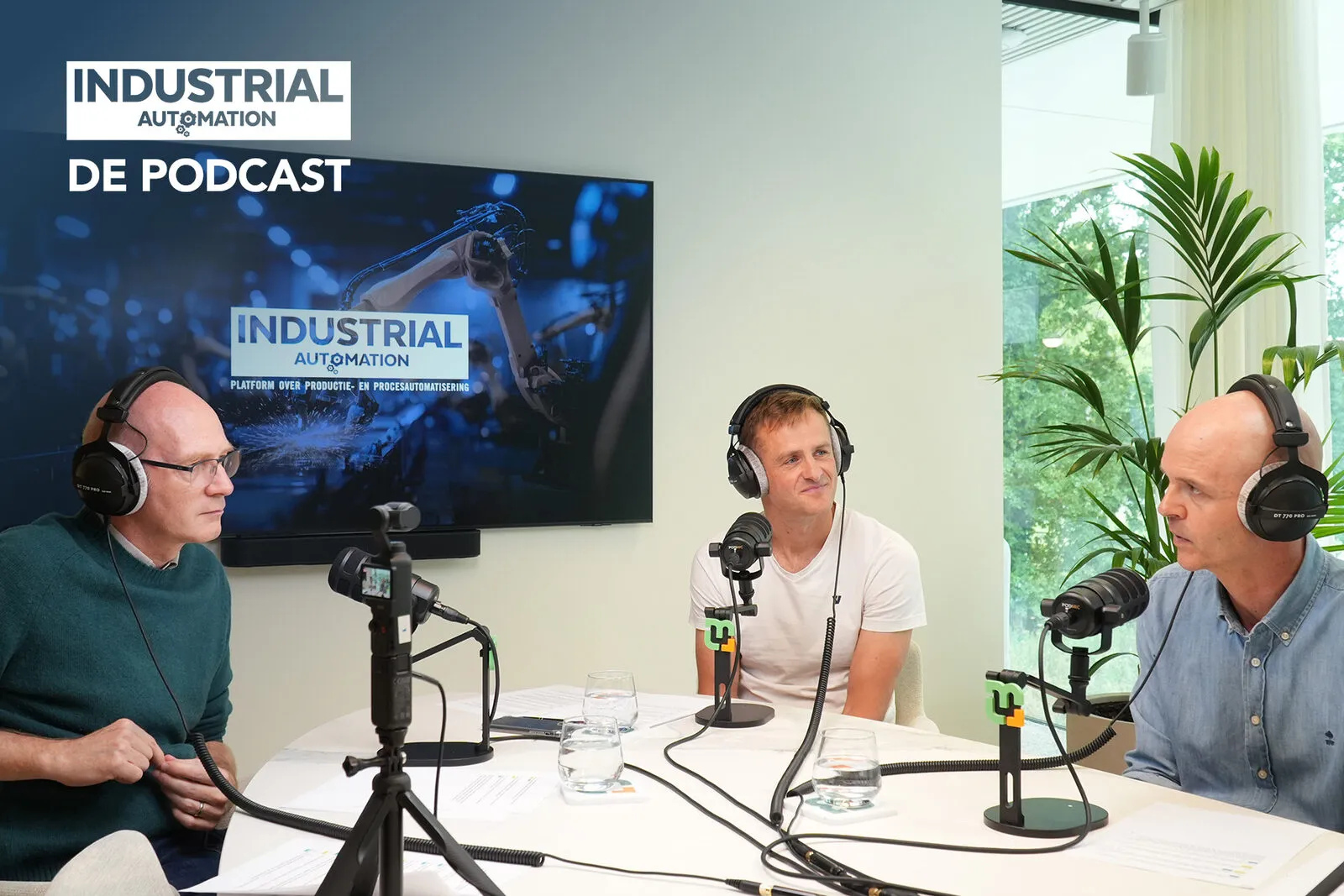
Guests: Joris Ceyssens and Timen Floré, director and Director Business Development respectively at VINTIV | Host: Björn Crul
When is it smarter to retrofit an existing production machine than to replace it entirely? And how do you ensure that an older installation once again meets the requirements for safety, digitalisation, cybersecurity and Industry 4.0? This episode focuses on the future of the existing machine park. Björn Crul talks to Joris Ceyssens and Timen Floré of VINTIV about the technical and economic considerations behind a machine upgrade. They discuss when a retrofit is still cost-effective, how to replace obsolete controls and components, what role data and automation play, and what an upgrade means for CE conformity and cybersecurity. Also covered at length are the importance of a thorough preliminary study, keeping production downtime short, and retaining knowledge of and control over your own production.
A business enquiry for VINTIV? Get in touch
Full transcript
All chapters (18)
- Replacing or upgrading existing machines
- When is it time to step in?
- When does a retrofit still make sense?
- A retrofit requires thorough preparation
- The complexity of a machine upgrade
- The business case for a retrofit
- The returns of a machine upgrade
- Four transformations in a retrofit
- Mapping an old machine anew
- Robot, cobot or mechanical automation
- CE conformity after a machine upgrade
- A digital leap with existing machines
- Making a retrofit future-proof
- Cybersecurity in a retrofit
- The course of a retrofit project
- Expertise in-house
- Keeping production in your own hands
- Prepare for the future today
Read the full transcriptCollapse transcript18 chapters
Replacing or upgrading existing machines
Björn Crul Welcome back to the Industrial Automation Podcast in collaboration with VINTIV. In the previous two episodes of this series, we discussed the state of Flemish industry, the importance of continuing to renew production processes, and VINTIV's approach to building tailor-made new machines that deliver a real return. Today we look at a different issue that is relevant to many manufacturers. What do you do with an existing machine park now that technology keeps evolving? [Inaudible] in a digital network, or that do not comply with new safety standards. What is the best solution in such a case? Dismantle and replace with a new machine, or build on the existing foundation and upgrade? My name is Björn Crul, and the two experts in our studio today know all about it. They are Joris Ceyssens and Timen Floré of VINTIV. Welcome, both of you.
When is it time to step in?
Björn Crul Joris, many production environments contain machines that have long been written off, that still do what they are supposed to do but have become outdated in the meantime. How does a production manager know that the time has come to step in?
Joris Ceyssens As a production manager, you will of course notice it quickly when downtime starts to increase. But in fact there are often several warning signs that things are going wrong. You see it reflected in a curve, the bathtub curve as it is called, where you plot the failure rate against time. With a new installation, for example, there is often downtime because of teething problems. Will the machine work well operationally? Ten, fifteen years with good maintenance and so on. And then at some point you see the failure rate rising again. The bathtub curve climbs back up. One cause is often that parts are no longer available, so things you can no longer buy on the market. Think of an old PLC, a PLC card. All kinds of faults that occur. Machine safety that leaves something to be desired. Machines that are seized after an industrial accident, and so on. Then you either replace it with a new one or retrofit it, if it is so specific that replacement is not an option. Yes, that is something you see coming back quite often.
When does a retrofit still make sense?
Björn Crul Timen, what factors do you take into account when deciding whether to do an upgrade or whether it really has to be something new?
Timen Floré Of course, it is the condition of the machine. In many cases an upgrade is realistic if the mechanical side of the machine is still sound. In very many cases the problem is mainly that components in the electrical control are no longer available. Then you can build on what is there mechanically. But you also have to ask yourself: can we make a real improvement here? I have an example that will hopefully illustrate this. I once saw a fantastic machine, designed in the 1950s. Very complex, with everything mechanically coupled and driven by a single motor. So you can renew the control, but you are still left with that one motor driving everything mechanically. [Inaudible] also had to be renewed without any documentation. That means stopping production, opening it up, measuring, drawing, opening it up again to install. You already know that this will never pay off. And then it is probably not the right choice.
A retrofit requires thorough preparation
Björn Crul I can imagine that companies sometimes wait too long and that you are only approached once a machine has failed. Does that make a renovation more difficult?
Joris Ceyssens Fortunately that is not too bad. [Inaudible] to patch up a machine so that it can keep running temporarily. But often you see that the retrofit has to be approached in a thoroughly considered way, and so customers also take the time to do that. The reason is what Timen just said. You are intervening in an installation that is standing on the shop floor. It is integrated into the customer's production environment. It is producing. If the tools come out on Friday evening to convert the machine, it has to be able to produce again on Monday, or the week after at the latest. So you do not have much time, the window you have is limited. Planning and preparation are therefore absolutely essential, given the major impact this has on the customer's production capacity.
The complexity of a machine upgrade
Björn Crul It seems to me there are three major challenges when you have to replace or renovate a machine: the business case, of course. The choice of what should receive an upgrade. And then the actual implementation. Timen, do you find that customers sometimes underestimate how complex it actually is?
Timen Floré To a certain extent. I think that customers usually have a good grasp of the big items. A control system has to be renewed, and they usually know the cost of those components. A major underestimate lies in the hours you need. Another major underestimate is the investigation required. How do you get to grips with a machine that you did not develop yourself, but that you have to understand thoroughly in order to carry out an upgrade? So the underestimate is mostly about time.
The business case for a retrofit
Björn Crul If we focus on the business case for a moment, what do you have to take into account? What is the total cost of a retrofit? What exactly do you calculate?
Timen Floré Of course, you always calculate what you need in terms of components and hours. You just have to be able to estimate them well. And that is what I mentioned a moment ago. Usually this is not entirely clear in the customer's mind. [Inaudible], then you have your hours on top of that. Something else, and it is just the same as when you are renovating a house: there is a compromise somewhere. Making a house 100 per cent airtight in insulation terms according to today's standard technique, when it is 50 years old, means that the last two, three, five per cent costs you a great deal of money for perhaps only a small return. And you see that with existing installations too. It would be ideal to relocate a certain station, but the cables are too short. They would all have to be extended. Do you do it or not? A fence is just slightly too high according to today's standard. Do we renew all of that or not? Those are the question marks that remain.
The returns of a machine upgrade
Björn Crul Joris, I have learned that in your line of work it is really about not seeing this as a cost, but as an investment in your company's agility in the future. What are the returns of a well-executed machine upgrade? What does a company stand to gain?
Joris Ceyssens Yes, there are the obvious returns, I would say. I am thinking, for example, of the fact that you once again have a machine for which spare parts are available. With a 50-year-old installation, those components no longer exist. If you retrofit, you again have spare parts on stock in the warehouse, so to speak. But there are also things that are perhaps less tangible. For example, the fact that after the retrofit you can start measuring, and with the data you get from the installation you can draw conclusions, link it to an ERP package and adjust continuously. That is something that is sometimes overlooked, but it offers a great deal of added value. I am also thinking of safety. An industrial accident is no longer accepted nowadays. It is no longer 50 years ago. So the safety of people, who are already harder to find on the market. There is a shortage of skilled operators, so make sure they can do their jobs safely. That is an indirect result, so to speak. Something that is certainly gaining in importance is the ability to work independently of the operator. And with a retrofit you of course have the opportunity to programme and adapt the installation as you wish. If you can do that on the basis of input from trained operators, you can already automate certain settings and fine-tuning, so that it is no longer dependent on one trained operator and other operators can also work with that machine. I think that offers a great deal of added value.
Björn Crul So "as good as new" applies not only to the parts but also to the technological side, I understand.
Joris Ceyssens Yes, that is absolutely correct.
Four transformations in a retrofit
Björn Crul A machine upgrade covers several aspects. You speak of four transformations. What are they?
Timen Floré We do indeed distinguish four transformations. You can in fact correlate them a little with who you are going to make happy in the factory. On the one hand you have the electrical transformation. That is what I mentioned earlier, and it is usually the first motivation for a retrofit, because the maintenance people are at their wits' end. There are no components left. Mechanical can be split into two. Mechanically you can say: let's automate a bit further. It may also be that something is genuinely worn mechanically. We also include the motors there. So often it is actually a new motor technology. Then the digital side: the people who are working on digitalisation. With a new control system you make data available. And with that data you can do smart things again. You can visualise. Security comes into play. And then the HSE manager is going to be happy too. Because usually you take the conformity into account, and that is the fourth transformation. Legislation today has of course evolved considerably. And it is also important to keep those machines state of the art, in line with today's legislation.
Mapping an old machine anew
Björn Crul Not always straightforward, because I can imagine that with machines from the 1950s or 60s, diagrams are missing or components are no longer available. How do you approach that?
Joris Ceyssens The basis we use at VINTIV is that we start with a bit of mechanics. That may seem contradictory, since we are talking about the electrical upgrade. But the machine as such also has a mechanical story. The mechanics perform a certain movement, carry out a certain action, generate a certain motion. Then there are sensors that pick up the signals. And of course, for us sensors are also something that a mechanical engineer includes in the design of a retrofit. So the installation is looked at again from a mechanical point of view. The sensors needed for correct functioning are integrated at that stage as well. Only in a second phase do we look at the next question: okay, those sensors are in the field, so what does that translate into at the low-voltage panel? New electrical schematics are drawn up and so on. We work backwards from the mechanical solution to the electrical solution. That is how you should see it.
Robot, cobot or mechanical automation
Björn Crul Timen, automation today is very often decisive for machine efficiency. So how do you decide which form of automation, mechanical, cobot or robot, is the best choice for a retrofit?
Timen Floré Yes, I think that as VINTIV we have the advantage that we are not a one-to-one robot integrator, so we are free to make that choice. In many cases a robot will be a good solution. If you deploy one today, you may be able to use it for something else tomorrow. Robots can work fast and they are precise. In some cases they are not precise enough or not fast enough. In that case a mechanical solution will probably be the better option. What we use less often are cobots. We are probably not against them. But what you notice is that, either because of the gripper you have to fit or because of the speed you expect, you cannot deploy them as a cobot one to one, and you then have to build safety measures around them after all. Which raises the question: why would we use a cobot in the first place?
CE conformity after a machine upgrade
Björn Crul Joris, safety and CE conformity are of course crucial. What impact does an upgrade actually have on a machine's original CE declaration?
Joris Ceyssens That is a very fair question, Björn. Everything depends on the impact, or the scale, of the retrofit. What I mean is: whether there are any changes in function, whether any additional hazards have been created. After 1995, every manufacturer has to draw up a CE declaration. If you refurbish the machine but there are no major changes, it does not produce any faster, the [unclear] of the machine has not changed, and there are no additional hazards, then in itself that is not a problem. But if that is the case and, for example, you say: okay, the machine will run faster, it will now work with a different product, it will be given a different purpose, then it is very important that the risk assessment and the intended conditions of use are looked at again. In that case VINTIV will also arrange a new CE declaration of conformity.
A digital leap with existing machines
Björn Crul Many manufacturing companies today are on a path towards Industry 4.0, which means digitalisation is also around the corner. Timen, what are the options for making a digital leap when you carry out a retrofit?
Timen Floré Yes, I think that is exactly it: preparing the machine so that it can be integrated into the plant's digitalisation roadmap. That is very much tied to the new control system, which can capture data and pass it on to higher-level systems, something that perhaps was not possible before. Of course, in cooperation with the customer, other sensors can be built in to take certain measurements or to create data points that are interesting for monitoring the machine. And what you also notice, of course, is that new sensors and actuators come with Industry 4.0 functions. I am thinking of IO-Link as a fieldbus for sensors and actuators. They pass on the value of a sensor, but also additional information, in a very simple way. A drive will now report by itself how long it has been running. So, to determine OEE, how much energy has been consumed. These are all functions that are now built into the technology and that become available through the renewal of technology, so you can do smart things with them.
Making a retrofit future-proof
Björn Crul Now that we know data and AI are being used on a large scale in industry, Joris, can you actually be sure with an upgrade that the machine is also future-proof?
Joris Ceyssens That is a fair question too. An upgrade in itself is a process, and it is a process that actually never stops. So it is not the case that you can say: we have upgraded the machine and now the story is finished. That is certainly not the case. It is not a closed chapter. It is also very difficult to predict what the future will bring. What is very important is that, once you have retrofitted a machine and new electrical schematics and new PLC programs have been written, you own the code that has been written and you own the drawings. That is very strong with a view to the future, because as the end customer you still have access to that knowledge yourself. And if something changes in the future, you can still get to it. You are no longer dependent on others to make any changes. So I think that is a very important point.
Cybersecurity in a retrofit
Björn Crul And then we certainly have to talk about cybersecurity as well. We hear more and more often in the news that digitalising and connecting machine fleets to IT networks increases the risk of cyberattacks. A new machine should be cyber-secure by design. How do you make sure that a retrofit is also adequately protected, Joris?
Joris Ceyssens That is a fair question. It is of course not that simple. Because I think it is in the newspapers every day that companies have been hacked and so on. But as a prudent operator you will always try to keep the risk to a minimum. On the one hand, that is by training our own software people on the new Machinery Regulation, knowing what falls under it and knowing how to deal with it during an implementation. On the other hand, our end customer, who operates the machine, or rather deploys it in his production facility, is also [unclear] involved in security. And you often see a collaboration between the customer's engineering team and our people, in which measures are taken to prevent, for example, a hack.
The course of a retrofit project
Björn Crul I would also like to return briefly to the way you approach projects. We discussed that in the previous episode, specifically around customisation. Timen, in a nutshell, how does the process work once a customer has decided to go with VINTIV for a retrofit?
Timen Floré A very important start to a retrofit project is actually a study phase. We can almost never, at least not in my recollection, say straight away [unclear]. People have to go on site to analyse functionally how the software is put together, what the control cabinet looks like, how the cables run, whatever it may be. So without that preliminary study there is no price, or at least no exact price. So that is a very important step. And then of course the engineering phase starts, in which, as Joris has already said, once you cut the cable from the cabinet, you have a big problem if you do not arrive at a result. Preparation, of course. And also installing things that can perhaps be installed while the machine is still running. Because once you actually start working on it, there is a production stoppage and everything has to be done as quickly as possible. But the big blocks are the preliminary study and then the project itself.
Björn Crul Does that mean a retrofit is mainly carried out on the shop floor at the customer's site?
Timen Floré That is correct. It does happen that we can bring machines to our premises, for example when a large group of machines goes from America to Europe or the other way round. If it passes through our site first, things are of course a bit calmer. Then you can prepare better, and it is allowed to go wrong once. But with most retrofits, the mechanics are in place, the machine is in place and the work is done on site. That is probably also the reason why we do not do it as globally as we do with new machines.
Expertise in-house
Björn Crul Joris, in the previous episode you explained that, with about 60 employees, you have virtually all the expertise needed for machine building in-house. Do you also handle everything yourselves for retrofits?
Joris Ceyssens Yes, that is correct. We handle that ourselves too. That has also evolved over the years. When retrofitting a machine, several competences come together. Think of mechanics, software, electrical engineering and machine cabling. But if there is one thing you can be sure of with a retrofit, it is that something will happen that nobody expected. And when that happens, you have to be able to step in. What I mean is: if the machine is being dismantled and it turns out that a shaft has worn, or a bracket has to be made, then it is very convenient to have your own manufacturing department that can respond very quickly. Because, as we said just now, that machine is standing still and has to start running again. That time window is very small. For that reason we decided several years ago to work with our own people as much as possible and to have the expertise in-house, in order to limit the risk.
Keeping production in your own hands
Björn Crul We have reached the end of this three-part series. What is the most important message you would like to leave with the listeners of our Industrial Automation Podcast?
Timen Floré I would like to answer: please take your production into your own hands. I think Joris, and perhaps many of us, have at some point seen the story of the iPhone. And how the Chinese built the iPhones. How they learned battery technology from it. How in time they gained control of the battery supply chain. How in time they started developing cars that are better than the Europeans'. So for me it is a very warm appeal to keep your production in your own hands. In my view, you are then the winner of the future.
Joris Ceyssens Yes, I think so too: take a critical look at your production equipment. Have the drive to take it on yourself. Certainly not all machines are built to be retrofitted. But there will certainly be some that are worth taking on. And do not just sit back and do nothing.
Prepare for the future today
Björn Crul What I take away is: prepare your future now. That is what it comes down to. A correct summary. Joris Ceyssens and Timen Floré, thank you for that conclusion.
Joris Ceyssens My pleasure, thank you.
Björn Crul And that concludes this three-part podcast series. Dear listeners, I would like to invite you to listen to the other episodes in this series via the Industrial Automation channels. Until next time.
Companies in this story
Keep following this
Get an email when a new story is published. No account needed.
- SubjectControl & network
- CompanyVINTIV