Software, IT, OT & cybersecurity
From data to added value
Artificial intelligence, cloud services and automation are intended to make engineering more productive. For Jan Fleming, Vice President Customer Journey at Eplan, however, that is only part of the challenge. The key is to make data useful throughout the entire process, from pre-planning through to operation. AI, engineering software, networks and open standards such as the Asset Administration Shell work together to turn individual tools into an end-to-end value-creation chain.
Held in Munich in May, Eplan Next26 was a global engineering event that brought together around 1,500 participants from 36 countries. It gave visitors the chance to discover new products, the Future Lab and the Partner Plaza. But alongside its new, almost festival-like format, with something for every visitor, the event also gave Jan Fleming a platform to share a broader message: “Eplan sees itself as the link between the various players in industry, from component manufacturers and machine and plant builders to end users.”
And these links will become increasingly close in the future, not only organisationally but digitally too. The aim is to create seamless end-to-end processes, from engineering and planning through to commissioning and day-to-day operation.
Integrated directly: the intelligent engineering assistant Eplan Copilot makes validated information available more quickly within Eplan Platform 2027 and supports users with concrete recommendations for next steps.
From Copilot to pilot
The most visible launch was Eplan Copilot, which brings together engineering expertise, platform functionality and specific tasks through natural language. For example, if an engineer wants to know which projects used a particular component, they simply enter its article number. The AI then searches all cloud-based projects and returns the relevant results. “We want to help users find their way around Eplan software more quickly and give them the information and functionality they need at the right moment,” Fleming explains.
At the same time, Eplan draws a clear line between assistance and autonomy. Initially, Copilot uses validated Eplan knowledge. In a later phase, knowledge from partner companies and customers, as well as relevant standards, will also be integrated. “In engineering, results must be reproducible and reliable. That requires the underlying architecture to be right,” Fleming stresses. That is why Copilot does not rely on information gathered indiscriminately from the internet. “Even a machine designed correctly 99 per cent of the time will ultimately fail when it really matters.”
The long-term vision is ambitious, however. As the knowledge base grows and additional functionality is added, today’s intelligent Copilot is intended to evolve into an increasingly autonomous pilot.
Jan Fleming at Eplan Next26 in Munich: “Eplan sees itself as the link between the various players in industry, from component manufacturers and machine and plant builders to end users.”
The platform evolves into a data-driven foundation
The next stage of development is Eplan Platform 2027, which has been available since early September. According to Eplan, around 500 customer requests were taken into account during development. Fleming describes the focus as “maximum ease of use”. New features in Eplan Preplanning, Eplan Electric P8 and Eplan Pro Panel further simplify and automate various steps in the engineering process, including pre-planning and the generation of 3D projects.
Fleming therefore sees this release as much more than a traditional software update. “The greatest benefit Eplan offers companies is the ability to scale up,” he says. “With the same resources available, organisations can execute more projects and manage a greater number of variants.”
Systematically organising reuse is also part of this. Rule-based project generation can already deliver significant productivity gains, without necessarily requiring artificial intelligence. “Scaling up does not start with artificial intelligence,” Fleming notes. “By standardising, reusing and automatically assembling functions, we increase both speed and quality, while also helping to address the skills shortage.” Many of these processes are already rule-based. “In Eplan, standardised, reusable circuit functions are combined into project-specific solutions. For now, artificial intelligence plays only a limited role in this,” says Fleming. Even so, these approaches are already delivering significant economies of scale.
Cloud data management is also taking on an increasingly strategic role. Project, master and device data can no longer be treated as separate entities. With Eplan Platform 2027, synchronisation of master and device data via Eplan Cloud is even more deeply integrated into the workflow. Fleming says: “For us, end-to-end means that data does not stop at the boundary of a single application.”
The ambition therefore extends beyond simply creating a more user-friendly interface. The platform is evolving into a consistent, comprehensive data foundation for subsequent process steps.
At Eplan Next26, manufacturer Eaton showed how this data foundation feeds into downstream processes. At a switchgear factory in China, Eplan Platform forms the backbone of electrical engineering. Humanoid robots use cameras to inspect wiring and check whether markings match the engineering documentation. Fleming sees this as more than a striking application of artificial intelligence: “The robot scans the cabinet, compares the markings with the circuit diagrams and detects incorrectly marked or miswired connections. This shows the value that high-quality engineering data can deliver, right through to quality assurance.”
Standards turn data into a process chain
Eplan Smart Sourcing, also introduced at Next26, shows how seamlessly this process chain can work. The solution connects electrical engineering and procurement: during the design phase, engineers can check whether the required components are available from participating manufacturers and distributors and when they can be delivered. Critical parts can therefore be replaced at an early stage, while validated bills of materials can be transferred directly to the procurement department. Fleming says: “Smart Sourcing is a good example of how we are closing the gaps in the end-to-end process. It directly connects a technical decision in engineering with actual availability in the supply chain.”
Of course, such connections only work if the systems involved speak the same language. That is why open standards are a central pillar of Eplan’s strategy. Fleming says: “AI has little value without clean, standardised data.” The Asset Administration Shell (AAS) is intended to ensure that data can be exchanged in a structured, vendor-independent way. ECLASS Advanced provides an important semantic foundation for this. The Industrial Digital Twin Association (IDTA) uses the AAS to define the structure, interfaces and semantics of a standardised digital twin.
For Eplan, this is about more than standardisation alone. The Data Portal currently contains more than four million static and configurable device data sets from over 550 manufacturers. When this data is available in a standardised format, it can be used not only in circuit diagrams but also reused in other process steps and processed automatically. Fleming says: “Data can become a real driver of productivity only when it is unambiguous and can be reused without translation or reformatting.” In his view, cloud technology, AI and the AAS are not separate technology trends, but building blocks of the same end-to-end architecture.
Fleming acknowledges that the Asset Administration Shell has been discussed for years. In Germany in particular, he says, there is a great deal of conceptual work and scientific analysis, while the pragmatic implementation of market-ready solutions does not always move as quickly. This time, however, he sees an opportunity to reach the necessary critical mass: “Simply declaring that we are committed to a standard will not get us any further. The key question is whether we can create solutions that users can deploy easily.” In his view, major industrial companies need to develop practical applications that go beyond merely expressing support for the AAS.
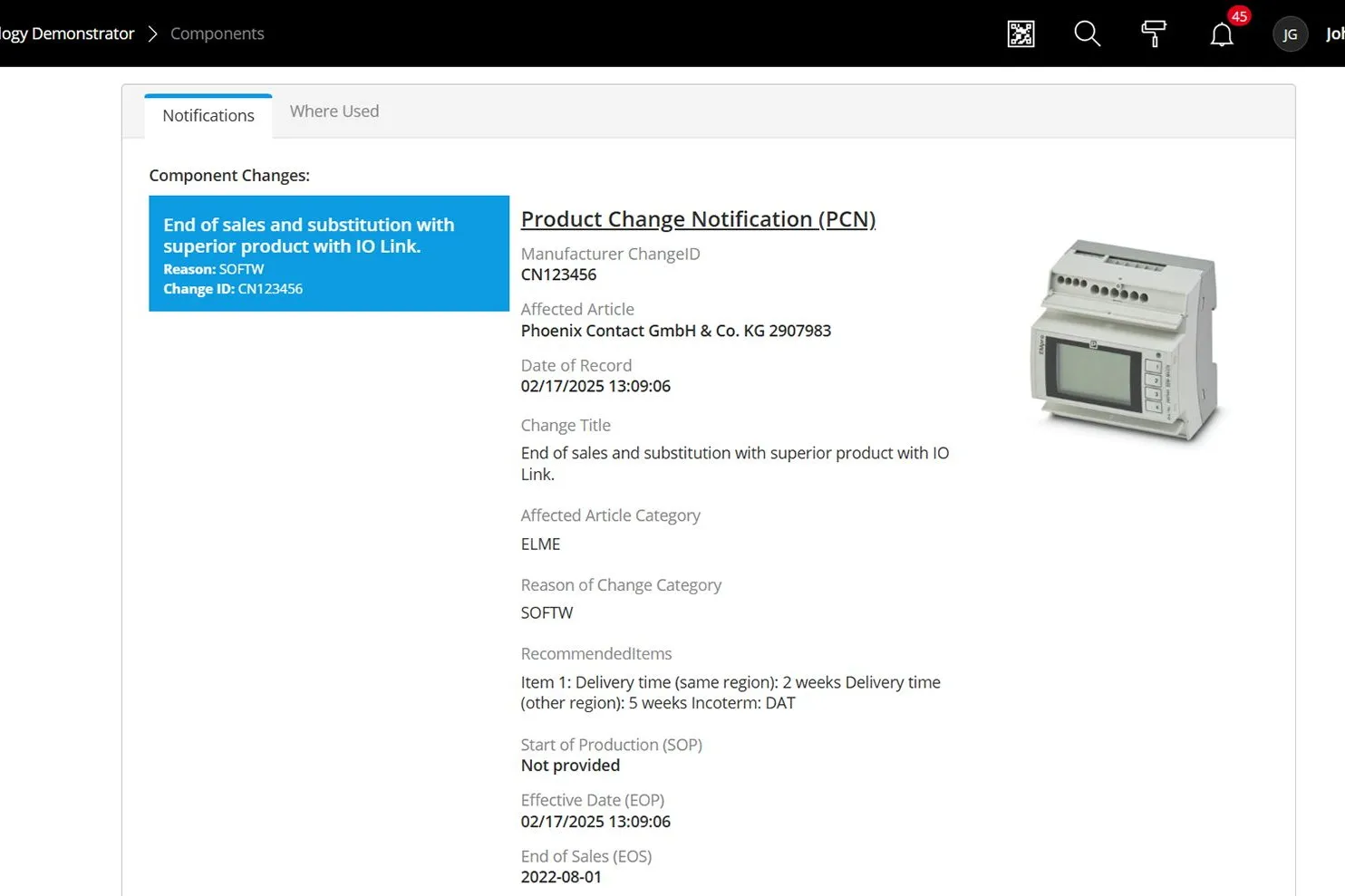
When a manufacturer changes a component, users are automatically notified of the impact on their projects. Standardised Product Change Notifications enable further automation of change management.
When the change reaches the user
Product Change Notifications (PCN) show how practical this approach can be. Fleming outlines the challenge from a component manufacturer’s perspective: “A component is supplied to a panel builder, the panel is integrated into a machine, and that machine is then supplied to the end user. As a component manufacturer, how do I ultimately reach the user of my component if I don’t know where it has been installed?” From a data perspective, these links can be connected via the AAS and Eplan Projects.
Eplan and Phoenix Contact developed a use case based on the AAS. When a manufacturer changes or discontinues a component, or issues a safety-related update, the information can be processed in a structured way via the Eplan Data Portal. The engineer receives a notification and can immediately see which projects or existing installations use the part in question. Fleming says: “These are precisely the applications that show whether a standard really creates added value. Information must not just sit unused somewhere. It has to reach the place where it triggers a decision automatically.” At the SPS trade fair in November, Eplan and Phoenix Contact will present their new PCN solution. “We are showing that in Germany we can turn a strong concept into a pragmatic market solution.”
This evolution is also changing Eplan’s role. The company is moving increasingly from being an engineering platform provider to becoming a central player in a digital ecosystem that connects component manufacturers, machine and plant builders, panel builders, distributors and end users.
The focus is not just on software functionality, but above all on whether data remains usable across different companies, systems and processes.
During the Connected Industry panel discussion, Eplan announced a new solution based on the Asset Administration Shell (AAS). It will be presented with Phoenix Contact at the SPS trade fair in November.
Eplan Next27 as proof
And that brings us back to Eplan Next. At Eplan Next26 in May, the Connected Industry panel discussion set out the ambition to develop practical solutions based on the Asset Administration Shell. The SPS trade fair is the next major milestone. Eplan and Phoenix Contact will present their first joint solution there.
The next edition of Eplan Next will take place on 9 and 10 June 2027 in Cologne. Fleming expects not only further product innovations and an even stronger presence, but above all tangible progress in data-driven applications. “Eplan Next27 will be the ultimate test for us. Have we made real progress with the AAS and end-to-end processes, or will we still be here a year from now saying that we really ought to do it?”
Fleming sees two key trends coming together here. On the one hand, AI, automation and improved usability need to help users become the best engineers they can be. On the other, standardised data and open interfaces need to ensure that the process chain runs seamlessly across organisational boundaries. Autonomous engineering is not the starting point, but the result of a robust data and process architecture. As Fleming puts it: “Only when data is consistently available everywhere can we also use AI consistently.”
Register now for Eplan Next27: Eplan Next27
Een zakelijke vraag aan EPLAN nv? Get in touch
Companies in this story

Keep following this
Get an email when a new story is published. No account needed.
- ThemeFrom design to flexible machine
- SubjectSoftware, IT, OT & cybersecurity
- CompanyEPLAN nv