Custom machine building: from proof of concept to high-performance production line
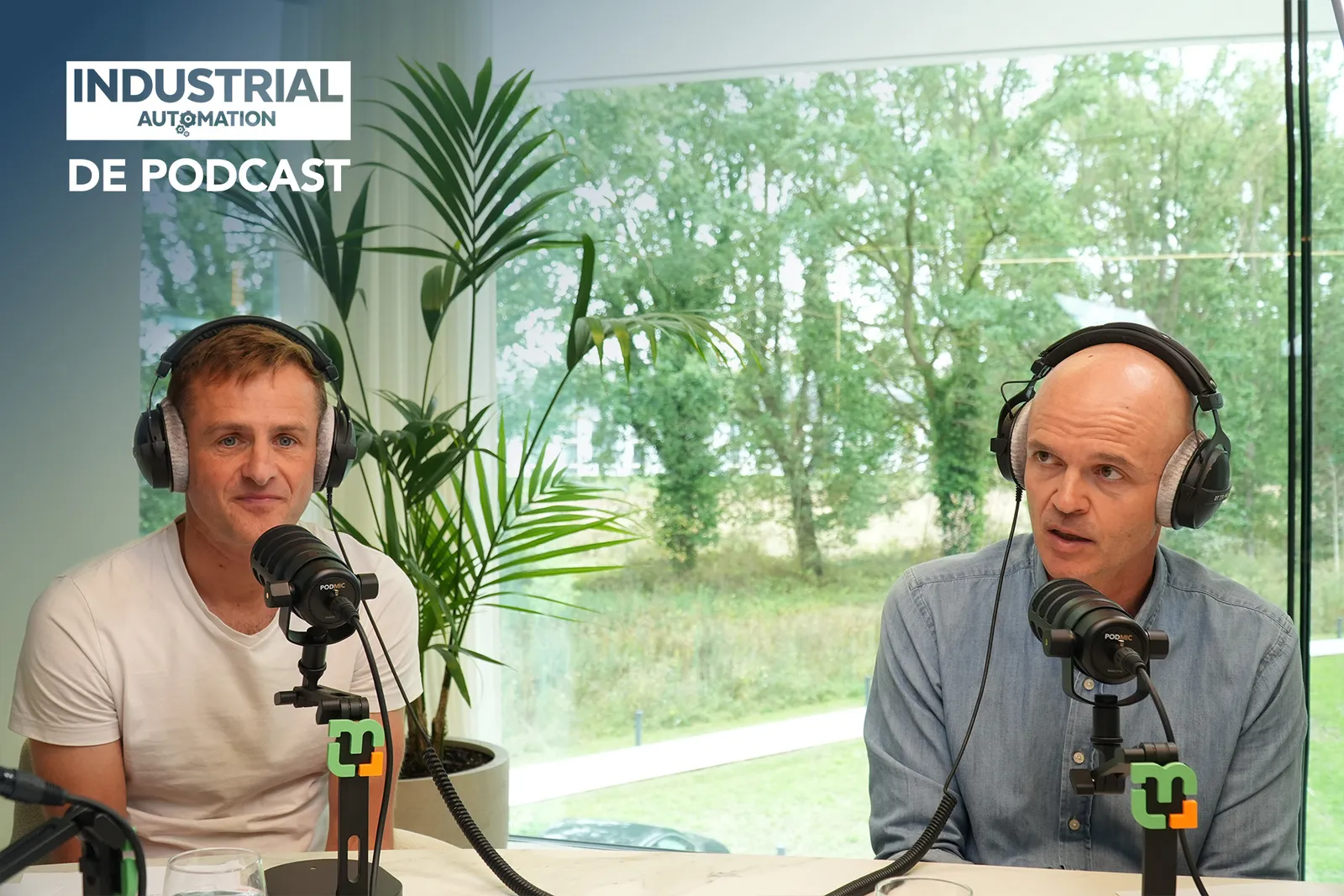
Guests: Joris Ceyssens and Timen Floré, respectively director and Director Business Development at VINTIV | Host: Björn Crul
When should you choose a custom-built machine over a standard solution? And how do you develop an automated production line that is both technically reliable and economically viable? In this episode, we explore the entire custom machine-building journey: from the initial analysis and technical feasibility study to engineering, testing, installation and service.
Björn Crul speaks to Joris Ceyssens and Timen Floré of VINTIV. They explain why process expertise and intellectual property play a crucial role in industrial automation, how a proof of concept can reduce technical and financial risks, and why close collaboration with the customer is essential. International roll-outs, flexibility during engineering and the importance of a strong business case are also discussed.
Een zakelijke vraag aan VINTIV? Get in touch
Full transcript
All chapters (18)
- From product innovation to a high-performance production line
- Intellectual property as a differentiating factor
- Customers seek new automation opportunities
- When custom solutions make the difference
- The business case for a custom-built machine
- From initial analysis to a viable project
- Assessing technical feasibility and risks
- A proof of concept tests the heart of the installation
- Engineering with one clearly designated person in charge
- Keeping as much expertise as possible in-house
- Agility when unexpected changes arise
- From factory testing to installation at the customer’s site
- The customer as an essential partner in development
- From prototype development to global roll-out
- Cultural differences in international projects
- From an initial sketch to a working machine
- Pride among employees and customers
- Closing
From product innovation to a high-performance production line
Björn Crul Hello, listeners. In the first episode of this podcast, produced in collaboration with VINTIV, we heard how the Flemish manufacturing industry is under pressure and why innovating in production processes is at least as important as investing in new products. Today, we look at what this means in practice. How do you build a high-performance production line that is not only technically excellent but also economically viable? What does the development process look like, from the first discussion to an installation running on the factory floor? And when should you opt for a custom-built machine rather than a standard product from a catalogue? I’m Björn Crul, and my guests today are Joris Ceyssens and Timen Floré, respectively director and Director Business Development at VINTIV.
Intellectual property as a differentiating factor
Björn Crul Joris, welcome. Once again, VINTIV has been around for almost 40 years. I saw on your website that you’ve delivered more than 5,000 projects worldwide. What makes you unique as a machine builder?
Joris Ceyssens Well Björn, thanks for having us. When you talk about a machine builder, everyone naturally thinks of a machine. And of course, that machine is a physical object. It sits on the factory floor, but ultimately it is also a body of knowledge. What sets us apart in the market is that, when developing a custom-built machine, VINTIV ensures that the intellectual property, meaning the knowledge generated in the process, belongs to the customer. The physical object, the machine used to do the work or manufacture products, is really secondary. It is the knowledge and intellectual property generated that belong to the customer. That is the asset that makes us unique in the industry.
Read the full transcriptCollapse transcript16 more chapters
Customers seek new automation opportunities
Björn Crul Timen, you’re responsible for business development. Looking at the situation today, what questions or expectations do customers bring to you?
Timen Floré Fortunately, in most cases, their initial enquiry is about automation or machine building. What I’ve noticed, or what we’ve noticed together, is that customers used to have a specific project in mind when they got in touch. They wanted to automate something. An investment was planned, a new production line was to be installed. That is under some pressure in Europe. I think we all know that. So these days, they’re generally exploring different cases. Where else can we automate? What other opportunities are there in our business? This has a number of consequences. First, complexity tends to increase, because everything that can normally be automated easily will already have been done. Second, and this is the challenge for us, we don’t have a standard catalogue. So simply putting a price on it and saying whether it is technically or financially viable for you takes time and money. We need to learn to handle that intelligently.
When custom solutions make the difference
Björn Crul So the question is, of course: when do you choose a standard solution, and when does a company really need a specific, tailor-made solution?
Timen Floré An easy answer would be: if a standard solution already exists, you don’t need to come to us, because we’d still have to do the engineering. We wouldn’t be competitive. But the truth, the reality, lies somewhere in the middle. What we’ve found is that some of our customers have become frustrated with standard machine builders. This usually comes down to the flexibility they require, [unclear]. That does create real opportunities for us. If the customer is willing to go along with it, they can gain the greatest possible competitive advantage. In other words, the result should normally be the best production process for their specific problem, and therefore the most efficient production. We then add the protection of that intellectual property. That’s where it all comes together.
Joris Ceyssens Obviously, first and foremost, if no standard solution exists, you have no other choice. But custom machine building often becomes really worthwhile when a manufacturing company is so good at production, and has such a firm grasp of its process, with so much expertise in-house, that it knows more about the problem than the standard suppliers do. If it wants to innovate and make its standard suppliers smarter using the process knowledge it has developed, it needs to prevent that knowledge from flowing back into the market through the machine builder. And that brings us back to IP. If you roll up your sleeves and develop your own machine, you also retain ownership of your own knowledge and safeguard it within your organisation. That is the ultimate outcome. That’s where custom machine building makes 100% of the difference.
The business case for a custom-built machine
Björn Crul It costs more than a standard product. Timen, how do you convince a company, if there is any doubt, to go for the more expensive solution?
Timen Floré It will only happen if value is created, if the customer gains a competitive advantage. Otherwise, we could come up with a hundred arguments and I don’t think it would happen. But the ultimate goal is to become best in class. In other words, to be the best in my sector and take the lead, producing as efficiently as possible. If the additional cost involved leads to a really strong business case, those are the arguments.
Björn Crul Joris, is it an investment in your company’s long-term future?
Joris Ceyssens Yes, exactly. I think that for most of the customers who come to us, the incentive to have a custom-built machine is greater than the investment, of course. The profit they make, or the ROI. Sometimes you’re talking about an ROI of less than a year, less than 12 months. Those are fantastic opportunities. So the investment is actually very reasonable. I don’t think we need to convince them. But the opposite is also true. Sometimes a business case simply doesn’t add up. We might even say: we wouldn’t do this with our own money, so why should our customer? In that case, not going ahead is also a very good idea.
From initial analysis to a viable project
Björn Crul Let’s take a look at how a new custom-built machine is developed. What is the very first step you take with a customer?
Timen Floré I’d like to return to what I mentioned earlier: customers are often still investigating whether the business case stacks up, whether the project will deliver results. That can be a difficult stage for us, because normally, to define the concept, meaning how we’re going to solve the problem and what it will cost, we need our most experienced and best people. Those are the senior project managers. Naturally, you don’t want to involve them if the chances of the project going ahead are slim. So Joris’s and my main task is to determine as quickly as possible whether something is viable, whether we have a chance or not. Drawing on our experience, we can give a rough indication of the likely cost relatively quickly. We can also assess fairly quickly whether it is viable.
Assessing technical feasibility and risks
Björn Crul So there’s an analysis phase before a quotation is submitted. If the customer decides to work with you, the next phase is to assess what is technically feasible. Joris, can you talk us through that phase and explain why it is so important?
Joris Ceyssens Yes, it’s obviously very important. When you talk about innovation, if you know in advance that something will work, you might ask: if you already know it will work, is it really innovative? So when do you carry out a proof of concept or something similar? When do you investigate technical feasibility? When something hasn’t been tried before, or when we have well-founded doubts about whether it will work technically. Or when we see major implementation risks, for example in product quality or cycle time, or other factors that could also undermine the business case. You might assume that a certain number of products can be made per unit of time, but if it turns out to be only half that number, then your business case, and the technical reality behind it, fall apart. Technical feasibility is often investigated by building very targeted, small-scale test setups. They can be very rudimentary, very simple. But the aim is to eliminate as many risks as possible from the project in advance. This gives us greater insight as the project progresses, so we can take that into account and carry it through into further development.
A proof of concept tests the heart of the installation
Björn Crul VINTIV has a lot of floor space where you can build test setups yourselves. Now, a proof of concept is not the same as a scaled-down version of a machine.
Joris Ceyssens No, that’s right. In a proof of concept, the first thing we do is identify the critical process steps with the customer and determine where we see risks, for example around cycle time or practical feasibility. We then test those on a small scale. But it’s certainly not a scaled-down version of the setup. It’s really the heart of the installation that you put to the test.
Björn Crul Can you give an example of a situation where a proof of concept demonstrated real added value, made a difference, or helped you find a better solution, Timen?
Timen Floré You could say that a proof of concept always adds value in prototype machine building. But of course, the customer has to invest in it. It will definitely reduce the risks and show whether the concept you have in mind is the right one. So the outcome will always be that what you do afterwards is better than what you initially had in mind, because you will have learnt something from it. Or, indeed, you will have learnt that it was a bad idea and that you should not go ahead with it. So you could potentially save a lot of money. I’ll give a specific example, without naming the customer. It was in the pharmaceutical sector, where we had to find a way to load a freeze dryer. That’s a kind of oven used to turn liquid into solid. It had to be loaded with magazines of a certain weight. Imagine a deep pizza oven. Everyone was convinced it had to be done with a robot. That would be ideal, too. You can buy one, develop a gripper and you’re all set. But when we did a proof of concept, we found that the robot moved beyond its centre of gravity. It started vibrating and would never have been able to do the job properly. Our colleagues had also submitted a proposal using a robot, so demonstrating that it wouldn’t work gave us enormous credibility. That’s why we’ve now come up with a different solution, in this case based on a shuttle, which gave us better control over the centre of gravity. It was a win-win, of course.
Engineering with one clearly designated person in charge
Björn Crul That clearly demonstrates the importance of a technical feasibility study like this. Next comes the engineering work. These are complex projects. How do you ensure both quality and on-time delivery during the implementation phase?
Joris Ceyssens I think you can sum that up in one word, Björn: responsibility. As Timen mentioned, there are several key roles in our company. One example is our lead designers or project managers. They are involved from phase one of the project, the costing stage. And they remain involved throughout the actual implementation of the project. So the person who does the costing stays on board during development. I think having one clearly designated person in charge is a very good rule of thumb. We then put together a team with enough critical mass on the customer’s side. That’s very important. And of course, we need the same on our side. Development then gets under way, with progress meetings every week or two to make sure we stay on schedule. Of course, things almost always [unclear]. That also means the goals have to be clear from the outset. You need specifications. If you don’t enter an address into your GPS, any direction will do. So we need to know where we’re going. That’s why we need clear specifications at the start of a project. Our project manager or lead developer then works with the customer’s core team to ensure quality and timing are properly monitored.
Keeping as much expertise as possible in-house
Björn Crul The person overseeing the project, then, is not just on the customer’s side, but on your side too. VINTIV has almost 60 employees. You have all the expertise in-house.
Joris Ceyssens A lot of it, yes. Over the years, I think we’ve found, and this brings me back to the question of dependency, that relying on others can be a disadvantage in certain situations. For example, we have our own panel-building department. [Unintelligible] is still an external partner. On some projects, such as retrofits, things simply come up or go wrong. That’s part and parcel of carrying out projects. Something will inevitably happen that you didn’t anticipate, and you need to be able to deal with it. Having most of the required people on board, from mechanical, electrical and software engineers to machinists, millers and welders, means you can deal with [unclear] that are bound to happen but can’t be predicted. Over the years, of course, you develop a good sense of what could go wrong. And it becomes second nature to think through different scenarios: if something happens, we’ll do this; if something else happens, we’ll do that. But that’s much easier when you have those people in-house.
Agility when unexpected changes arise
Björn Crul Is that speed and responsiveness the customer’s biggest advantage?
Timen Floré Yes, agility is certainly a big one. It means you can respond quickly to things you hadn’t anticipated. Although, as Joris says, you do expect something to happen. I have a specific example of a customer who confirmed that. They had a complex assembly machine for a very diverse product mix, and each product processed by the machine required a specific gauge. They knew we had a CNC department. We could make a gauge and test it before producing a large number of them. When a new product came in, we could make adjustments. Our own electrical team could make changes using our own technicians. That’s a major advantage.
From factory testing to installation at the customer’s site
Björn Crul Joris, what happens after the machine has been developed and tested on your shop floor? What happens next?
Joris Ceyssens An important stage, of course, in proving that the machine is fit for purpose is the FAT, which you carry out with the customer based on a set of parameters agreed in advance. For example, success might be defined as processing x products per unit of time, with no damage, and so on. Once the machine has been accepted, it is partially dismantled into larger sections, depending on the size of the installation. If it is a standard machine, it can of course be lifted as it is. It is then packed and shipped to the customer, anywhere in the world. Our installation team follows it and installs the machine at the customer’s site, integrating it into their production facility. Operators also receive additional training. Knowledge needs to be transferred from us to the customer’s organisation through courses, training and so on. There is then a final acceptance test at the customer’s site, the Site Acceptance Test. Once that is complete, the project has been fully handed over. After-sales service may follow, for example, with an annual visit for servicing and maintenance. We can draw up a critical spare parts list and carry out a risk analysis of critical components, among other things. The aim is to give the customer everything they need to keep the machine running for a long time.
The customer as an essential partner in development
Björn Crul Yes, that’s a project delivered successfully. Timen, what do you expect from the customer during the development of the machine? Surely the customer also needs a team to oversee the project?
Timen Floré That’s absolutely right. We need the customer to be heavily involved in developing their machine. The customer is the only one who really knows the process or the product. They’re also the only one on the project who knows their factory and has experience of the factory or production process. We have to step into their world, and we can never know everything. So we need the customer to tell us what works and what doesn’t. What has happened in the past? What lessons have they learnt that we should make sure not to repeat? The more information the customer shares, the better and more efficiently we can work. That’s not always so straightforward. Sometimes information comes through too late, as can happen with people, I think. And that’s never a good thing. But we absolutely need the customer’s involvement.
Björn Crul Is that also because some things may not be documented in companies and a lot of information is often stored in people’s heads?
Timen Floré Exactly, yes. And there can also be staff turnover at the customer’s organisation. Someone may have had an experience, but if nobody else knows about it, it doesn’t get shared. Or, and this happens even more often, the wrong people are sitting around the table.
From prototype development to global roll-out
Björn Crul Joris, you often work for customers around the world. I read that you work in Belgium, Asia and South America. Are those more complex projects? What specifically do you need to bear in mind when working with customers like that?
Joris Ceyssens They certainly can be. The initial project often starts in Belgium, though. The initial, let’s call it parent development, takes place here. The reason is that developing a prototype over a long distance carries quite a lot of risk, because you need to put together teams in which both the customer and we are closely involved in the development process. All our machines take their first steps here, locally. But those parent machines often have, and increasingly have, daughters, cousins and other relatives. These are further developments of proven installations, and they are the ones that get exported. That’s a considerably lower risk for both us and the customer, because you know in advance that the heart of the installation is sound and works. I don’t think anyone benefits from installing a prototype machine 5,000 kilometres away. What we distribute or roll out around the world is often further development of machines we’ve built before. So managing risk is always important to us. I think our customers take that into account too. You need to export something you already know will work, and work well, and then continue developing it. I think that’s the main thing to bear in mind.
Cultural differences in international projects
Björn Crul And Timen, do cultural differences play a role in any way?
Timen Floré Yes, that’s a good question too. Joris, the first thing that comes to mind is the machine that was christened in India. Do you remember that?
Joris Ceyssens Yes, indeed. There are local customs that aren’t necessarily obvious to us. So, just as you would christen a ship with a bottle of champagne, the installation was christened with incense.
Timen Floré Yes, that’s a nice anecdote. But I think it’s very difficult to develop a genuinely bespoke machine with an engineering team from India, for example, or China. The machine can go to India, that’s not the problem. But it needs to be developed with a team that’s at least somewhat local.
From an initial sketch to a working machine
Björn Crul Joris, speaking of anecdotes, you’ve been at VINTIV for more than ten years. Which custom-built project are you most proud of?
Joris Ceyssens It is difficult to name just one machine. I certainly would not want to leave any out. Personally, I am always amazed when you look at what has been built and see how something like that takes shape from an idea on a drawing board. Or when you talk to a customer during an initial visit and they say: we have identified a need, and we would like to do this and that. You start with a sketch and you start developing ideas. Then, after a certain amount of time, you see the machine standing there. And the customer is very satisfied. The value it brings to the customer is so great that they achieve an ROI within one or two years. That is the finest compliment you can receive as a developer. Of course, as a company we also have to run our own business. So if both companies can benefit from it, that is really the best kind of collaboration.
Pride among employees and customers
Björn Crul Timen, turning to you, what do you find most rewarding about your job?
Timen Floré When I think about it, I get the most satisfaction from other people, both internally and externally, among our customers. There is certainly enormous pride in our team in what they make, and rightly so. You can see in people’s eyes how proud they are of what they have done. But there are also plenty of customers who are immensely proud of what is there after a project, and who thank us for it. When they come to visit us, they say: this is VINTIV-style, fantastic. That gives you a tremendous sense of satisfaction.
Closing
Björn Crul Joris Ceyssens and Timen Floré, it is great to have you in the studio today. Thank you.
Timen Floré Thank you.
Björn Crul The world of machine building remains fascinating, that much is clear, dear listeners. Thank you for listening. Listen via the Industrial Automation channels. Until next time.
Companies in this story
Keep following this
Get an email when a new story is published. No account needed.
- ThemeFrom design to flexible machine
- SubjectServices & solutions
- CompanyVINTIV