












Laurens Joosten wins Wout Theuws Award for bachelor’s project on online vibration measurements
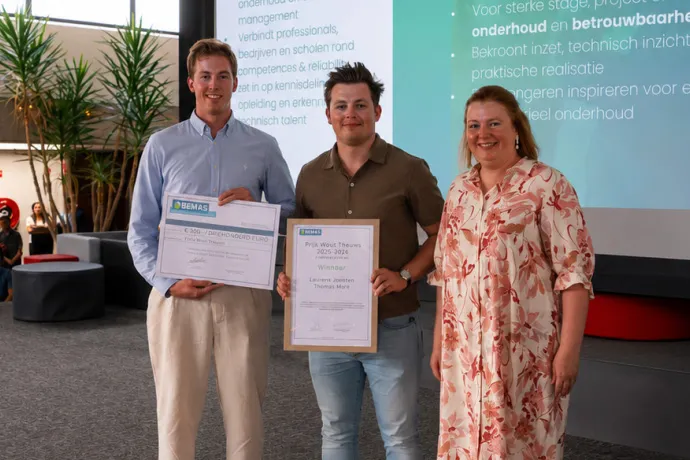
BEMAS vzw, the Belgian maintenance and asset management association, has awarded the 2025-2026 Wout Theuws Award in the Professional Bachelor category to Laurens Joosten, a Professional Bachelor’s student in Electromechanics, specialising in Maintenance Technology, at Thomas More campus Geel. Laurens received the award for his bachelor’s project, “Educational rig for online vibration measurements”, a practical test set-up that helps students understand how vibration measurements can be used for condition monitoring, predictive maintenance and fault diagnosis.
The Wout Theuws Award is an initiative of BEMAS and recognises outstanding final-year projects that make a clear contribution to maintenance, reliability and asset management. Through the award, BEMAS aims to encourage young people in technical courses to develop their talents in a field that is essential to the reliability, safety and competitiveness of industry.
The jury recognised Laurens Joosten’s work as a particularly relevant contribution to maintenance technology. His bachelor’s project combines a technical implementation with clear educational value and closely reflects the shift towards data-driven and predictive maintenance. Laurens achieved a final score of 81.3 / 100, making him the winner in the Professional Bachelor category.
Making machines speak through vibration
Every machine has something to tell us about its condition. A motor, pump, fan, gearbox or compressor operating correctly has a characteristic vibration pattern. When wear, imbalance, misalignment or other mechanical problems arise, that pattern changes. By measuring and analysing vibration, maintenance technicians can identify anomalies early, often long before a machine actually fails.
That is precisely the focus of Laurens Joosten’s bachelor’s project. He designed and built an educational motor and gearbox rig on which controlled mechanical faults can be introduced. The rig was also built using industrial equipment supplied by industry: the motor and gearbox came via Van Loock Motoren, while the electrical panel was supplied by Signify Turnhout. Sensors measure vibration at various points on the rig. The measurement data are then made available online, enabling students to learn how to interpret vibration spectra and link a machine fault to the resulting measurement pattern.
This is particularly valuable for students of maintenance technology. Vibration analysis often remains abstract when taught only in theory. With this rig, future students can see for themselves how a machine responds when a fault occurs. They learn to distinguish between normal operating conditions and an anomaly, and gain a better understanding of how modern condition monitoring is used in industrial settings.
Predictive maintenance in practice
Laurens’s rig closely reflects the shift towards predictive maintenance. Rather than waiting for a machine to fail, or replacing parts preventively without knowing whether this is necessary, companies are increasingly using measurement data to monitor the actual condition of their machines. This allows them to plan maintenance more effectively, avoid unexpected downtime and replace parts at the right time.
This approach is an essential part of modern industry. In an Industry 4.0 environment, machines are connected to sensors, cloud platforms and intelligent analysis software. Machine data are collected continuously or periodically and used to identify trends, anomalies and risks. Vibration measurements play an important role here, particularly for rotating machinery such as motors, pumps, fans, compressors and gearboxes.
The link with artificial intelligence is also becoming increasingly important. AI systems can analyse large volumes of measurement data, identify patterns and detect anomalies faster than is possible through conventional manual checks. However, technical expertise remains indispensable. Maintenance professionals need to understand what the data mean, which fault mechanisms may be involved and what action is required. Laurens’s educational rig helps students make precisely that connection between technology, data and practical maintenance know-how.
Collaboration with I-care
The bachelor’s project was developed in collaboration with I-care, a Belgian technology company and international player in predictive maintenance and machine health. I-care specialises in monitoring the health of industrial machinery using sensors, data analysis and AI-supported platforms.
This collaboration played an important role in Laurens’s project. By using industrial sensor technology and analysis tools, students gain access to technologies also used in real production environments. This makes the rig not only valuable from an educational perspective, but also highly relevant to industry.
The collaboration also demonstrates the importance of links between education and industry. New maintenance technologies are developing rapidly. By introducing students to modern measurement methods, online data platforms and data analysis during their training, they are better prepared for the maintenance roles of the future.
Reliable machines benefit society
Better vibration measurements and more reliable maintenance benefit more than just businesses. They also have a wider impact on society.
When machines operate more reliably, the risk of unexpected downtime falls. This means less production loss, fewer emergency repairs, less waste of parts and raw materials, and more efficient energy use. In sectors such as food, chemicals, pharmaceuticals, energy, infrastructure and manufacturing, reliable maintenance also directly contributes to safety, security of supply and sustainability.
A well-maintained machine also lasts longer. This reduces the need for premature replacement and helps companies manage their assets more sustainably. Predictive maintenance therefore supports not only economic performance, but also safety, circularity and responsible asset management.
Laurens Joosten’s bachelor’s project therefore delivered more than a technical test rig. He built a learning tool that helps future maintenance professionals understand how data, technology and expertise work together to make machines more reliable and industry stronger.
Jury decision
The BEMAS jury particularly valued the clear link with condition monitoring, predictive maintenance and fault diagnosis, the practical usability of the educational rig, and the significant added value it offers the next generation of Thomas More students.
Laurens achieved solid to very good scores across the various assessment criteria. The added value for the client, the project’s relevance to maintenance technology and its clear link with vibration analysis were particularly influential in the final decision.
For the jury, the combination of relevance to maintenance, practical applicability and educational value ultimately proved decisive. With this award, BEMAS recognises a bachelor’s project that brings together technical implementation, educational value and societal relevance to great effect.
“Predictive maintenance is of great economic importance to the competitiveness of our manufacturing companies. By detecting incipient machine problems in good time, businesses can avoid unplanned downtime. At the same time, predictive maintenance also helps prevent excessive maintenance: parts are not replaced too early, interventions can be planned more effectively, and the costs of unnecessary downtime, spare parts and labour hours are reduced. This makes maintenance not only more technical and intelligent, but also more strategic for industry.”
Wim Vancauwenberghe, director of BEMAS and jury member
“As his supervisor, I am immensely proud of what Laurens has achieved. With his educational rig for online vibration measurements, he makes predictive maintenance tangible and forward-looking. The collaboration with I-care, as well as the particularly committed collaboration with Laurens himself, shows how effectively education and industry can reinforce each other. The Wout Theuws Award, an initiative of BEMAS, is the icing on the cake in recognition of his hard work and dedication. This project is a textbook example of the MORE professional in action: innovative, enterprising and making a societal impact.”
Niels Verellen, supervising lecturer/project supervisor, Thomas More
“It was wonderful to see how Laurens approached his project; his passion for vibration analysis grew by the day. With his winning bachelor’s project, he has not only strengthened the link between I-care group and Thomas More Geel, but also created a safe, user-friendly rig. Laurens is also a fantastic person to work with, so his contract is already waiting for him here!”
Tim Franken, company supervisor, I-care
About the Wout Theuws Award
The Wout Theuws Award is an initiative of BEMAS that aims to encourage young people with technical talent to further develop their skills in maintenance, reliability and asset management.
Since 2016, the award has been presented to students in the final year of a technical course in secondary education, including vocational, dual-track and SE-N-SE programmes. In the 2025-2026 school year, the award was presented for the first time in the Professional Bachelor category as well.
With this expansion, BEMAS also aims to recognise bachelor’s students in technical courses whose final-year projects make a clear contribution to maintenance technology, industrial reliability and responsible asset management.
Question about this story? Ask your question
Keep following this
Get an email when a new story is published. No account needed.
- ThemeProcess measurement and control
- SubjectNews







