Intelligent pumps reduce complexity and improve process control
Text Kris Vandekerckhove / MepaxImage Mepax

The integration of intelligence at component level continues unabated in industrial automation. Traditionally, pumps served purely mechanical functions, but today they are evolving into active, data-driven subsystems. With the introduction of integrated ‘intelligent pump features’, KNF is responding to this trend, as well as to the growing demand for simplicity and precision.
At the heart of the development is the combination of sensor technology, motor control and closed-loop control in a single compact pump. This shifts a significant part of the system intelligence from the machine to the component itself. “Customers are looking for solutions that are easier to integrate while offering greater accuracy,” says CTO Christian Kissling. “By integrating sensors and control technology into the pump, we take away much of that complexity.”
Closed-loop control as a key technology
In conventional systems, precise control of flow, pressure or vacuum requires a combination of external sensors and bespoke software. This not only increases the engineering effort, but also makes systems more susceptible to errors and deviations.
KNF addresses this with integrated closed-loop control. The pump continuously measures the relevant process parameters and actively adjusts its operation to maintain set values. This applies even when temperature, pressure or medium properties fluctuate. According to Kissling, the challenge lay in bringing together different technologies: “Combining sensors, control algorithms and pump mechanics in one compact, reliable system was particularly challenging from a technical perspective.”
Four functions, one platform
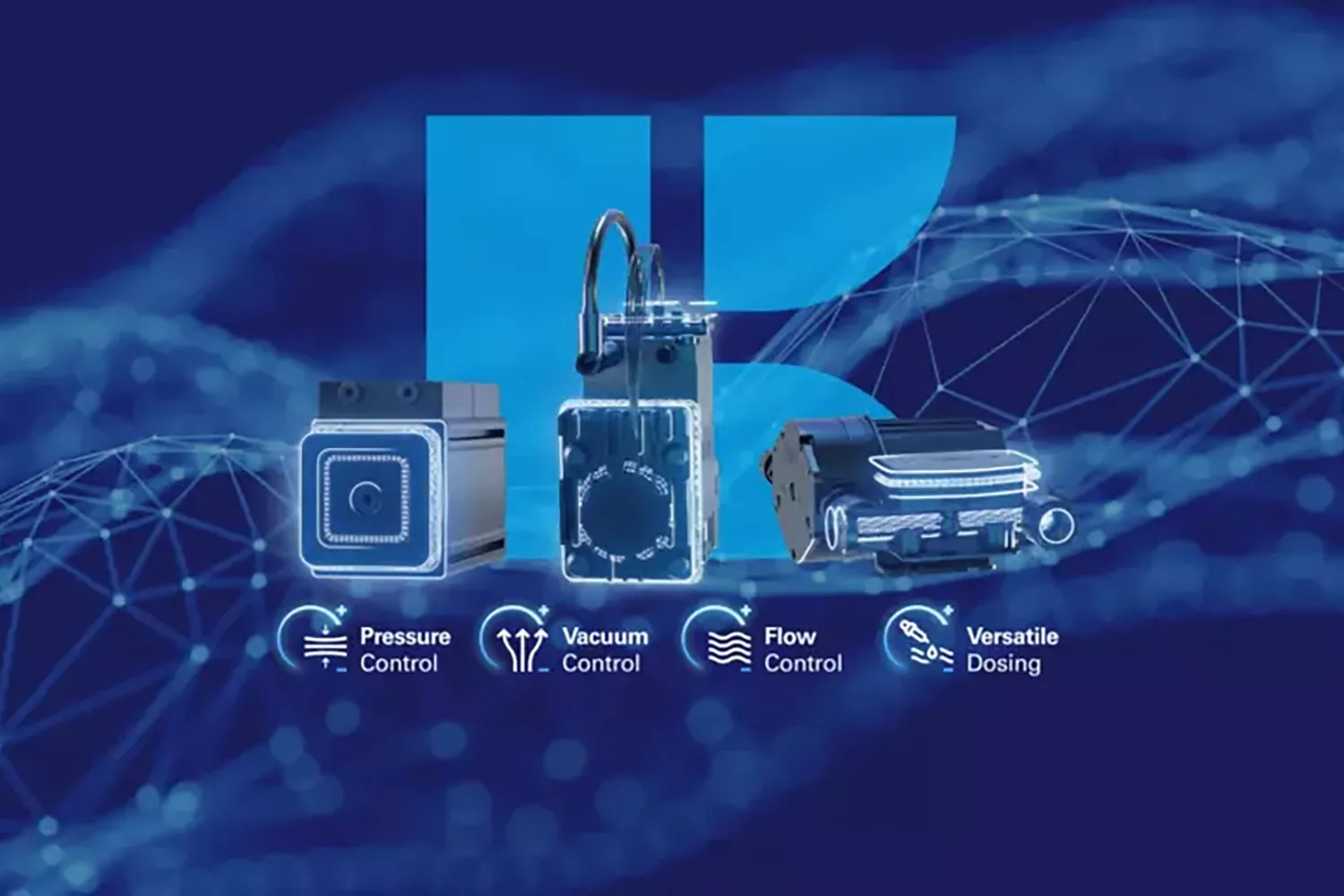
The new technology delivers four practical solutions, each targeting a specific parameter in process control.
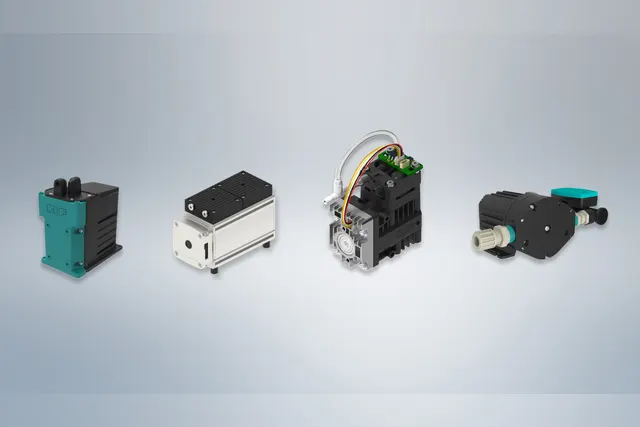
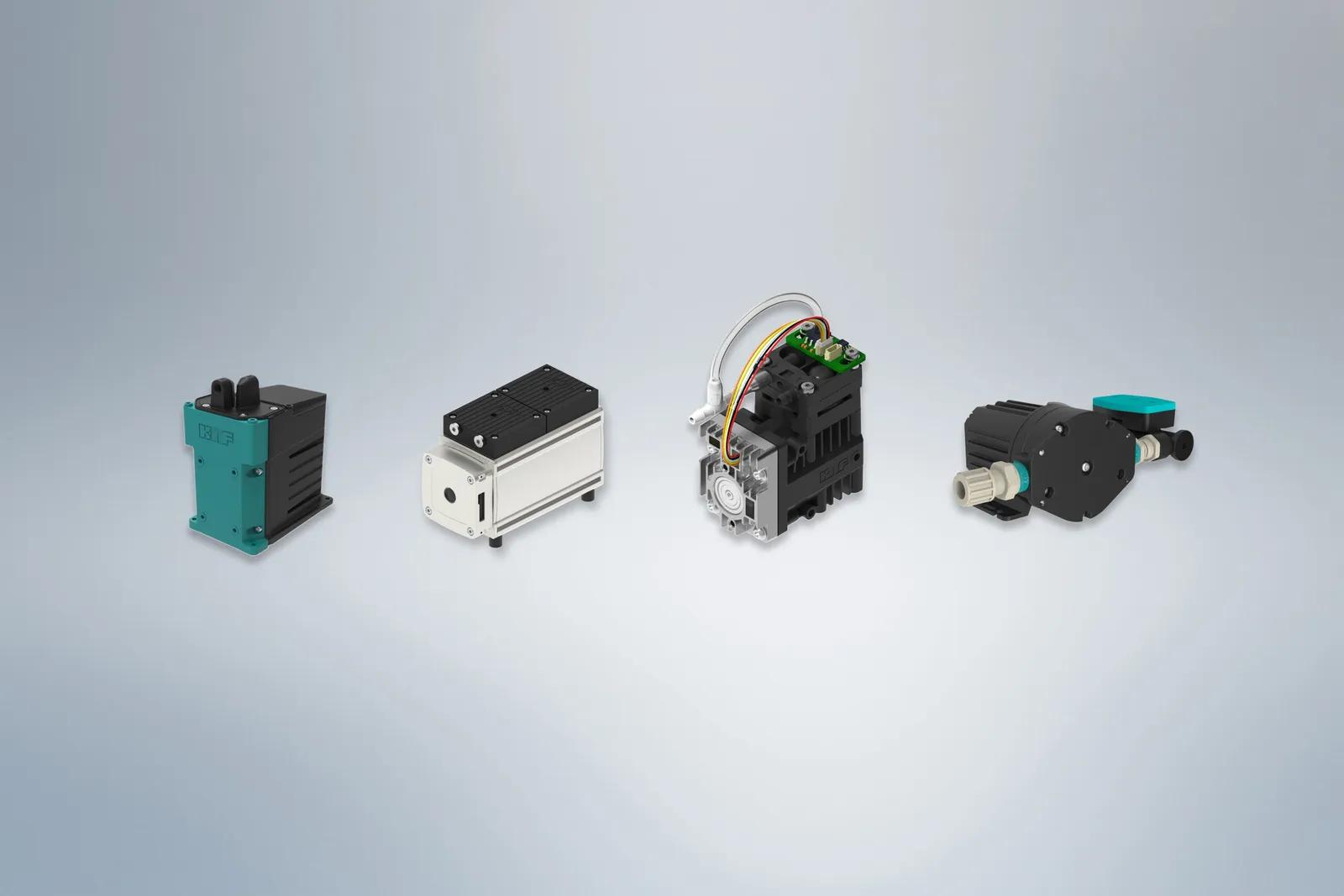
For liquid applications, the FMS-FC 1.400 offers integrated flow control for stable, precise dosing. The FD 1.200 is designed for reproducible volumetric dosing, supported by stepper motor technology and actively controlled valves. For gas applications, the MGP 75 provides constant pressure control, while the compact NVC 830 micro-vacuum pump maintains precise vacuum levels under dynamic conditions.
What all the pumps have in common is their ability to detect and correct deviations in real time, making processes more stable and predictable.
Less engineering, faster integration
For OEMs and machine builders, the greatest benefit lies in simplified integration. With sensors and control technology already built into the pump, there is no need to develop complex control strategies in-house. “The aim is to let customers focus on their core application rather than developing peripheral functionality,” says Kissling. The pumps support both autonomous operation and control via analogue signals and communication protocols such as UART, simplifying integration into automated systems.
From component to solution
Market expectations are also playing an important role in this evolution. According to CSMO Reto Furrer, demand is clearly shifting: “The market is moving from individual components to integrated solutions. Today, customers expect not only performance, but also simplicity and a shorter time to market.” This shift is pushing suppliers to look beyond hardware alone and offer greater system intelligence.
Flexibility remains essential
Despite the integration of intelligence, customisation remains a crucial factor. Thanks to a modular design, parameters such as material selection, connections and digital settings can easily be adapted to specific applications. This makes the pumps suitable for a wide range of sectors, from medical technology and analytical systems to industrial process environments where reliability and reproducibility are essential.
Smarter components, more robust systems
The rise of intelligent pumps is part of a broader trend towards ‘smart components’. By bringing functionality and intelligence closer to the process, system complexity and integration risks are reduced. The implications for industrial automation are clear: fewer separate components, less engineering and more predictable performance. Or, as Kissling puts it: “The future lies in components that do more than simply perform a task: they also contribute to the process.”
Question about this story? Ask your question
Companies in this story
Keep following this
Get an email when a new story is published. No account needed.
- SubjectProcess & instrumentation
- CompanyKNF