












Software, IT, OT & cybersecurity
What you need to know about quantum computing
Text Valérie CouplezImage iStock
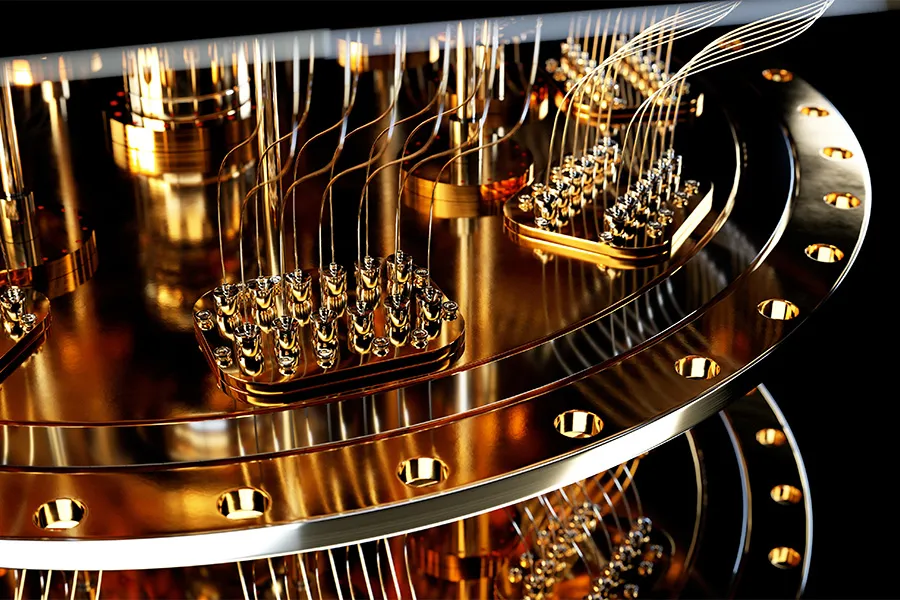
Forget classical bits and bytes: quantum computing is all about quantum bits, or qubits. They enable computers to run simulations and calculations much faster. This allows engineers to analyse complex systems more quickly and optimise their design. It can also be used to simulate the properties of materials at the atomic level, paving the way for new materials with improved properties. The possibilities are compelling, but how far away are we from realising them today?
We cannot simply use the computers we all know today to harness the power of molecules during photosynthesis. Quantum computers are needed to measure and observe quantum systems at the molecular level, and predict the probability of events. In short, tasks that would take your PC billions of years to calculate can be done by these computers over a weekend. This should enable them to solve some of the world’s most complex problems. It is as if computers will take us from the candle to the light bulb.
From bits to qubits
The building blocks are qubits. You can think of them as the classical bits you know, but with an extra trick. Thanks to superposition, they can exist in several states at once. While binary bits are limited to 0 or 1, qubits can be any proportion of 0 or 1, in a superposition of both states. This allows them to perform large numbers of calculations in parallel using algorithms. They can be made from ions, photons, artificial or real atoms, or even quasiparticles.
Quantum computing is nothing new. It has been talked about since the 1980s. But building quantum computers requires keeping the interference that can occur between qubits under control, to ensure reliable results. A second challenge is maintaining superposition and keeping qubits in that quantum state. This requires isolation and cooling (to below -250 °C).
Applications
All well and good, but what can you actually do with quantum computers?
If the scientific community is to be believed, the sky is the limit. The focus is primarily on industrial sectors, where factors such as cost, quality and production time carry considerable weight. Quantum computing could lead to new ways of managing air traffic, delivering parcels, storing energy and much more.
Quantum computers could also accelerate the application of artificial intelligence. Experts have yet to reach a consensus on this, however. One important point to bear in mind is that the algorithms we know and use today cannot simply be transferred. The rules of quantum technology differ significantly at the most fundamental level. But there is confidence in its potential applications, including in tackling climate change. For example, it has been proposed that quantum simulations of large molecules could be used to develop a catalyst that removes CO2 directly from the atmosphere.
Experimenting in earnest
The stuff of the future? Certainly, but quantum computers already exist and are in use. However, large-scale applications like these will have to wait. The focus is currently on small molecules, for example, molecular modelling of lithium hydride. This can be simulated using a supercomputer, but quantum simulation techniques offer an excellent opportunity to double-check the results produced by classical simulations. This is how progress is made, step by step, towards experiments with larger particles. Would you like to try it out for yourself? Cloud platforms are already offering a taste of the quantum experience. The fun has begun. ■
Question about this story? Ask your question
Keep following this
Get an email when a new story is published. No account needed.
- SubjectSoftware, IT, OT & cybersecurity







