












Software, IT, OT & cybersecurity
Technology to stay ahead of the competition
Text Valérie CouplezImage Beckhoff Automation
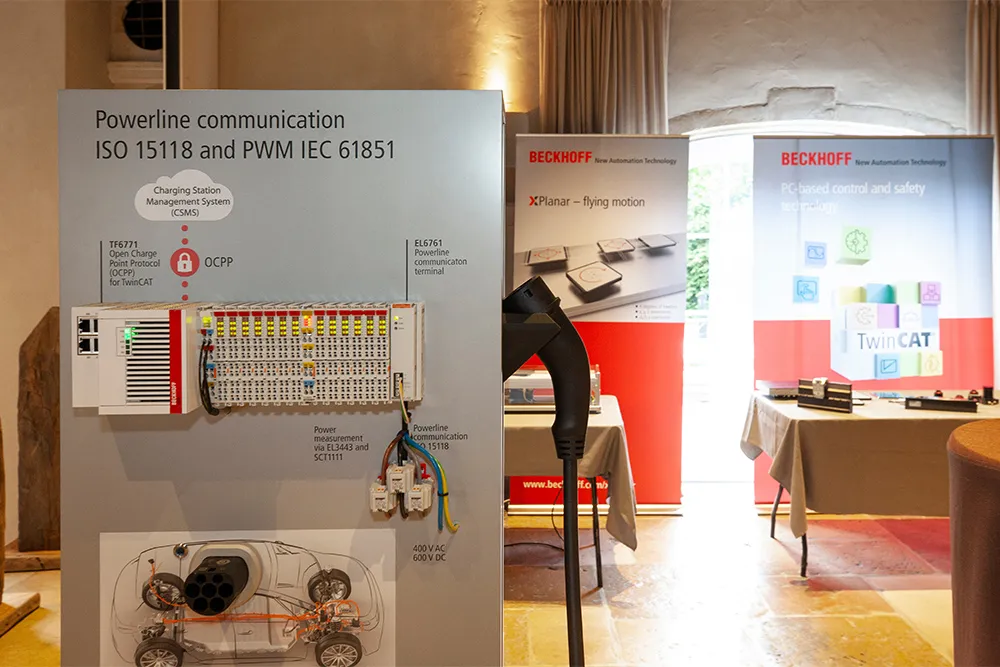
If you want your machines to stand out, you need innovative, smart components. Tomorrow’s trends? Flexible drive concepts, integrated vision technology, a control cabinet that is no longer a control cabinet, and a robot tailored to every application.
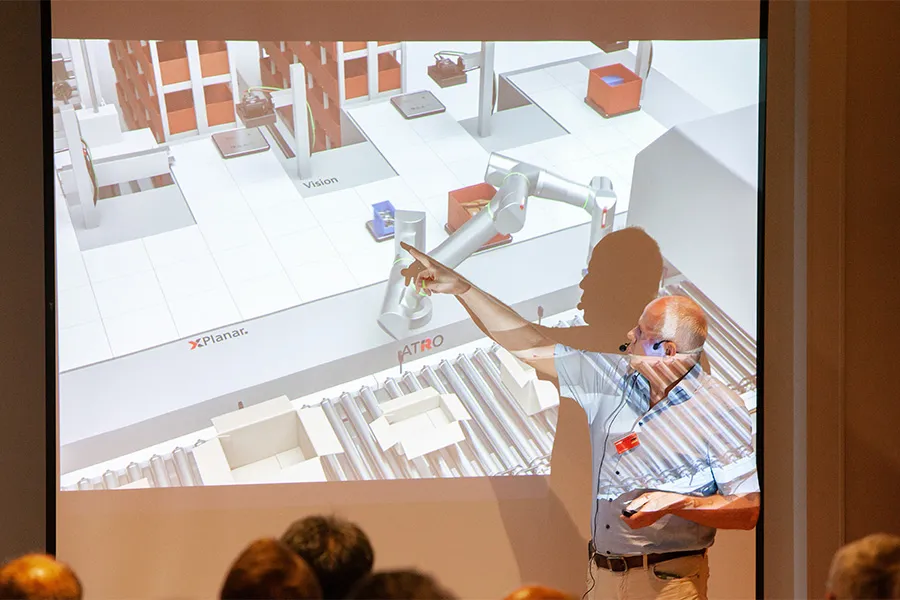
The robot in question is the ATRO, an industrial robot that can be configured from standard modules. One or more axes, one or more robot arms with grippers…: simply click the modules together to build a robot suited to your application. If your needs change, the same modules can be used to create a completely different configuration. Base modules have all the connections needed for power supply built in. Motor modules contain a motor, gearbox and all the associated electronics. Finally, link modules connect everything neatly together. Whether you want to build a three-axis delta robot, a four-axis picker or a five-axis palletising robot, the possible applications are endless. Payloads of 3, 5 or 10 kg will be available.
Ease of use comes first
Flexibility is a key advantage, but Beckhoff has also made ease of use a priority. Your application can be up and running in just a few minutes. The robot configuration is scanned, then easy handling lets you teach it positions manually with ease, and you’re ready to go. No programming knowledge is needed to set positions very precisely via parameters. Everything is, of course, fully integrated into TwinCAT for perfectly synchronised operation.
Another notable feature is that everything is inside the robot. All media are integrated into the modules, from the base to the end effector, including data, power, compressed air and water. This means there are no restrictions on rotation, opening up a host of new application possibilities. It also allows the robot to have a very compact footprint, as it can always take the shortest path. The ATRO is expected to be available from 2025.
XTS: a step towards customised products
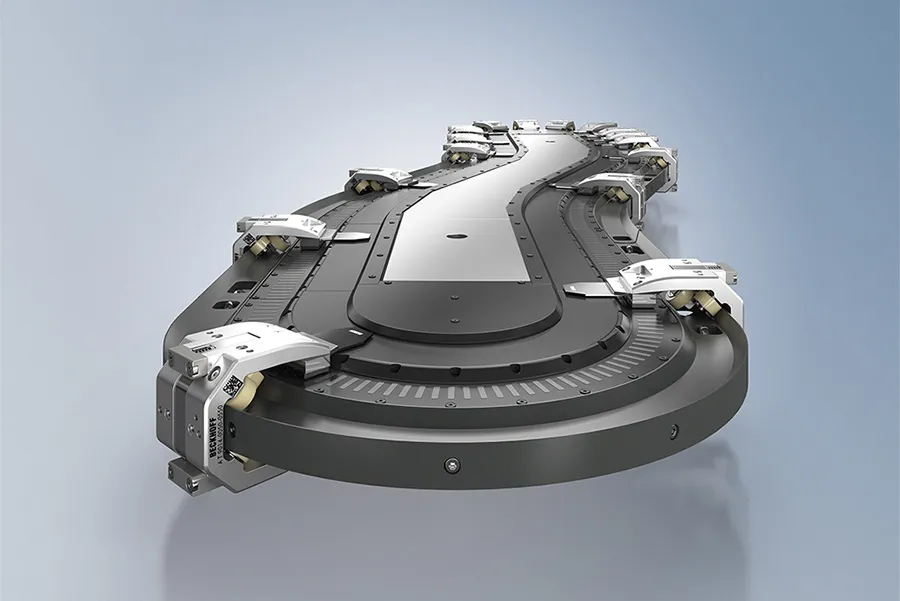
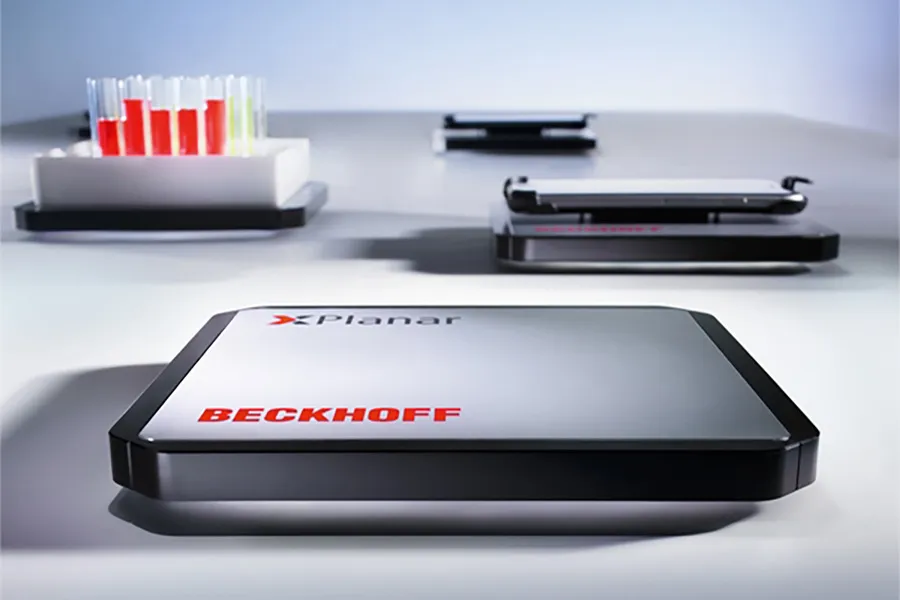
Two promising outliers in the world of drive technology are XTS and XPlanar. We mention them together because both help machine builders move towards customised products. They do things a little differently, and a little better, than what we have been used to for years.
Today’s and tomorrow’s machines must be more compact, efficient and flexible than ever. So forget the conventional conveyor belt, which is less suited to a high-mix, low-volume production environment, especially if you want to avoid downtime for mechanical adjustments. XTS, by contrast, makes it possible to create an individual track layout between different machines or process steps. Need to increase output quickly? Simply add more movers. Traffic can be simulated and monitored directly in TwinCAT. Need to make a production change? All it takes is a software update, and production can resume. And did you know that food manufacturers can also opt for a fully hygienic version in electropolished stainless steel, with an IP69K protection rating?
XPlanar: complete freedom of movement
For those looking to go further and enable complete freedom of movement in their machines or production lines, there is XPlanar. The movers no longer need a track. Instead, they move in two dimensions across tiles using a magnetic field. Rotation, movement along the X or Y axis, lifting, tilting… it can do it all. With this, Beckhoff is already showing what the next step in intelligent product movement will look like.
Sounds like something for the distant future? Quite the opposite. These systems are already up and running in industry. One application involves plasma cleaning. Instead of moving the plasma head over the products, the products move underneath it. The result: less wear and therefore a longer service life. There are also plenty of possibilities in the food industry, for example, creating a buffer zone after slicing. The slices then continue under UV cleaners towards the packaging process, always perfectly positioned and hygienic. You can put together your own solution or have Beckhoff supply ready-to-use, tested XTS and XPlanar assemblies, including the correct parameter set and control cabinets, to your workshop.
Achieving perfectly synchronised vision applications
Another new addition to the Beckhoff range is a suite of hardware components for vision applications: cameras, lenses and lighting. Why is a PLC specialist entering this market? To enable perfect synchronisation between the camera, lighting and PLC.
Specialists were brought in to develop the hardware components, while the lenses were developed in collaboration with a specialist partner. One feature that immediately stands out on the LED and camera housings is the EtherCAT P connector. Both the cameras and LEDs are EtherCAT slaves with Distributed Clock technology. This enables highly precise synchronisation, for example in applications with a fast trigger. Another major advantage is that the lighting has integrated electronics, so no additional LED strobe controller is required.
The VCS2000 area scan cameras are available with resolutions from 1.6MP to 24MP and a transmission speed of 2.5 Gbits/s using the GigE Vision standard. The VIx2000 OGB-IR850 lighting family comprises panel, ring and bar lights in various sizes, with mounting adapters. Ideal for quality inspections, precise object detection and other vision applications.
MX-System: no control cabinet needed
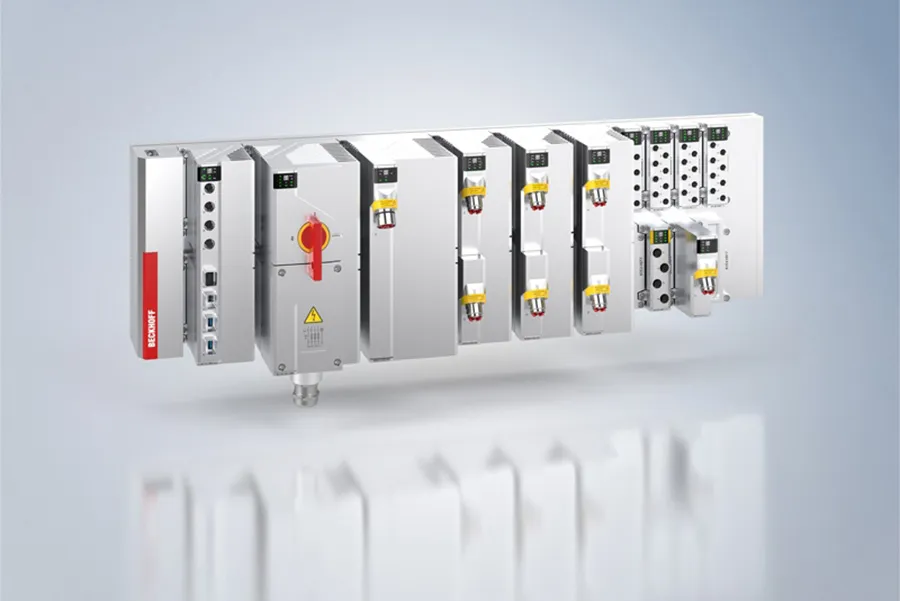
Finally, let’s not forget to mention MX-System. It too has enormous potential to turn machine building on its head. With MX-System, there is no longer any need for a conventional control cabinet. Control cabinets are undoubtedly useful, but they often take up space and require long cable runs, as well as a great deal of engineering and installation work. Surely there must be a better way? With MX-System, everything you need for power supply, data connections, relays, IPCs, I/Os, motion control… now fits on a baseplate. All you have to do is screw it in and click it into place. German Chancellor Scholz demonstrated at the recent Hannover Messe just how easy it is.
So what does that mean in practice? A typical control cabinet contains 146 components, whereas now you need just 15. Set-up time has fallen from 28 hours to 1, and electrical diagrams now run to just 24 pages instead of 92. A significant gain across the board: less space, less assembly time, everything pluggable and hot-swappable…
Your application is now fully digitalised too, as all functions can be monitored via EtherCAT. A configurator is currently in development, allowing you to see what you need based on your application parameters. Ultimate ease of use!
Een zakelijke vraag aan Beckhoff Automation? Get in touch
Companies in this story


Keep following this
Get an email when a new story is published. No account needed.
- ThemeFrom design to flexible machine
- SubjectSoftware, IT, OT & cybersecurity
- CompanyBeckhoff Automation
- CompanyHANNOVER MESSE







