












Software, IT, OT & cybersecurity
Significantly higher capacity thanks to intelligent transport system
Text and images Beckhoff Automation
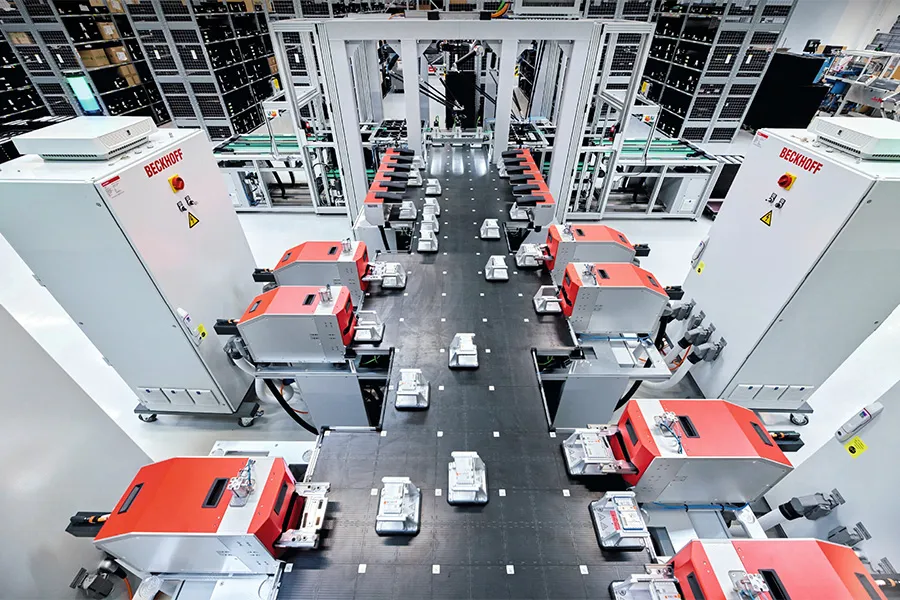
Automation is a top priority for technology suppliers too. Beckhoff’s in-house production department developed a system that can programme, set up and test around 10,000 I/O terminals fully automatically per shift. The intelligent XPlanar transport system was one of the factors behind this major boost in speed and flexibility. This enables production output to grow with the existing workforce and within the available space.
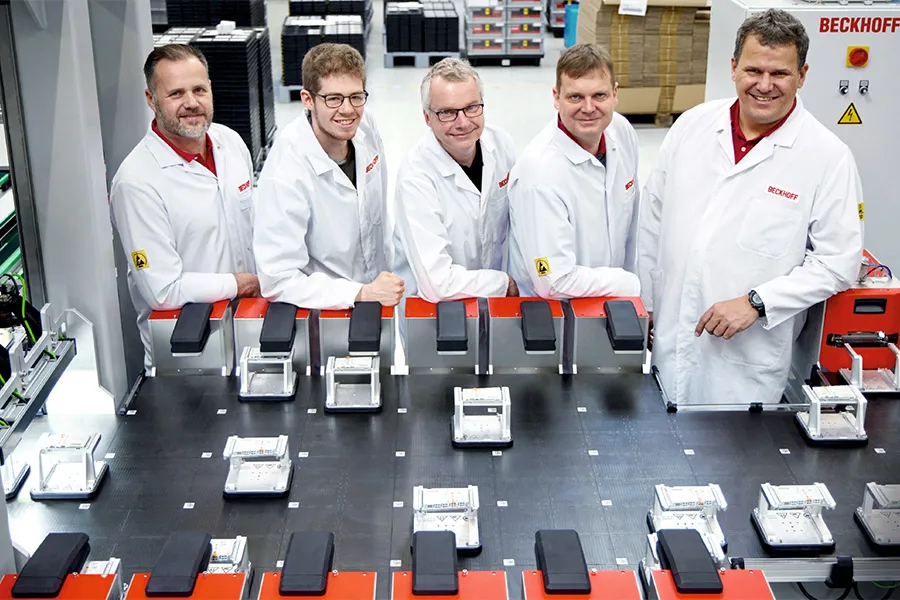
“Keeping pace with the growth Beckhoff manages to achieve year after year.” This was, and still is, the challenge facing Michael Golz, head of the demo systems department. Golz and his team completely redesigned the final inspection system for I/O terminals, using XPlanar as the transport system, specially developed firmware programming devices and test stations with universal test units. “On average, every three seconds a fully tested I/O terminal, programmed with the correct firmware, leaves the system, regardless of the terminal type or the order in which they are supplied.” The system can currently programme and test more than 200 different terminal types. The number of different types in the system has no impact on the production rate of 10,000 terminals per shift.
Faster than the sum of its parts
An impressive feat of engineering, especially when you consider how long each individual component takes. “It can take up to thirty seconds to install the firmware and configure all the analogue channels,” explains Stefan Engelke, who developed and programmed the test units with his team. The solution lies in parallelising and separating firmware installation on the one hand from functional testing on the other. In itself, this is not a groundbreaking idea; the innovation lies in the systematic use of XPlanar’s degrees of freedom for all internal logistics and the delivery of terminals to the workstations.
Thanks to the products’ unrestricted 2D movement, it does not matter whether an individual bus terminal needs to spend ten seconds or one minute in a test system. The remaining movers simply bypass occupied stations and proceed to the next available station. This means that individual delays do not affect the system’s overall output.
Less mechanical complexity thanks to XPlanar
“The system’s interface and layout allow for future expansion without major modifications,” emphasises Daniel Golz, who is responsible for the system’s mechanical design and the specific details of the terminal contact interface. XPlanar makes machines modular while also simplifying their mechanical design. For example, the programming stations use XPlanar’s precise XY positioning. This means the programming devices can lower their pins onto the terminal’s connection contacts as soon as they reach the exact position, and start loading the firmware. At the test stations, another XPlanar feature reduces design work: variable flight height. This allows all the contacts to be accessed and reached freely.
After testing, the terminal is placed back on the mover in reverse order. The ability to rotate the movers by 180° is useful. “It has considerably reduced mechanical complexity and made it possible to configure the test system and programming device on both sides in a space-saving arrangement.”
ELM Series Measurement and Test Technology
The entire measurement and test technology is based on Beckhoff technology, in particular the precise ELM Series measurement terminals. As the test units are installed in mobile cabinets and connected to the system via plug-in connectors, they can be replaced quickly without shutting down the entire system.
If a test system detects a fault in a terminal, it is recorded using the terminal’s unique Beckhoff Identification Code, while the test system sends the terminal back for reconfiguration. A build-up of error messages in a programming device or test system indicates a fault. “In that case, the tester is reported to the system as unavailable, and this position is no longer accessed until the tester has been inspected and, if necessary, replaced,” says Ulrich Brockhaus, who is responsible for system programming.
The strength of PC-based control
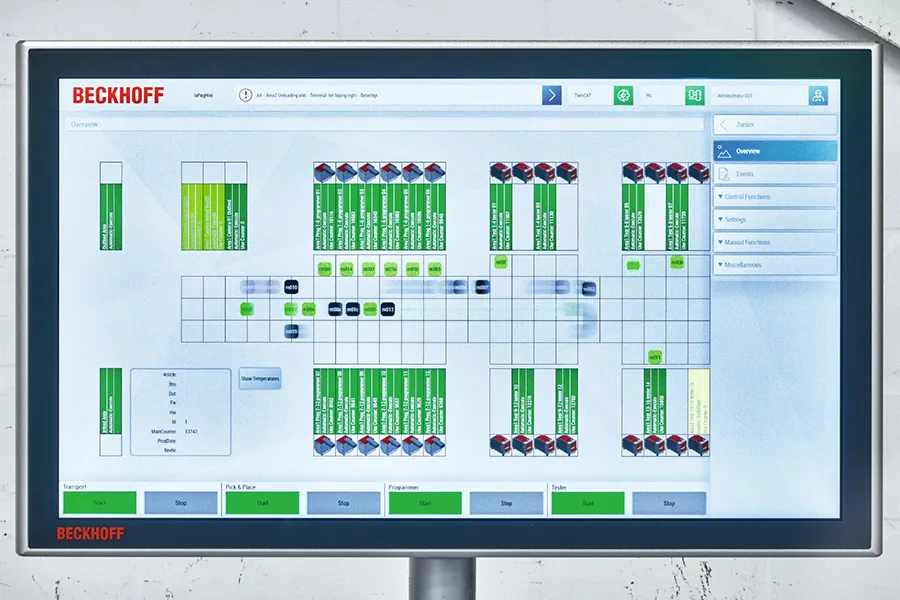
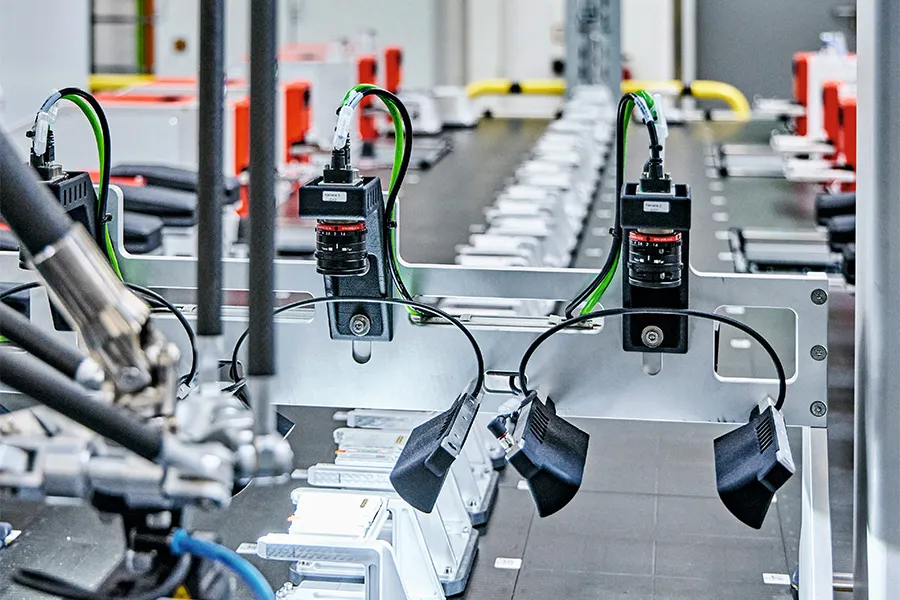
The system is an excellent example of how PC-based control can be used to perform a wide range of tasks and functions. Alongside a C6670 industrial server with control cabinet, which coordinates the 33 movers on the 100 tiles, a total of ten C6032 ultra-compact industrial PCs control the other system components. The delta robots are automated using the AX8000 multi-axis servo system and AM8000 servo motors. All safety technology is implemented with TwinSAFE. TwinCAT Vision reads the DataMatrix codes. Around 40 ELM Series EtherCAT measurement terminals are installed in each of the four test units. In addition, a large number of EL Series EtherCAT terminals are used. Michael Golz says: “PC-based control made many things easier in this project and gives us the opportunity to expand further.” ■
The test system benefits from four XPlanar features
- 2D product movement individualises terminal transport and facilitates parallel processing at the programming and test stations.
- Precise XY positioning means no handling is required from the system at the programming stations.
- Moving the bus terminal using Z movement (raising/lowering) replaces complex mechanics at the test stations.
- 360° rotation enables the system to be arranged symmetrically.
Een zakelijke vraag aan Beckhoff Automation? Get in touch
Companies in this story

Keep following this
Get an email when a new story is published. No account needed.
- SubjectSoftware, IT, OT & cybersecurity
- CompanyBeckhoff Automation







