












Software, IT, OT & cybersecurity
Siemens, Quinaptis and Thomas More University of Applied Sciences Geel achieve breakthrough in warehouse automation
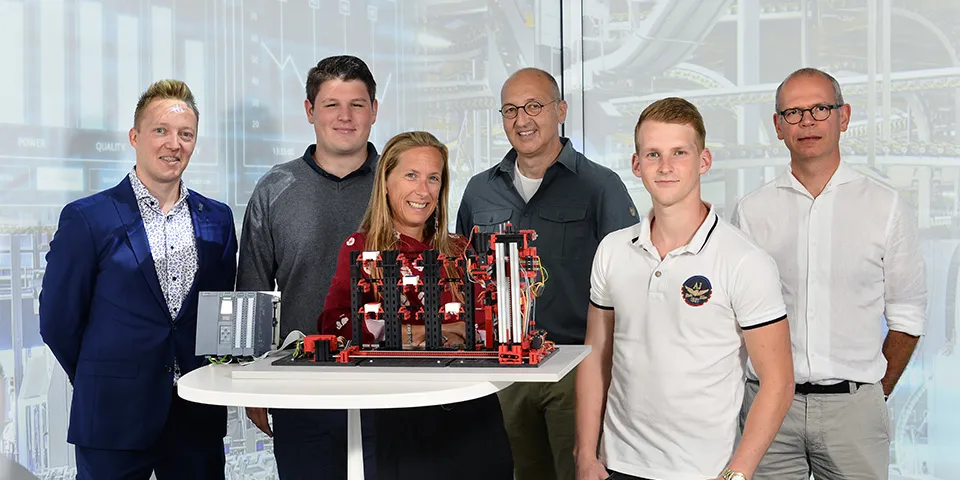
In a warehouse, automated cranes are controlled by dedicated software, while stock is managed and goods flows are planned using other software. Linking the two can deliver a major efficiency gain, but bringing the systems together is a particularly difficult challenge. After all, you cannot simply experiment in a real warehouse. Quinaptis, Siemens and Thomas More University of Applied Sciences in Geel found a groundbreaking solution by testing the communication in both a miniature warehouse and a virtual environment.
The logistics world, which manages warehouses and stock using software such as SAP EWM, and the automation world, which controls cranes using programmable logic controllers (PLCs), operate separately. As an SAP specialist, Quinaptis has been working for some time to improve the operation of automated warehouses by planning certain tasks and having cranes perform predefined movements. “We have long been working on a solution to link stock management and process automation by getting the two software systems to ‘talk’ to each other. But as an SAP specialist, we have limited in-house knowledge of automation. We therefore approached Siemens, the market leader in PLCs, to bring these two worlds together,” says Dieter Baert, Logistics Consultant SAP at Quinaptis.
Together with An Lietaert, automation specialist at Siemens België, they explored various ways of linking SAP EWM and the PLC. “I suggested using Virtual Commissioning,” she says. Virtual Commissioning involves virtually testing a machine, installation or, in this case, an automated warehouse before it is handed over. A ‘digital twin’ of the installation is created to identify and ‘debug’ any faults before commissioning. “A digital twin like this can be created using Siemens NX MCD software,” she explains.
Students join a fully-fledged project team
Quinaptis and Siemens set out to develop both a real and a virtual version of a warehouse, in which SAP EWM and PLCs could communicate and work together. It was no simple task. The two partners turned to Frank Peeters, lecturer in process automation at Thomas More University of Applied Sciences in Geel, where working with PLCs has been an important part of the professional bachelor’s programme in electromechanics for many years.
He sought two students willing to take on this dual challenge for their bachelor’s project. “It was no small undertaking, as the students had no experience with NX-MCD software and even less with SAP software. Gillian Stevens and Stef Dierickx rose to the challenge,” says Frank Peeters.
In February, a fully-fledged project team was formed, comprising two experts from Quinaptis, two from Siemens and the two students. They decided to tackle the problem in both hardware and software. But because testing in a real warehouse, the hardware, would be difficult, the students used an automated miniature warehouse from Fischer Technik, controlled by a PLC. “At the same time, we also created a digital version of it, the ‘digital twin’,” explains Stef Dierickx.
“First, we used the miniature warehouse to further develop and refine communication between the SAP software and the PLC computer. We also recreated the warehouse virtually. This made it possible to identify and resolve faults much faster,” adds Gillian Stevens.
Proof of concept demonstrates its potential
The approach proved highly successful, resulting in a workable proof of concept. “Using the NX-MCD simulation tool, we were able not only to verify that communication between SAP EWM and the PLC works, but also to show that the concept is scalable and can be applied in a real warehouse with real cranes,” says Stef Dierickx. According to Dieter Baert, the same concept can now be used for communication between SAP EWM and PLCs to control other warehouse equipment, such as Automated Guided Vehicles (AGVs) and even robots.
“Taking a software-based approach to a project often makes the work faster and more effective. The project also showed that exchanging knowledge between parties from different worlds creates a productive cross-fertilisation: here, the whole was clearly greater than the sum of its parts,” says An Lietaert.
“This kind of collaboration is certainly worth repeating,” adds Frank Peeters.
Gillian Stevens and Stef Dierickx’s outstanding bachelor’s project earned them a mark of 17/20.
Question about this story? Ask your question
Keep following this
Get an email when a new story is published. No account needed.
- ThemeSmart manufacturing and logistics
- SubjectSoftware, IT, OT & cybersecurity







