












Software, IT, OT & cybersecurity
Reducing machine start-up and operating costs
Text and images Festo
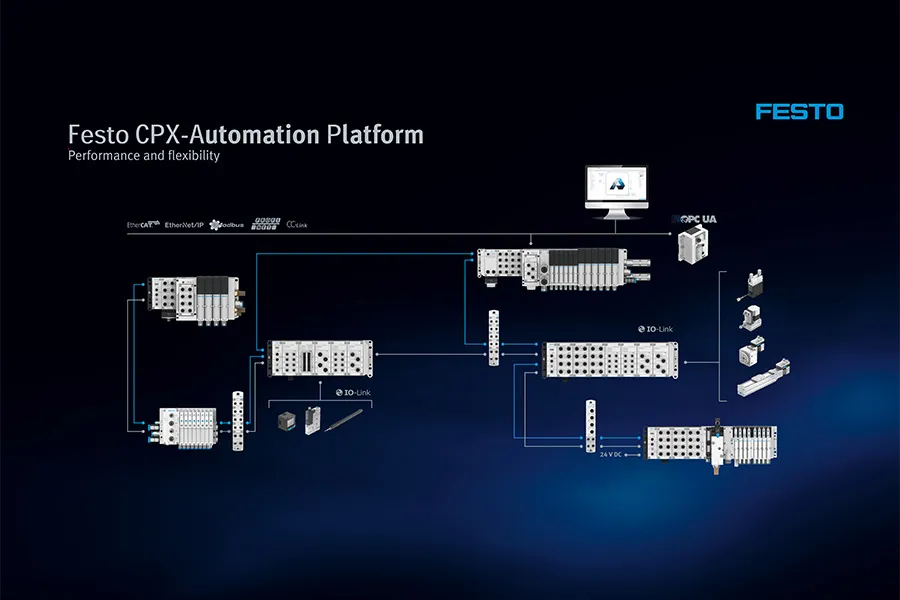
Automation depends heavily on machine control architecture and field-level software. These determine machine design and build times, and therefore have a major impact on overall costs, says Thierry Van den Bosch. Festo has developed a new control system, Festo Automation Platform [AP], to meet machine builders’ needs for performance, flexibility and cost efficiency.
Since the 1990s, the widespread use of digital communication networks in industrial automation has continued to grow. Replacing fixed wiring and serial RS232 communication between the machine controller, the Programmable Logic Controller (PLC) and individual devices has reduced wiring time, accelerated commissioning and greatly increased the flexibility of machines equipped with fieldbus. Previously, every sensor, valve or actuator required a physical connection to the PLC. Fieldbus enabled digital communication between the ‘Master’ and the ‘Slaves’ over a single shared cable. Several fieldbus protocols emerged as leading PLC manufacturers developed the best solutions for their target markets. They had different priorities, making it clear, despite attempts to define common standards, that there was no ‘one size fits all’ solution. Instead, the industrial automation market had room for multiple protocols. Although the capabilities of Ethernet-based bus systems have all expanded over time, their origins differ subtly.
Switching PLC manufacturers can be costly
For a machine builder, it is not easy to switch between bus systems or combine them within a single control system. As a result, special-purpose machine and line builders often have to redesign their control systems to meet end users’ changing specifications, adding time and cost to their operations. Larger end customers specify their PLC manufacturer and Ethernet bus system. Siemens with Profinet is typically specified in European markets, while Allen Bradley/Rockwell with Ethernet IP is most common in the US market.
End-user specifications are often determined by the location of the parent company, which defines its global machine standards. The choice of PLC and bus architecture is also often a matter of familiarity: the knowledge and experience of on-site personnel in understanding and supporting software from their existing control system manufacturer.
Continuous innovation
Festo developed the pneumatic valve terminals we see everywhere today. Festo was the first to combine electrical inputs and solenoid valves on a single assembly. This evolved into the pioneering CPX system, which combined fieldbus nodes with modular, freely selectable digital I/Os, solenoid valves and specialised modules such as analogue control, pressure and temperature inputs, and proportional pressure control. The new AP system is compatible with the ‘classic’ system, but represents a revolution in terms of its capabilities.
Festo AP meets the key needs of both series and special-purpose machine builders. The system allows machine builders to switch the PLC they use to meet their customers’ specifications, while keeping up to 90% of remote I/O [RIO] field and control cabinet components common. This makes it easier and cheaper to support a range of machines, and creates an ideal platform for a machine range based on common technology and components.
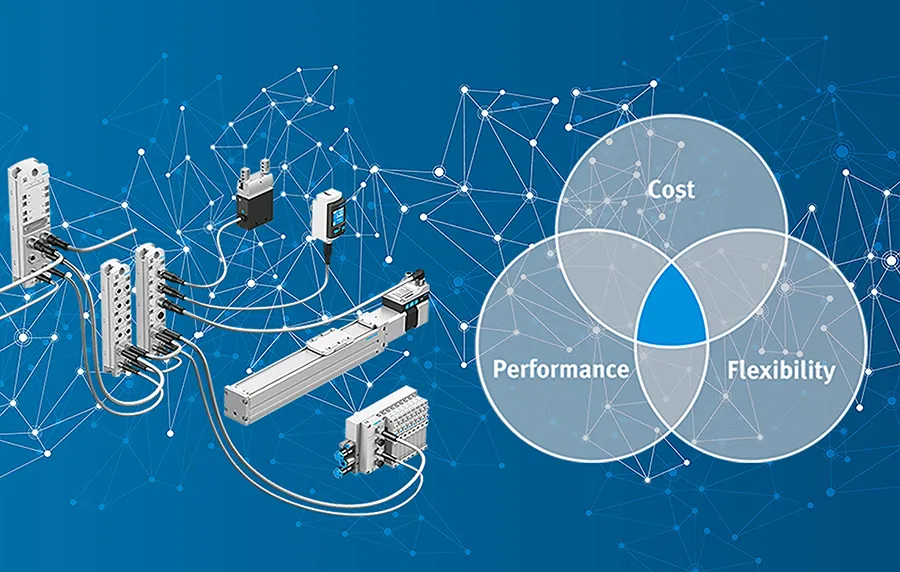
Ready for the digital factories of tomorrow
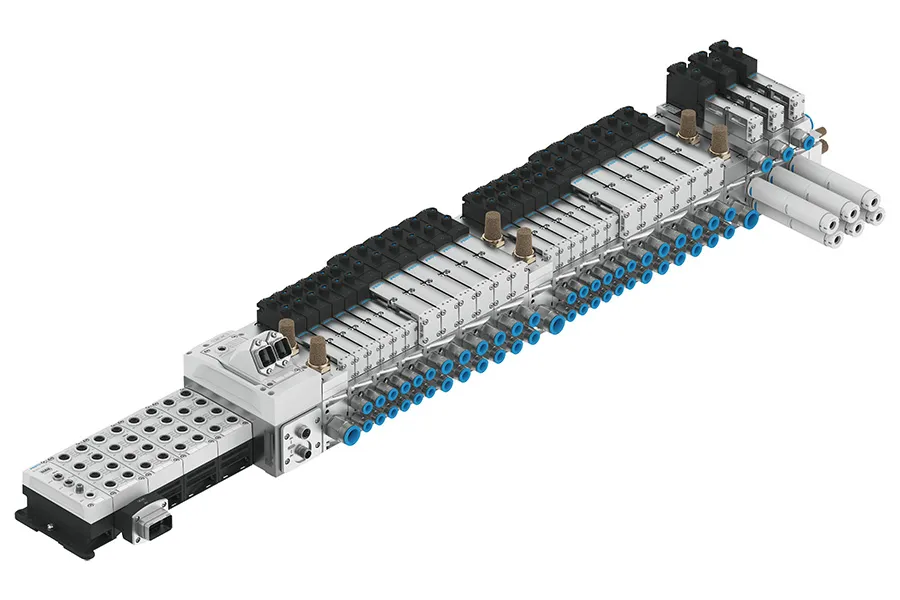
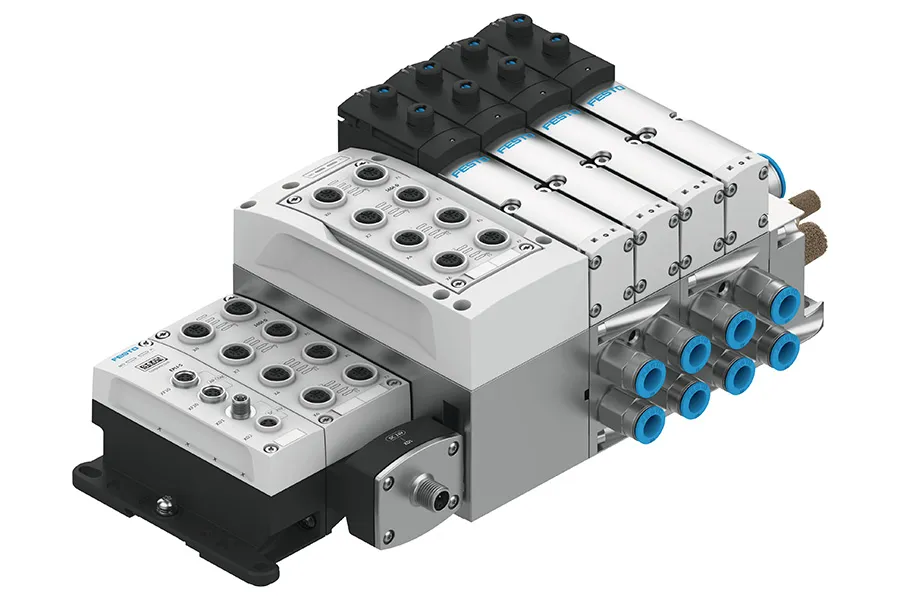
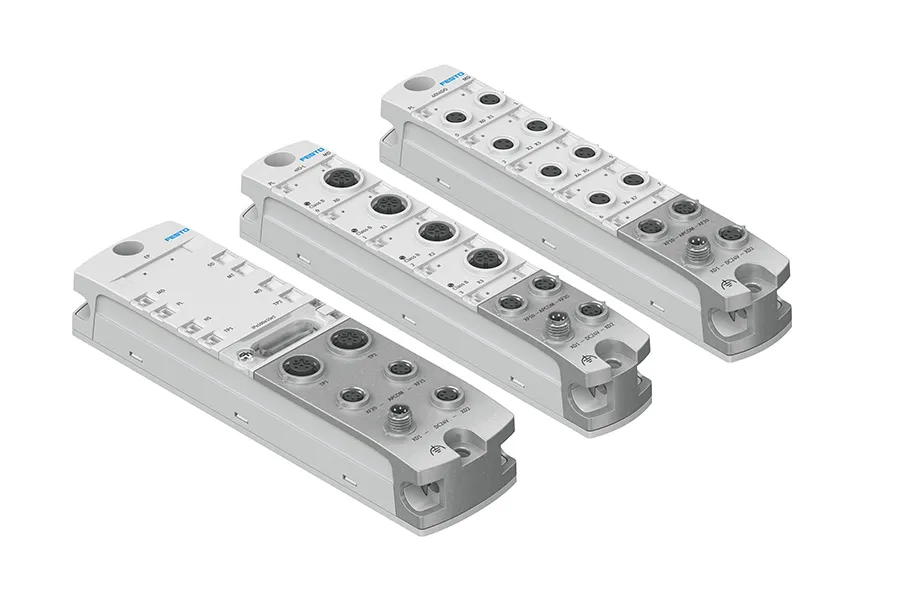
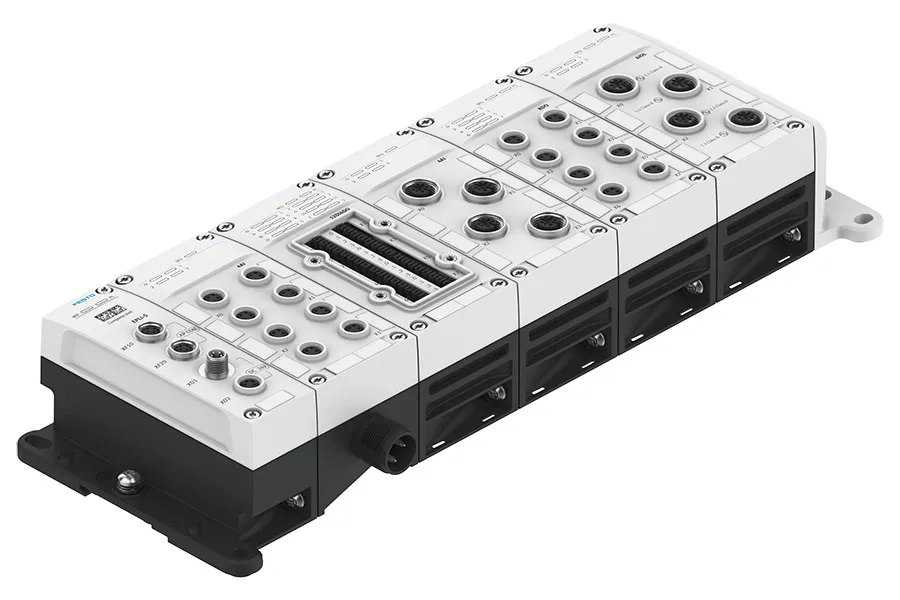
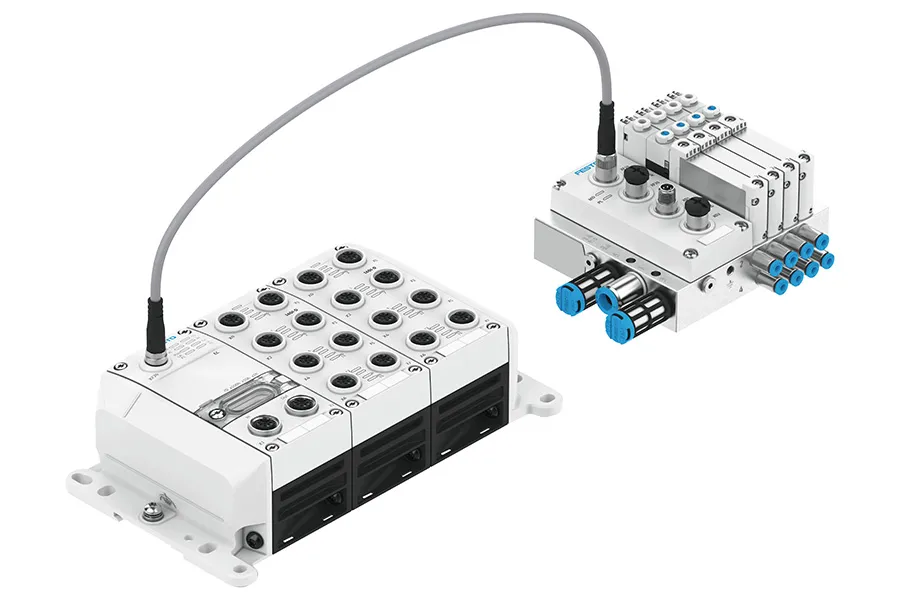
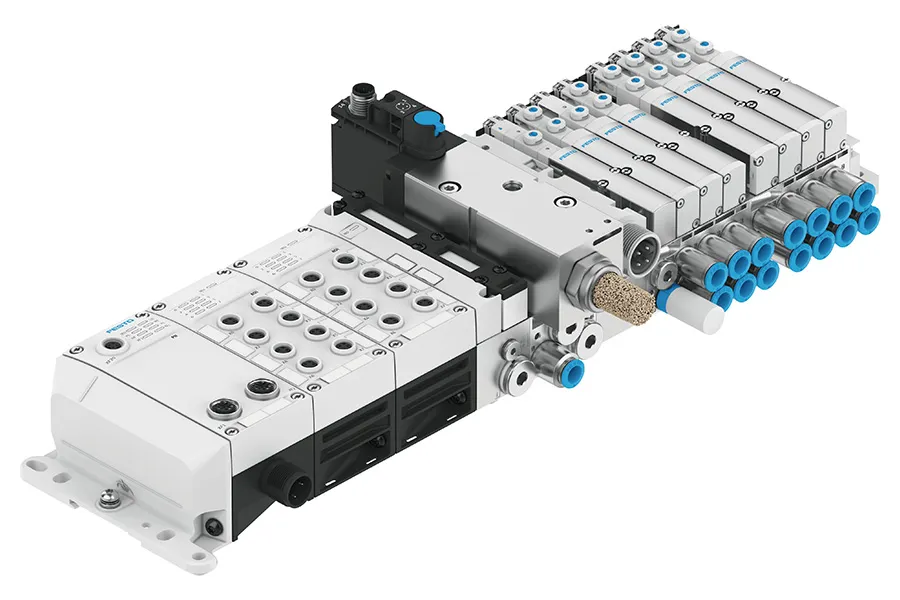
The AP system takes a hybrid approach, delivering interconnected modular and decentralised I/O on a scalable, flexible and high-performance communications backplane. The designers were tasked with addressing three key factors: performance, flexibility and cost. They created a modular system of robust digital RIO components that can be installed in the field or in a cabinet, either on their own or in combination with leading pneumatic valve solutions. The system uses a single fieldbus input module, which is then networked with a wide range of inputs, outputs and valve terminals.
The AP system and its components can be arranged flexibly, with no restrictions on topology or space, to suit the machine design. This costs less than using multiple proprietary fieldbus nodes, while remaining easy to address and fully visible within the PLC controls. Modules are connected using pre-formed plug-in cables, saving time and cost once again.
IO-Link is integrated into the system, allowing users to make full use of component parameterisation and data collection capabilities. Advanced diagnostics are available at module level, over the fieldbus and via the integrated web server for live diagnostics.
Why Festo AP?
Centralised and decentralised control architectures each offer clear advantages. Festo Automation Platform is a solution that brings together the best of both worlds. It is a scalable, modular and therefore flexible decentralised solution, while retaining the simplicity of a centralised solution from a control and software perspective. It achieves this by ensuring that all data describing these configurable components can be easily scanned and uploaded to the PLC in its original format, for example GSDML files for Siemens and L5X for Rockwell environments. The same applies to all leading host protocols. The files contain complete, specific descriptions of the Festo components, making them quick and easy to address and read. ■
Key points
• Performance: up to 80 components with 50 m between modules, Real Time Connectivity (data rate of 200 MBaud, cycle time down to 250 µs), control and data processing, host systems include Profinet, EtherCAT, Ethernet IP, Modbus TCP, TSN, with CC-Link IE Field Basic in preparation.
• Flexibility: flexible decentralised/centralised modular remote I/O, application-specific pneumatic valve terminals, Cloud and Edge compatible with MQTT and OPC-UA.
• Cost: reduced component complexity and costs. Standardises control cabinet design, while the smaller footprint reduces cabinet costs and the space required in compact machine designs.
A business enquiry for Festo? Get in touch
Companies in this story

Keep following this
Get an email when a new story is published. No account needed.
- ThemeFrom design to flexible machine
- SubjectSoftware, IT, OT & cybersecurity
- CompanyFesto







