












Software, IT, OT & cybersecurity
Powerhouse with a long stroke for collaborative applications
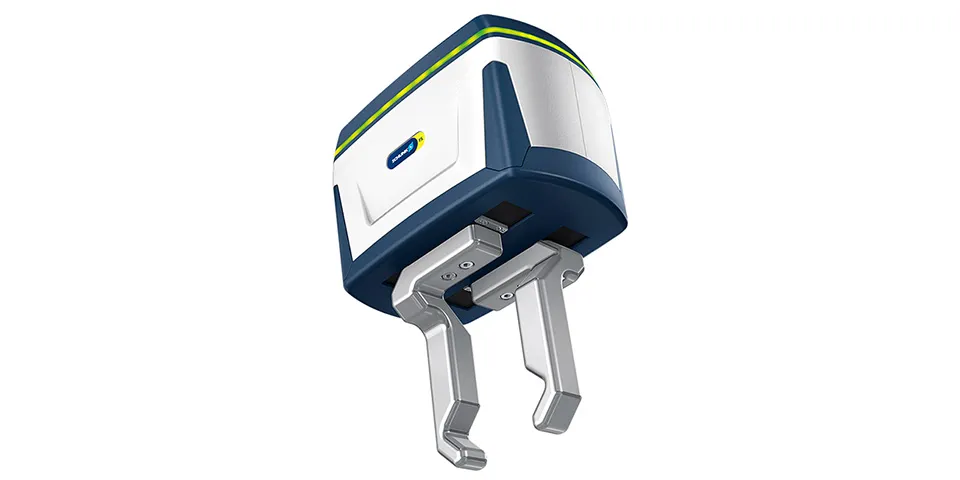
A milestone that paves the way for close collaboration between humans and robots. The SCHUNK Co-act EGL-C is the world’s first long-stroke gripper for collaborative applications. It delivers high gripping forces of up to 450 N combined with a long stroke of 42.5 mm per finger. This smart 24 V powerhouse is suitable for handling workpieces weighing up to 2.25 kg and can be used in a wide range of applications. As an additional benefit, the components will be DGUV-certified for HRC applications, just in time for their market launch at the end of 2019.
While the gripping force of SCHUNK’s DGUV-certified grippers has so far been limited to 140 N, the company is now offering a completely innovative range of components with the Co-act EGL-C. For the first time, SCHUNK will further expand the potential of human-robot collaboration to handle heavier loads than those involved in the assembly of small parts. With this, the market leader in gripping systems and clamping technology is primarily targeting automotive suppliers and manufacturers, which are working intensively on relevant HRC scenarios. The specialists in the SCHUNK Co-act team are also focusing on other industrial applications, such as machine building, where the powerful gripper can make HRC applications more efficient and faster. Until recently, this was not possible because no reliable drive systems were available for loads of up to 2.25 kg.
Combined force and displacement measurement
To comply with the biomechanical limit values set out in ISO/TS 15066 despite its high gripping force, the SCHUNK Co-act EGL-C gripper is equipped with combined force and displacement measurement. Force-measuring jaws and incremental encoders are integrated into the base jaws, continuously monitoring the respective gripping force and the position of the gripper fingers. The gripping procedure stored on the rotating gripper is divided into several phases. The gripping force is limited to 30 N at a theoretical distance of 4 mm from the taught-in workpiece, which is much less than the thickness of a finger. If a collision occurs during this approach phase, for example through contact with the operator’s hand, the gripper immediately adopts a safe grip without risk of injury. Only in the second phase, when the distance to the workpiece is less than 4 mm, do the fingers close with a user-adjustable force of up to 450 N. If the system detects flexibility during this closing phase, for example because a gripped workpiece is too small and the operator wants to remove it manually, this movement also stops automatically. The same applies if the expected workpiece dimensions are exceeded by 2 mm, for example because a part is missing. In the third phase, the gripper detects whether the part has been securely gripped and then activates the integrated gripping force retention by engaging the brake. This means that the gripped part can never fall, even in the event of an emergency stop. In addition, no referencing is required in the event of a power failure.
The SCHUNK Co-act EGL-C, the world’s first long-stroke gripper for collaborative applications. Suitable for handling workpieces weighing up to 2.25 kg
Plug & Work
The powerful long-stroke gripper from the SCHUNK Co-act series is supplied fully pre-assembled and is available with the corresponding interfaces for HRC robots, including those from KUKA, YASKAWA, FANUC, Universal Robots and NACHI. This means it can be commissioned quickly and easily using Plug & Work. A start-up wizard assists with the programming process. In addition, a diagnostic interface provides access to the gripper’s key process and status data while it is operating. To ensure smooth and intuitive collaboration with the user, the gripper features traffic-light-coloured LEDs that indicate the module’s status. The smart SCHUNK Co-act EGL-C can optionally be controlled via PROFINET, EtherCAT, EtherNet/IP, Modbus/TCP or TCP/IP. To save space, the complete control and regulation electronics are installed in the housing, enabling decentralised use. Thanks to its 24 V DC operating voltage, this gripper can also be used in mobile applications. Stable guides and a brushless servomotor provide a high degree of robustness and long-lasting, reliable operation with minimal maintenance costs. The gripper will be available from the end of 2019.
Question about this story? Ask your question
Keep following this
Get an email when a new story is published. No account needed.
- ThemeRobots on the shop floor
- SubjectSoftware, IT, OT & cybersecurity







