












Software, IT, OT & cybersecurity
New logistics system creates an efficient flow across multiple floors
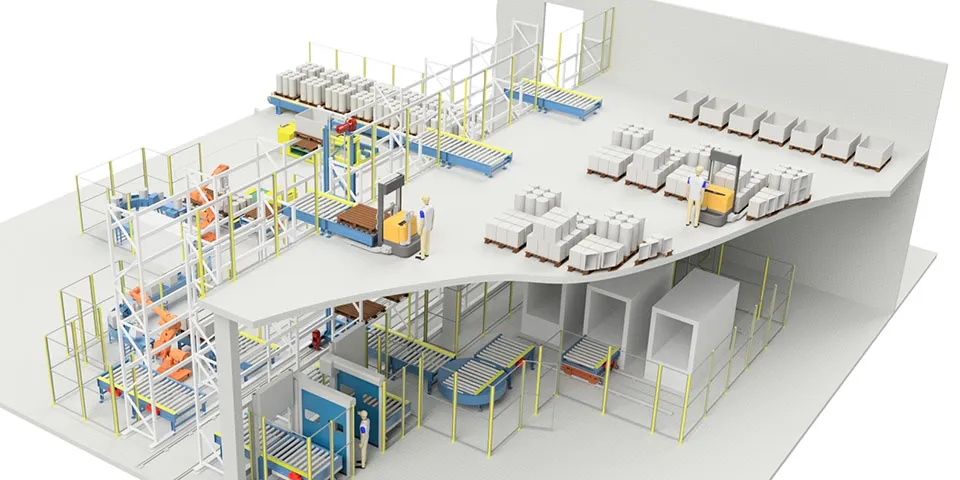
Space is scarce in production. But have you considered making full use of the cubic metres beneath the roof of your factory? They could provide the space for an extra floor, provided you can set up an efficient logistics flow. That is the principle behind RDL Engineering’s Backbone. It enables companies to link their logistics processes seamlessly across multiple floors. With this concept, RDL Engineering brings together its experience in horizontal and vertical movement to keep your production running more smoothly than ever.
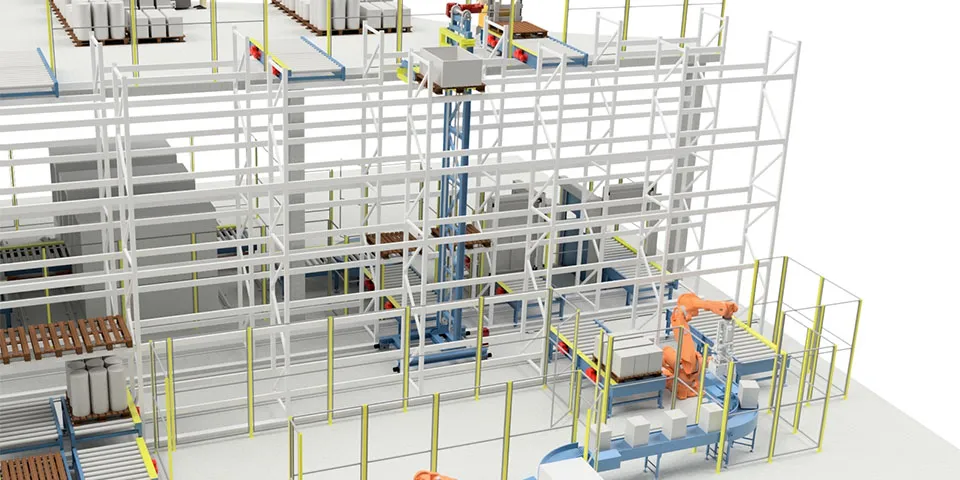
As its name suggests, the Backbone can become the backbone of your production, with every step required to make your product connecting seamlessly to it.
As a company grows, the production floor becomes increasingly crowded with machines, stock and staff. Businesses looking to expand or optimise further will need to find every last square centimetre of floor space. That is why more and more entrepreneurs are looking upwards. The cubic metres beneath the ceiling often remain unused. “For businesses, an extra floor or mezzanine can be an excellent solution for order picking or preparing the pre-production of semi-finished goods …”, says managing director Dominiek De Leersnijder. He leads the Izegem-based company together with his brothers Vincent and Xavier. But how can they organise their logistics processes as efficiently as possible across several floors? That is the question RDL Engineering set out to answer, because large, fully automated warehouses are not always suited to SMEs. The answer: the Backbone!
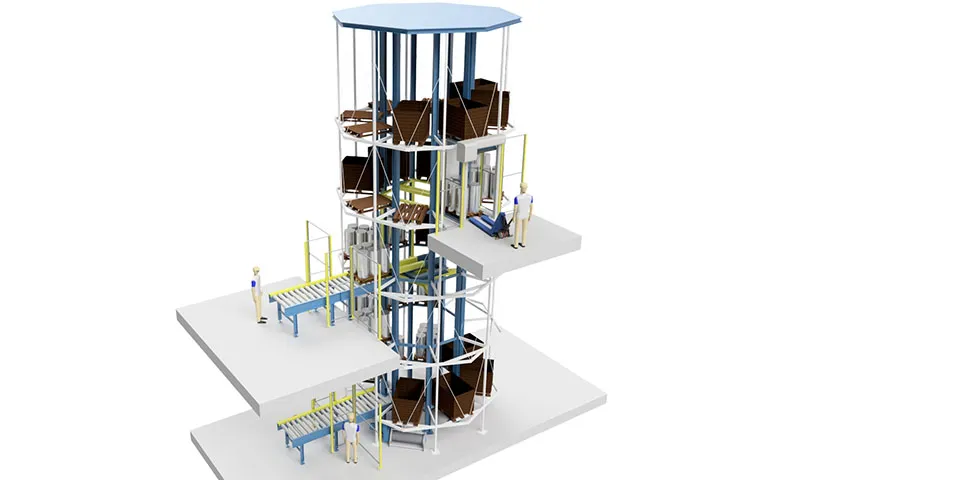
The 3D-Backbone excels at making efficient use of space. For around 40 pallets, it performs 50 to 60% better than a manual solution.
Three versions of the Backbone
With the Backbone, RDL Engineering has developed a logistics concept that brings together its expertise in handling, roller conveyors (horizontal movement) and lift systems (vertical movement). De Leersnijder: “We clearly felt this need in the market, so we started thinking about how we could help our customers save space while also creating buffers to absorb production imbalances. This resulted in three versions, each of which we can adapt to the customer’s specific situation.” The 1D-Backbone is the simplest version, consisting of a lift system seamlessly connected to roller conveyors. RDL Engineering already has hundreds of installations to its credit. The system can be expanded modularly to create the 2D-BackBone. The lift is then made mobile, allowing it to serve multiple cells. Feeding in raw materials, collecting finished orders and buffering semi-finished goods can all be handled by a single system. Finally, in the 3D-Backbone, the lift rotates within a shaft system. This version excels at making efficient use of space. For around 40 pallets, it performs 50 to 60% better than a manual solution.
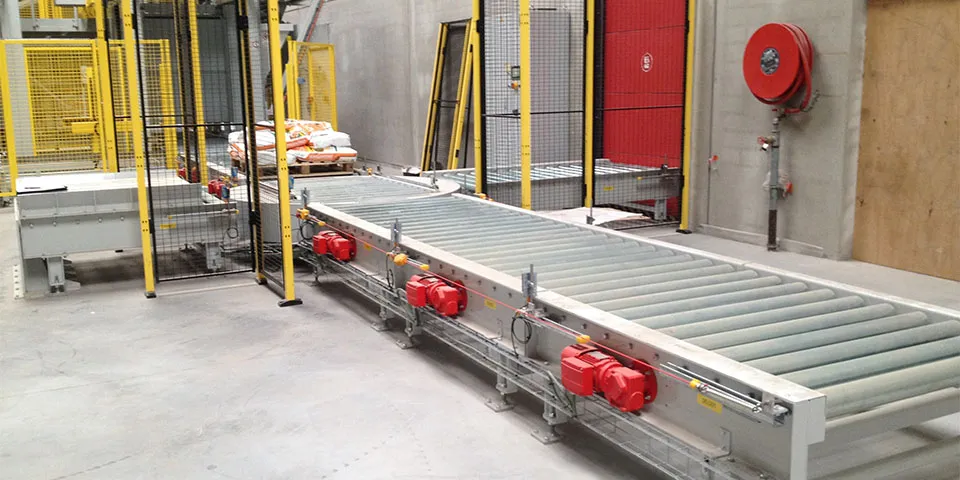
RDL Engineering has more than thirty years’ experience in automating internal transport systems and lifts. It can also seamlessly integrate everything around the Backbone.
Every pallet accessible
For RDL Engineering, the priority was to ensure that every individual pallet remained fully accessible, in addition to saving space. De Leersnijder: “As its name suggests, the Backbone can become the backbone of your production, with every step required to make your product connecting seamlessly to it. Because every pallet or box is accessible, and customers have plenty of options in this regard, all materials (raw materials, semi-finished goods, finished products, picked orders …) can be stored in one and the same warehouse, ensuring an efficient flow throughout your entire production process. The system can also grow with your success. All that is needed is to add extra inlets and outlets.” The Backbone’s strength as a new logistics solution also lies in the knowledge and expertise of its creator. RDL Engineering has more than thirty years’ experience and expertise in automating internal transport systems and lifts. It can also seamlessly integrate everything around the Backbone, such as software for keeping track of stock or lift systems, or a robot to automate part of your logistics.
Conclusion
“The Backbone is designed to take the logistics burden off customers’ shoulders, so their production runs more smoothly than ever. It is a solution for anyone looking to work across multiple levels. And this certainly doesn’t have to involve a spectacular logistics operation. The costs and space the Backbone helps save, along with the gains in time and efficiency, make it an attractive option for any SME,” concludes De Leersnijder.
Question about this story? Ask your question
Companies in this story
Keep following this
Get an email when a new story is published. No account needed.
- SubjectSoftware, IT, OT & cybersecurity
- CompanyRDL ENGINEERING







