












Software, IT, OT & cybersecurity
How much artificial intelligence is already built into machines?
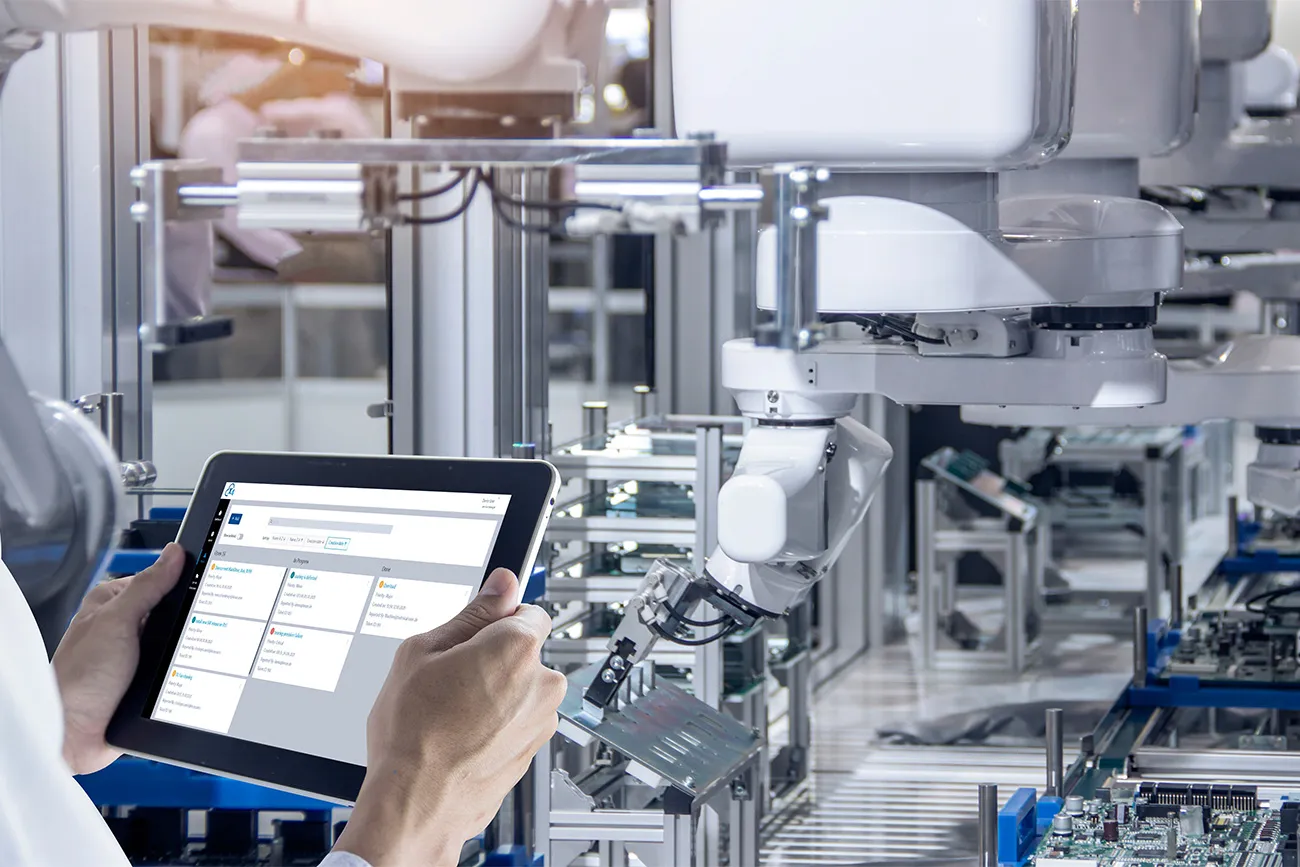
Since ChatGPT, artificial intelligence has become impossible to ignore in the media. But what does it actually look like in industry? And to what extent is it already being used to make machines more intelligent? We spoke to Dr Johannes Kühn, Head of Control Engineering, Motion Control and Robotics at Lenze, about where things stand today.
“Artificial intelligence has not yet been integrated into production itself, into the heart of machines,” Kühn says, tempering expectations from the outset. With the exception of image recognition, which almost always uses artificial intelligence, machines are built and controlled on the basis of physical models. “That should come as no surprise. Reliability and continuity are the key words here, and there is little room for risky experiments. Machine learning, the most widely used form of AI in industry, is actually one of the weaker methods. It is based on mathematics that has been around since the 1970s. It involves statistical procedures: classifying data and making decisions based on historical data. The reason this method is now being used more and more is that there is enough computing power to make predictions of this kind. The method has its limitations, because you cannot train a model well enough to handle entirely new situations. It only knows what it has learnt. A mechanical engineer cannot afford that. And this is where, for example, self-driving cars also reach their limits.”
In processes around production
This does not mean, however, that artificial intelligence has yet to make its way into industry. Quite the opposite.
“Today, its applications are found in all the processes and services surrounding production,” Kühn explains. “And if you take a broader view, for example in marketing or merchandise management, it is even commonplace. So it has considerable potential. If we can predict exactly how many products we will need, we can use resources more efficiently. In that sense, artificial intelligence will play a crucial role in our journey towards carbon-neutral production. But not by developing a smarter, more energy-efficient drive system. It is still too early for that.”
Lenze itself uses artificial intelligence in its condition monitoring and predictive maintenance tools. “These are areas where artificial intelligence is taking off. Components generally behave in the same way throughout their service life and are exposed to the same loads and wear. So there is a lot we can learn from their behaviour to prevent unexpected downtime and optimise maintenance performance.”

Better to have smart data than lots of data
And although data is at the heart of artificial intelligence, Kühn says the engineer still has a particularly important role to play.
“It all starts with collecting data. If you have enough data, you can get to work and draw the right conclusions. But with intelligent data, you can make even better decisions. It is the engineer’s job to find the right needles in the haystack of data. If you think purely in statistical terms, you could find a correlation today between the number of Arctic foxes in Antarctica and the number of unemployed people in Germany. But the unemployment rate would not also fall just because the Arctic fox population was declining. That is meaningless data. The smarter we can make our data, the less powerful our artificial intelligence algorithms need to be.”
Know-how makes the difference
This is another way in which Lenze stands out. “We use our motor as a sensor to capture data for our customers. But there are almost unlimited ways to capture and process torque in the inverter. If you had to get artificial intelligence to listen to all those signals, it would require too much computing power and cost too much. So you need to extract only the data that tells you something about the condition of the motor. And that starts with knowledge of the hardware and the applications. That is why Lenze is better,” Kühn adds with a broad smile. “This knowledge allows us to lay the foundations for things like effective condition monitoring.”
But, of course, data remains the starting point. Lenze brings it together in its Drives Datahub software, which provides direct access to ready-to-use drive data via a range of communication interfaces. From there, users can monitor their own machines in dashboards or in Nupano. “So machine builders already have an interesting new tool at their disposal in artificial intelligence. But it will still be a while before it really reaches the heart of the machine. And we should not forget that not every problem can be solved with a screwdriver,” Kühn concludes.
Een zakelijke vraag aan Lenze BV? Get in touch
Companies in this story

Keep following this
Get an email when a new story is published. No account needed.
- ThemeData from shop floor to decision
- SubjectSoftware, IT, OT & cybersecurity
- CompanyLenze BV







