












Software, IT, OT & cybersecurity
Helping machine builders innovate
Text Valérie CouplezImage Siemens
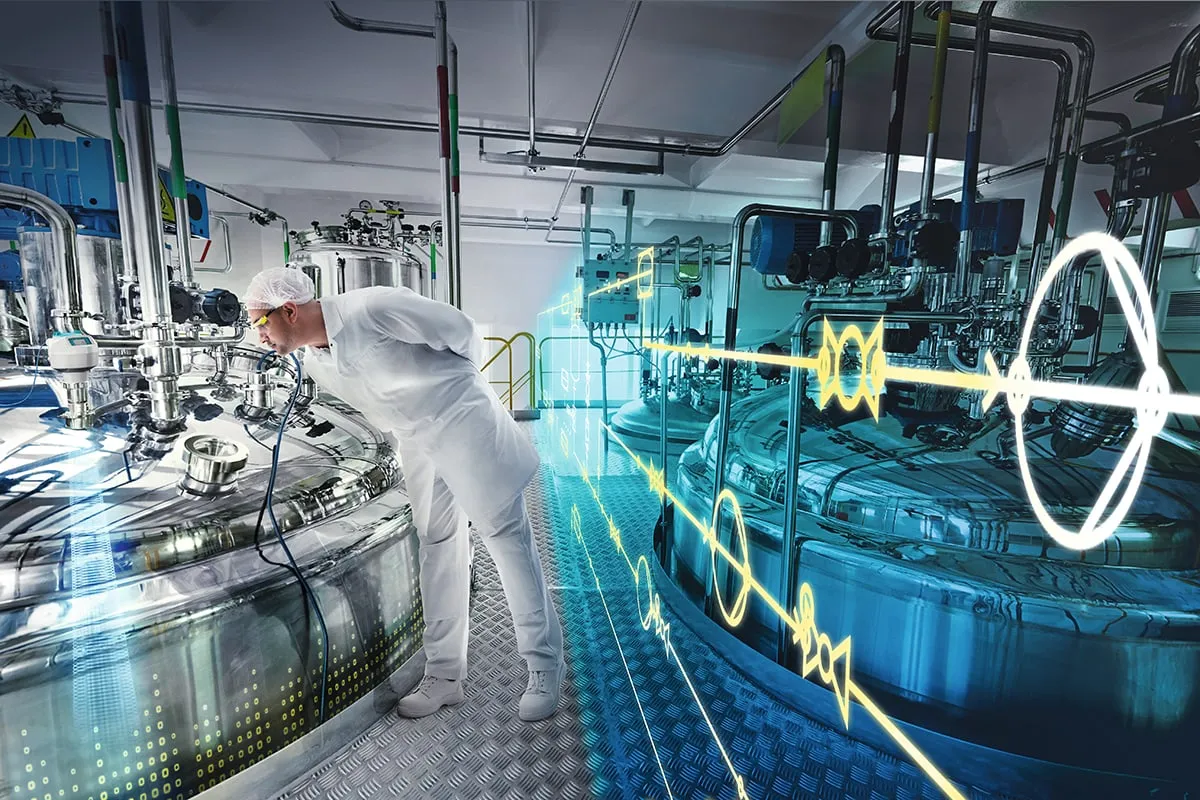
To strengthen their competitive position, machine builders need to innovate more than ever. Where they once relied on expertise within their own organisation, increasingly complex technology now calls for collaboration within ecosystems. The breadth of the technology portfolio, combined with experts who know both the products and their applications inside out, makes Siemens a key player in this ecosystem. We spoke to Nick Vanden Broecke, head of sales OEM and business segment manager Machine Tools, and Thierry Van Eeckhout, head of Siemens Digital Industries Belgium-Luxembourg, about how bringing the real and virtual worlds together can accelerate innovation.
The shortage of technically skilled staff is forcing the entire Western European manufacturing industry to automate, whether you make biscuits or build machines. “At the same time, we are seeing automation become much more complex. It is no longer enough to deliver the highest output at the fastest speed. You also have to switch flexibly between batches, deal with cyber threats, make efforts to become more sustainable, comply with new machine safety regulations and add software to monitor the machine throughout its service life … That requires specialist knowledge. It is virtually impossible to have all that knowledge in-house. That is why we are seeing more and more ecosystems emerge in the machine-building market,” says Vanden Broecke.
A partner throughout the machine lifecycle
Their own IP naturally remains at the heart of the machine. “Machine builders remain firmly in control of that. But that does not mean they cannot get support to take the next steps. Belgium is fortunate to have a strong network of knowledge centres and research institutions. Their fundamental research can help validate innovations in IP more quickly. Ultimately, you want to bring a new machine to market as quickly as possible,” adds Van Eeckhout. Academia can also play a role here. “Our task is to work with the customer to engineer everything around it as competitively as possible. In the past, the customer would give us a bill of materials. Today, we work with them to determine how best to do that, how to build the best machine and how to integrate it into a larger system, including connectivity and cybersecurity. That is our ambition for the future: to be part of the machine builder’s entire process.”
Sorting and pricing 1,500 books an hour
Looking up, cataloguing, pricing and labelling books can quickly take up a whole day for a second-hand bookshop. Valvan’s Automated Book Processing machine (ABP) automates the entire process. The biggest challenge was centralising all the different data streams within the ABP machine and controlling its various components. A Siemens ET 200SP Open Controller is at the heart of the installation: it receives book data (price, genre, location label, sorting position) from the vision computer and forwards it to the printer and robot. The ET 200SP Open Controller also tracks each book throughout the installation, ensuring it is sorted into the correct position. A third challenge was the SCARA robot. Thanks to the 3D camera, which continuously scans the height and corners of objects on the conveyor, the robot adjusts to the book’s position and applies the label in the right place, in three dimensions. AI makes the machine even faster. The distance between books on the conveyor can vary. An intelligent infeed model running on a digital twin of the machine gets smarter over time, allowing the conveyor to run faster between successive books. This model also runs on the ET 200SP Open Controller. “Choosing Siemens was an obvious choice for us, as we work together on all our machines. The capabilities are unrivalled and their products are available for a long time,” says Ruben Forceville, automation engineer at Valvan.
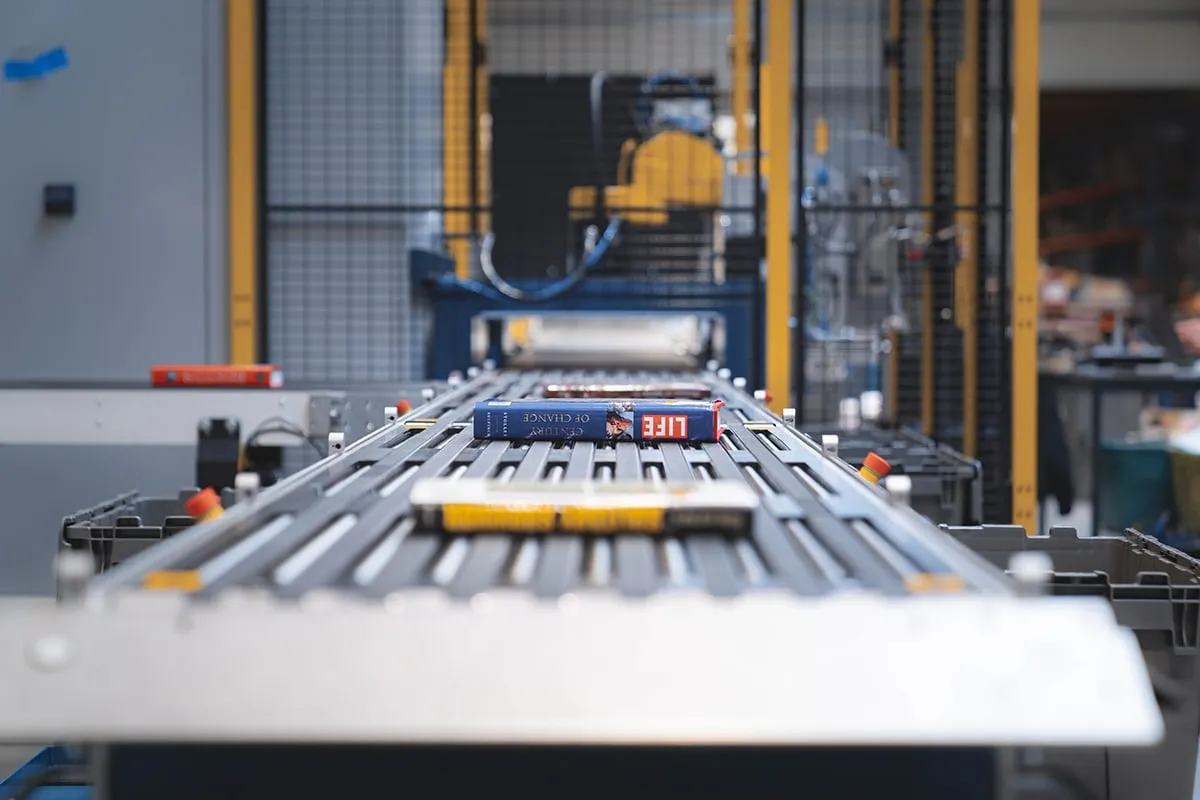
Looking up, cataloguing, pricing and labelling second-hand books. Valvan’s Automated Book Processing machine (ABP) automates the entire process.
Experts with broad and deep expertise
This does, however, require a very different approach. According to Vanden Broecke, Siemens’ broadest portfolio of hardware, software and services on the market is invaluable in this respect. “You still need specialists who know the technology inside out, and are familiar with all the little tips & tricks that make it work perfectly in an application. We have those. But you also need a team that gets to know the world their customers operate in, and understands how their machines ultimately need to work. Otherwise, you will never achieve seamless integration. We have that too.” Lifelong learning is therefore a guiding principle for Siemens employees. Through its Siemens Industry Academy, the company has also been inspiring the next generations of engineers for more than six years. “We get them working with our partners on innovative projects, so that they choose a career in industry.”
Bringing the virtual and real worlds together
Many of these innovative projects now use digital twins. “You can make enormous gains by bringing the real and virtual worlds together on a single platform,” explains Van Eeckhout. “A lot rides on innovation projects for machine builders. If they fail, it could, in extreme cases, lead to bankruptcy, because so much budget has already been invested. But with the technology available today, machine builders can simulate and virtually validate new developments first, without having to build dozens of machine prototypes. This is more sustainable, because there is no waste; it also means you can innovate much faster, with fewer risks. And afterwards, you can use it to monitor the machine throughout its entire service life, for OEE, predictive maintenance … you name it.”
Sustainable packaging, made to measure
A made-to-measure box for every e-commerce product: machine builder Avercon’s X7 is revolutionising packaging. Siemens technology was an essential part of the solution. In traditional industry, boxes are made to fit a particular product. In e-commerce, batch sizes are reduced to one: every product has different dimensions. What is more, each product needs a unique label. Avercon designed an adjustable machine that automatically switches from product A to product B, even when they have different dimensions. Digital twin technology was essential for understanding a complex process and verifying that the components designed by Avercon would actually do what they were supposed to. “A machine like this has at least 50 servo motors: every movement has to be timed precisely for the next one. Using a digital twin made it easy to visualise the entire process,” says David Provoost, sales & marketing manager at Avercon. The machine can now prepare, package, label and dispatch an individual parcel in 3.5 seconds. This makes it 30% faster than comparable systems and eight to ten times faster than a person. Products are now packaged up to 40% more efficiently, saving the customer more than 20% on transport costs.
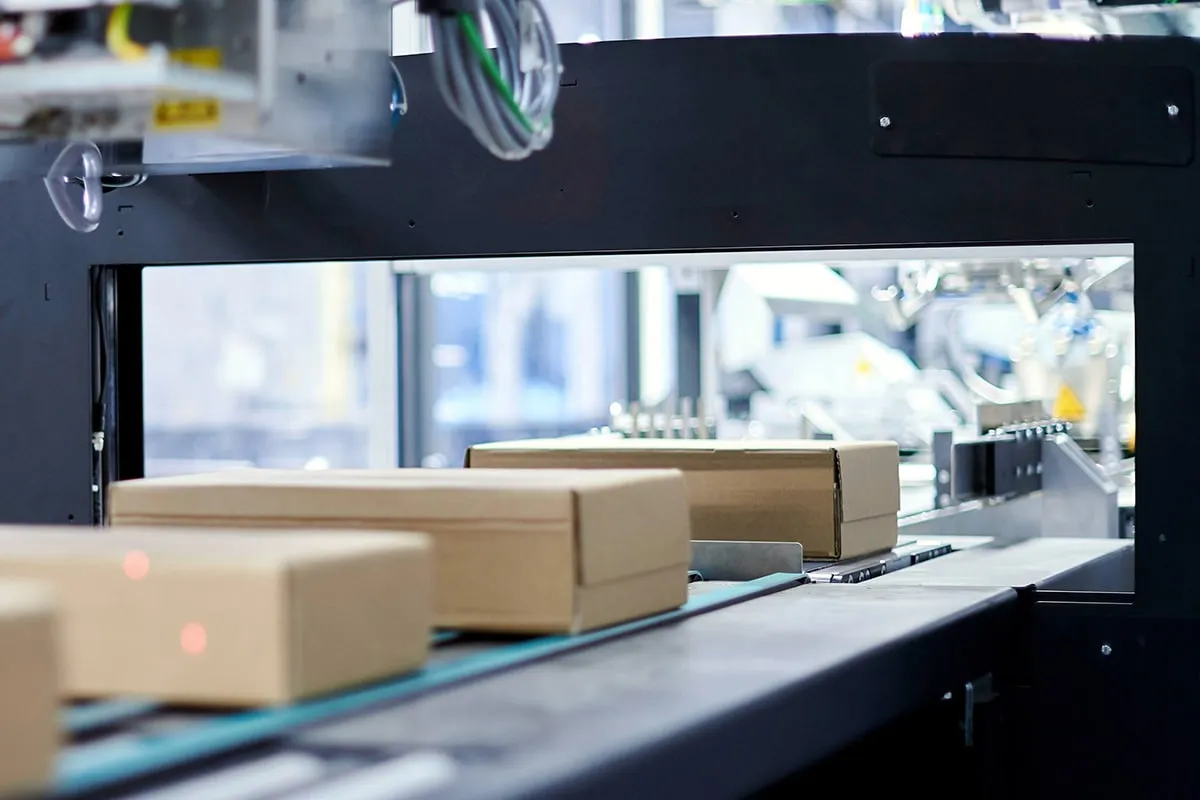
A made-to-measure box for every e-commerce product: machine builder Avercon’s X7 is revolutionising packaging.
Ready for artificial intelligence
A second technology trend is artificial intelligence. Vanden Broecke says: “Operators used to be able to tell what was wrong from the sound the machine made. That kind of knowledge is disappearing. We now need to introduce other ways of communicating and interacting with machines. Our Siemens Industrial Copilot uses generative AI to do this. The machine now tells you its status and the possible causes of problems. This offers huge potential for faster fault diagnosis, training operators or maintenance technicians, and optimising machine processes. The technology is ready to automate automation. It is now a matter of building trust. People can make mistakes, machines cannot. But we already see AI as an enabler of innovation, and by sharing our experience we want to make it as easy as possible for machine builders to get started.”
Developing a data strategy
Data will therefore be indispensable. According to Vanden Broecke and Van Eeckhout, machine builders have now fully grasped this. “A great deal of data is already being generated, but the question is what percentage we are actually using. Every machine builder needs a data strategy, and is working on one. It is up to us to make the tools for working with that data increasingly easy to use, so that they can take the next steps towards standardising machines, generating and simulating programme code, and delivering their machines virtually,” the two conclude.
Growing mushrooms three times more efficiently
Harvesting mushrooms is highly labour-intensive and difficult to automate. TLT Automation therefore took a different approach, separating picking from sorting. The solution works: in the new system, pickers harvest up to 90 kg of mushrooms per hour, compared with 30 kg previously. That is three times as efficient, but each picker now also needs a sorter. Automating the sorting process was therefore the next step. A delta picker takes a picture of each individual mushroom and decides where it should go. TLT Automation developed the algorithm itself and worked with Siemens on the control system to calculate the mathematical kinematic transformations. The robots must move in perfect synchronisation with the conveyor. Using MCD and a SIMIT Digital Twin, TLT Automation was able to test the kinematic transformations before building the mechanical part. This was faster and avoided the risk of damage caused by calculation errors. Managing director Jan-Emiel Tack says: “Because the ‘intelligence’ is housed in an open Siemens ecosystem, this solution can easily be scaled to other dimensions if our customers have different requirements.” The result? Efficiency has now genuinely tripled. There are still challenges. Can we automatically close the boxes? Will this eventually work with cardboard boxes too? The open nature of the Siemens ecosystem means we can experiment to our heart’s content.”
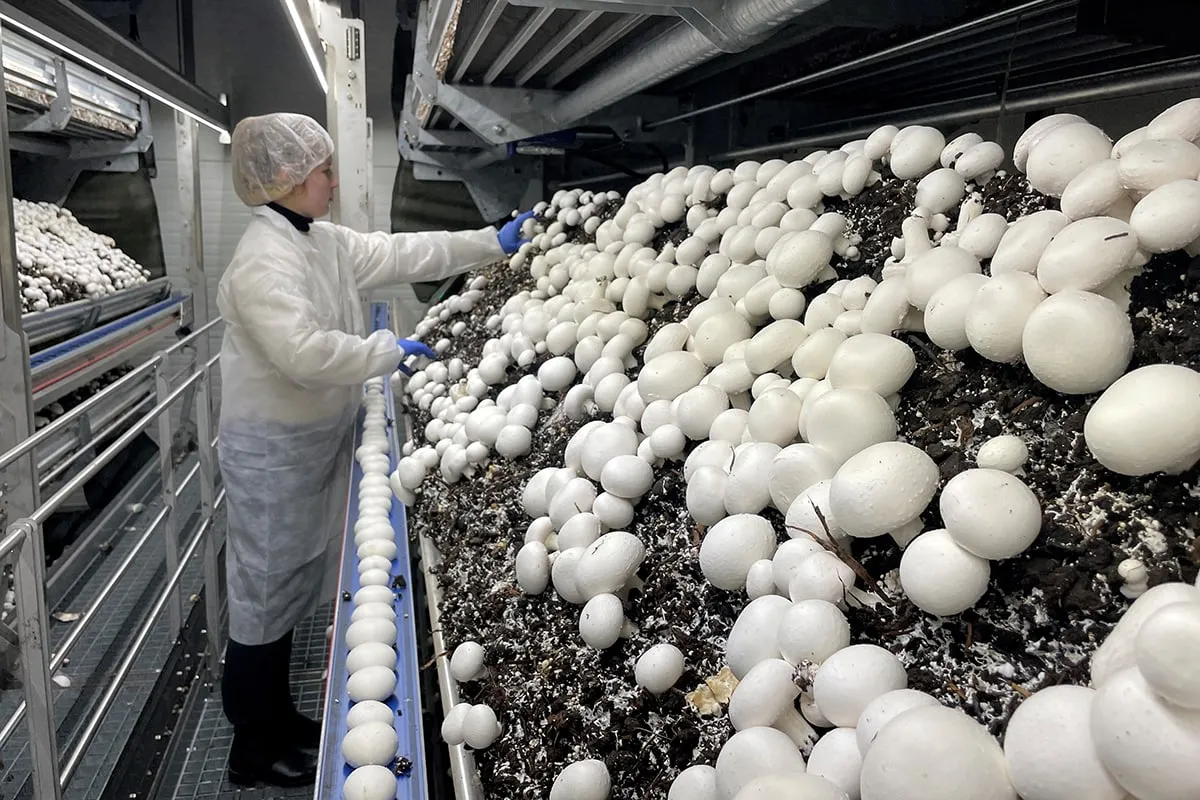
TLT Automation separated picking from sorting. In the new system, pickers harvest up to 90 kg of mushrooms per hour, compared with 30 kg previously.
A business enquiry for Siemens NV/SA? Get in touch
Companies in this story
Keep following this
Get an email when a new story is published. No account needed.
- ThemeFrom design to flexible machine
- SubjectSoftware, IT, OT & cybersecurity
- CompanySiemens NV/SA







