












Software, IT, OT & cybersecurity
Greater efficiency through intelligence: smart servo axis with IIoT functions
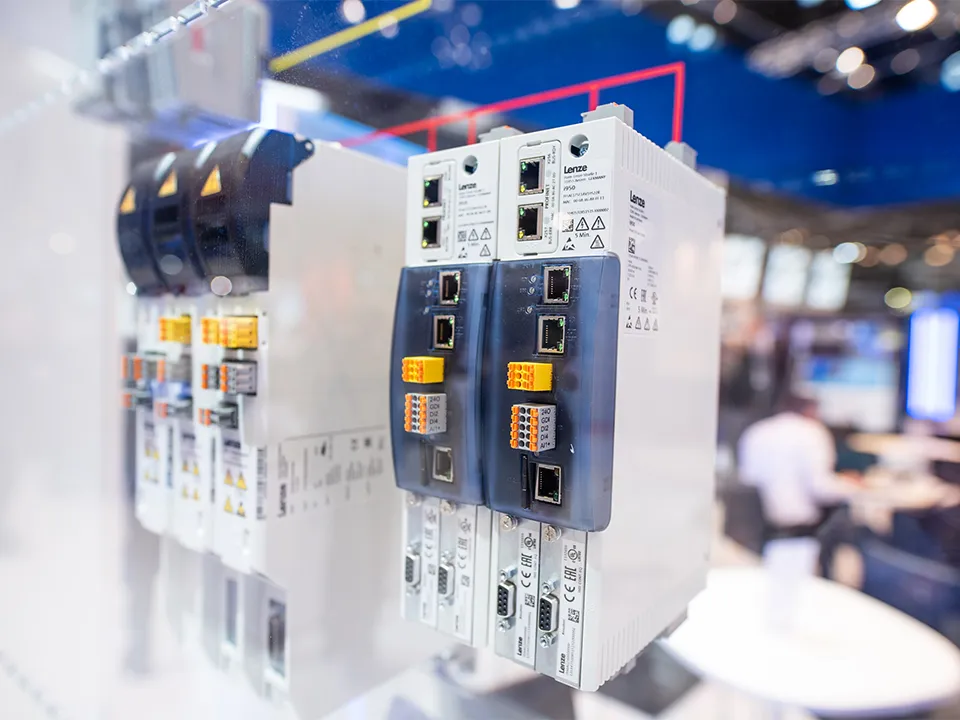
An innovative motion control concept that reduces complexity and offers modern, intelligent IIoT functions creates benefits for OEMs and machine operators.
Lenze’s smart servo axis achieves cycle times up to 20% faster. The solution also offers benefits in engineering.
Text and images Lenze
Lenze has designed its smart servo axis as a power unit with a high degree of scalability. The combination of the i950 inverter, g700 planetary gearbox and m850 synchronous motor covers everything from highly precise positioning tasks to dynamic handling and assembly applications, robotics and conveyor solutions. At the same time, the i950 serves as a comprehensive data source for the Industrial Internet of Things (IIoT) and the service models based on it. The smart inverter eliminates the need for additional sensors.
Power and brains
Adapting to different tasks and concepts in industrial automation requires both high computing power and intelligent functions that enable the efficient implementation of Industry 4.0 requirements. The Lenze i950 inverter was designed specifically to meet these demands. One example is its exceptionally dynamic computing performance. The inverter’s optimised kinematics take account of both the drive axis itself and the control path behind it. This means that errors and deviations are corrected much faster than with standard inverters on the market. The target value is therefore restored in less time, and deviations from the servo axis’s normal operation are kept to a minimum. This pays off handsomely during operation. On the one hand, positioning is highly accurate. On the other, higher speeds can be achieved. For users, this means a significant gain in performance and efficiency, with cycle rates up to 20% higher, without compromising quality and with better results.
An information hub for IIoT
Future-ready factory automation must take account of the shift towards IIoT. But where does the necessary data come from? Using additional sensors involves a great deal: cabling and control systems become more complex, planning and installation costs rise, as do the costs of materials and maintenance. Lenze shows that there is another way. Making intelligent use of data already available from the servo axis eliminates the need for additional components. Instead, the drive itself becomes a sensor, laying the foundation for services such as condition monitoring. Lenze’s development experts advise partners on identifying belt tension, friction and inertia deviations in existing data, and on developing profitable new service models based on this data.
Easy access to the cloud
Data processing for condition monitoring and predictive maintenance can be handled by the powerful i950 in combination with the edge. But IIoT also means networking beyond individual machines, for example to monitor different systems together, centrally maintain multiple sites or benchmark them. Such more complex tasks are usually handled via cloud services, which enable the use of machine learning and artificial intelligence. With the x500 gateway combined with the X4 Remote platform, machine builders get a ready-to-use cloud solution that includes continuous condition monitoring, remote machine maintenance and user-friendly asset management. OEMs and users are free to choose their cloud provider when building their IIoT platform.
Easy network connection
Lenze also meets the machine-building industry’s cabling requirements. Standardised One-Cable-Technology (OCT) further simplifies machine design. Instead of separate power and data lines, only a single connection is required. The open motor feedback protocol transmits motor data digitally. In the case of Lenze’s MCS and m850 series drives, it also transmits the encoder signal and motor temperature. This is part of the ‘drive as sensor’ concept, as resolvers and motor temperature sensors can be omitted. Less cabling reduces material costs and saves space in the control cabinet. It also reduces potential sources of error: connection- and wiring-related faults are less frequent, and troubleshooting is easier because fewer possibilities need to be tested.
Conclusion
Users are asking for more intelligent and flexible machines. At the same time, efficiency must increase, so continually adding more sensors, interfaces and computing power will not achieve the goal. Lenze’s answer is greater performance despite less complexity, more data despite less hardware, better services through greater intelligence, and a consistent focus on future-proof technologies such as IIoT. As a powerful motion control element in the Lenze automation system, the smart servo axis combines several approaches that save time and money for OEMs while supporting users’ productivity targets.
Question about this story? Ask your question
Companies in this story

Keep following this
Get an email when a new story is published. No account needed.
- ThemeFrom design to flexible machine
- SubjectSoftware, IT, OT & cybersecurity
- CompanyLenze BV







