












Software, IT, OT & cybersecurity
From simulation to virtual commissioning
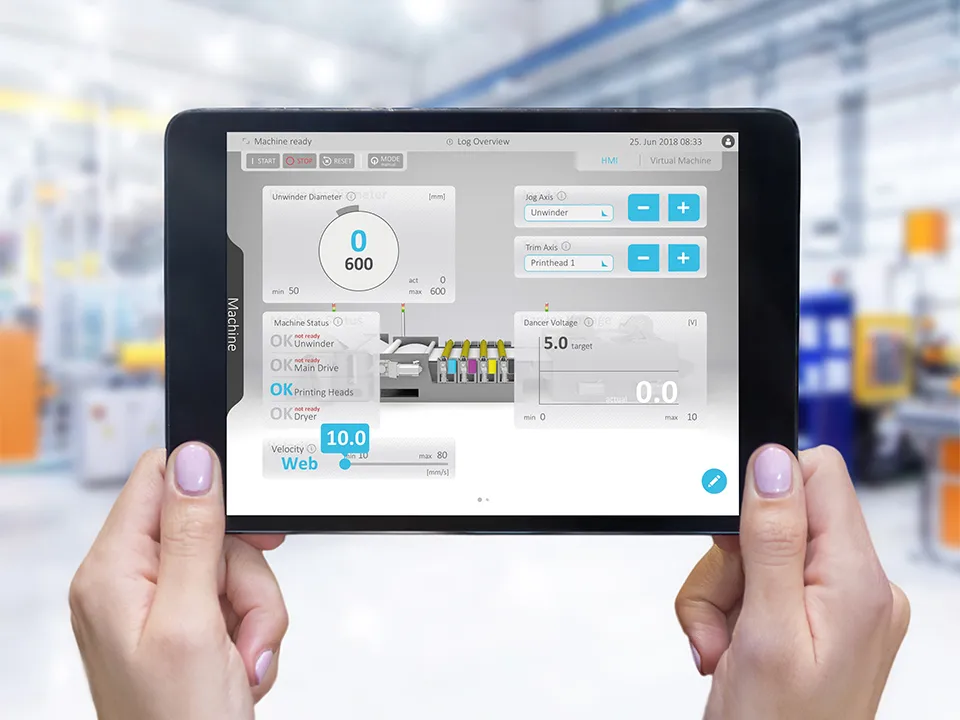
The vision of Industry 4.0 is closely linked to the digital twin. However, as standardisation across individual development tools is still limited, there are significant gaps in consistency.
Several of these gaps can now be closed in the field of simulation. As a result, digital engineering is already delivering significant efficiency gains.
More efficient processes and improved time-to-market are essential to staying competitive in an increasingly fierce global market. With the digital twin, or Asset Administration Shell (AAS), industry has developed a concept that drives this progress. The aim is to ensure an uninterrupted flow of information throughout the entire lifecycle of machines and installations: from data models used in the early development phase, through machine data from the production phase, to asset management, maintenance and repair.
The path to digital simulation
In practice, however, gaps remain because development tools are only partially standardised. Do component and equipment suppliers support the relevant development tools with suitable data formats? Lenze has long been supporting and promoting digitalisation in mechanical engineering and this concept. Now the company is going a step further, extending its support for partners to include simulation and virtual commissioning. OEMs will benefit from extensive digital engineering capabilities in the design, development and production of machines and installations.
From simpler diagnostics to virtual commissioning
The crucial foundation has already been laid with a 3D simulation model, which provides a relatively general model of a machine. This makes it easier to diagnose complex machines. Taking things a step further and refining the 3D model makes it possible to predict specific aspects of machine behaviour, such as the throughput that can be achieved in operation. If the model is adapted in even greater detail to the specific machine, it can be used to simulate not only mechanical behaviour, but also the entire manufacturing process, including machine logic, fault management, changes in operating modes and parameterisation. At this stage of development, virtual commissioning of the machine is even possible.
Addressing OEMs’ pain points
Lenze itself uses some of the best-known simulation tools: SimulationX from ESI ITI (simulation and sizing of drives), ISG-virtuos from ISG (virtual commissioning) and Virtual Teachware from Forward TTC (Augmented & Virtual Reality for HMI and machine diagnostics, as well as learning software for virtual training). In every case, the ultimate aim is to address the critical challenges at this stage of the lifecycle: experience shows that machine builders are looking for better diagnostics, shorter development times or more accurate planning when sizing drives. Machine builders can use these applications themselves, relying on solutions from Lenze. The manufacturer advises them on choosing the right tools and can provide support with modelling simulations and virtual commissioning. The first projects have already been completed, and Lenze has also prepared a showcase demonstrating the process and the extensive capabilities of digital engineering through simulation and virtual commissioning.
Further development
While different data models are still needed for different applications, standardised formats and interfaces will be used in the future. Relevant concepts have already been developed under the names FMU (Functional Mock-up Units) and FMI (Functional Mock-up Interfaces). Lenze supports the commonly used tools available on the market and is also continually developing its digital engineering toolchain.
Conclusion
Whether the goal is better diagnostics, shorter development times or more accurate planning when sizing drives, simulation in digital engineering and parallel engineering make it possible to implement machine concepts efficiently and quickly, and above all to avoid costly rework. This is made possible by interdisciplinary development, in which control and IoT software in particular can be tested and validated on a virtual machine during the early concept and development phases.
Question about this story? Ask your question
Companies in this story
Keep following this
Get an email when a new story is published. No account needed.
- ThemeFrom design to flexible machine
- SubjectSoftware, IT, OT & cybersecurity
- CompanyLenze BV







