












Software, IT, OT & cybersecurity
Flexible and future-proof with safety
Text and images Sigmacontrol
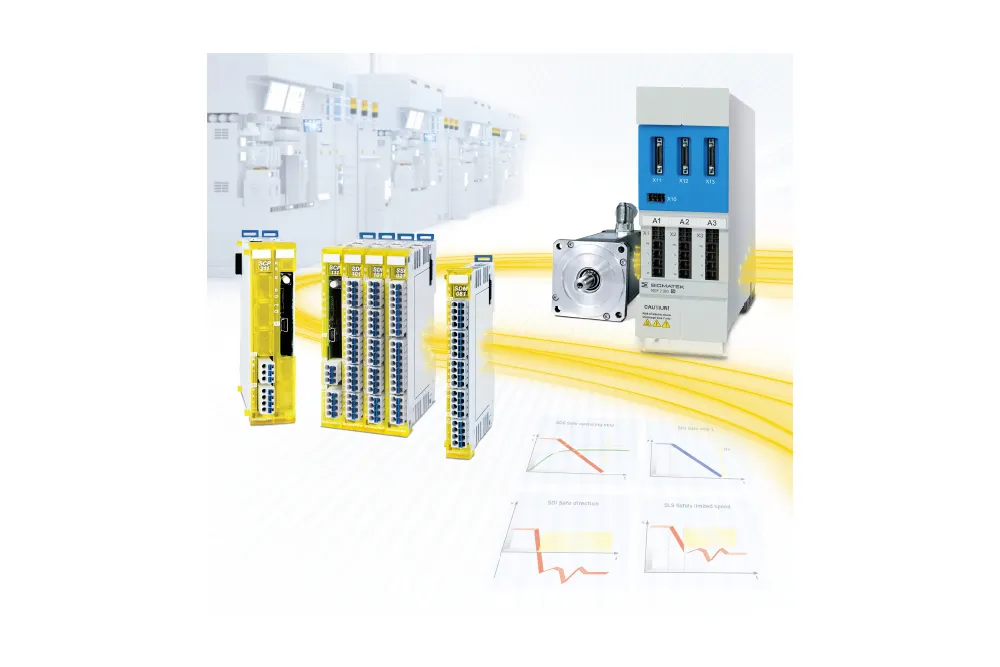
Applications are expected to provide sufficient functional safety to protect people and machines. However, safety circuits wired using conventional relay technology are very rigid structures. Their inflexible safety concepts require the system topology to be defined precisely during the programme design phase. This makes modular machine design more difficult and dynamic changes to the machine configuration impossible.
As early as 2007, Sigmatek was one of the first manufacturers of industrial control and automation systems to bring a programmable safety system to market. It transfers signals from safety-related sensors to a safety CPU using safe input and output modules via Black Channel over the Ethernet-based system bus. Transmission can also be wireless, for example via WLAN. Wiring the safety circuit was replaced by programming the safety controller. This requires no in-depth programming knowledge, as it is carried out through configuration in the graphical user interface of the user-friendly LASAL Safety Designer software tool.
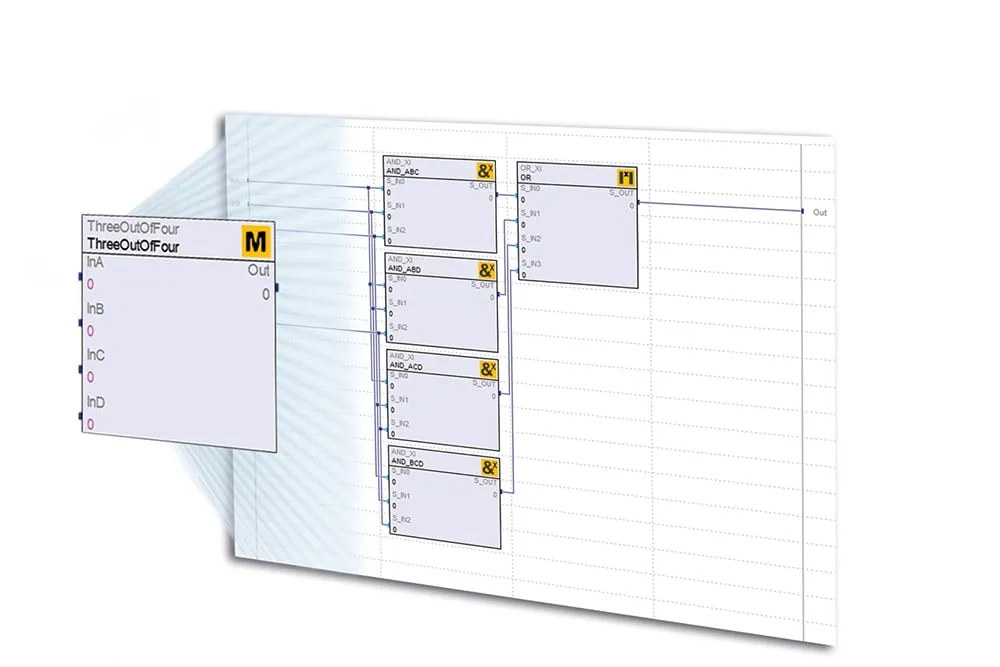
Macro technology
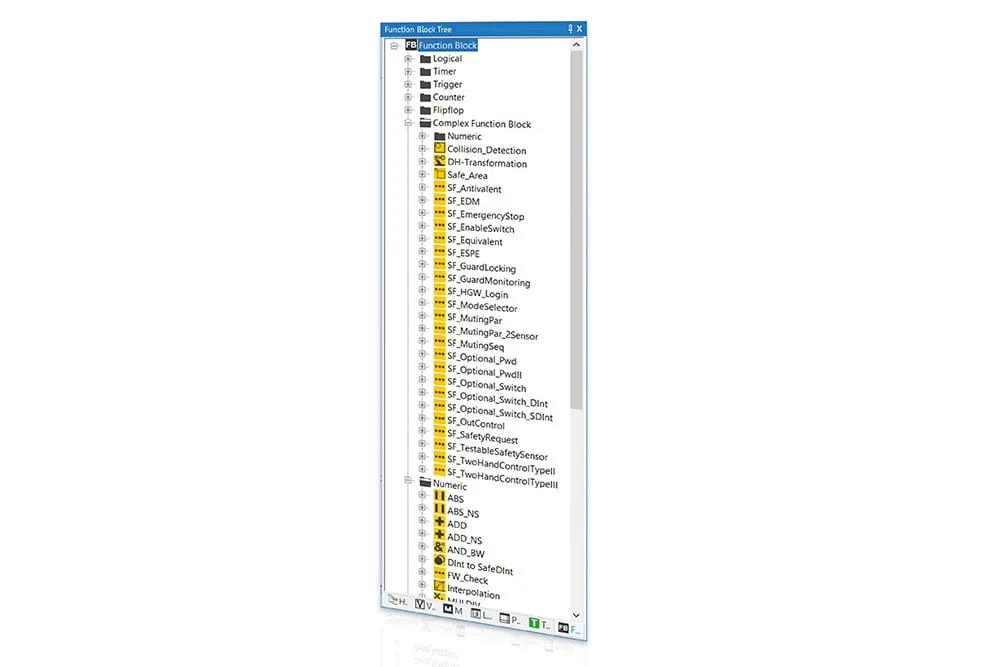
Development in LASAL Safety Designer is based on certified function blocks (FUBs). The FUB library in LASAL contains more than fifty of these PLCopen-based blocks. Following the example of object-oriented programming, which has characterised Sigmatek controls on the application side for 25 years, Sigmatek created the option of customer-specific macro libraries. What makes Sigmatek’s LASAL safety macros special is that they can be structured in a multi-level hierarchy. Each macro is encapsulated and can be tested independently because it has its own CRC check value. This significantly reduces the time and effort required for overall testing to obtain certifications.
Parameterisation
Using parameter lists to create large safety applications alone significantly reduces the engineering effort involved in producing machines in a range of variants. In addition, unrestricted data exchange with the “grey” control system enables test sequences to be automated. The time savings are enormous, particularly for large modular machines whose safety programmes can contain up to 10,000 FUBs.
A safe yet dynamic system concept
However, the most interesting or distinctive feature of configurable safety using parameter lists is that it is not only suitable for quickly and easily producing different variants before delivery. This method makes it possible to change the safety controller’s parameterisation during operation by replacing the parameter list. This means that machines and systems can be operated much more flexibly than before. Thanks to a Dynamic Link Library (DLL) developed by Sigmatek, a non-safe application in the machine control system or an edge device can transfer a new parameter list via a secure connection. To ensure the necessary safety, machine personnel must confirm the data exchange manually.
Greater flexibility
The ability to change the configuration of a safety application dynamically completes the hot-swap capability that has been available for some time. This makes it possible to log individual machine modules in to or out of the safety application during production. Machine sections with their own safety CPU can therefore be added, removed or regrouped flexibly. Here too, users must take action to register and remove machine sections in order to ensure orderly and safe operation. If a unit is disconnected from the central safety controller without first logging out, this triggers an emergency stop for all connected machine modules once the configurable watchdog time has elapsed.
Safe drives
Sigmatek’s DIAS 2000-series servo drives offer high power density and flexibility for controlling servo motors in a very compact housing. As well as one to three axes, they integrate a power supply, power filter, braking resistor and DC link in a housing measuring just 75x240x219 millimetres in size 1 and 150x240x219 millimetres in size 2. The controller’s very short cycle times of 62,5 μs give the DIAS Drives excellent servo performance and the ability to respond quickly to safety-related violations.
These actions must be carried out reliably and quickly, preferably directly in the drives. The MDD 2000 drives were previously equipped with integrated safety functions certified by TÜV to SIL 3, PL e, Cat. 4, including Safe Torque Off (STO), Safe Stop 1 (SS1), Safe Operating Stop (SOS), Safe Brake Control (SBC) and Safely Limited Speed (SLS). Following the latest expansion, they now include eleven additional safety functions as standard. These include Safe Speed Monitor (SSM), Safe Maximum Speed (SMS), the acceleration functions Safe Maximum Acceleration (SMA) and Safely Limited Acceleration (SLA), the position functions Safely Limited Position (SLP), Safe Position (SP), Safely Limited Increment (SLI) and Safe CAM (SCA), and Safe Direction (SDI).
A business enquiry for SigmaControl? Get in touch
Companies in this story
Keep following this
Get an email when a new story is published. No account needed.
- ThemeFrom design to flexible machine
- SubjectSoftware, IT, OT & cybersecurity
- CompanySigmaControl







