












Software, IT, OT & cybersecurity
Flexible and “Future Proof” with Safety
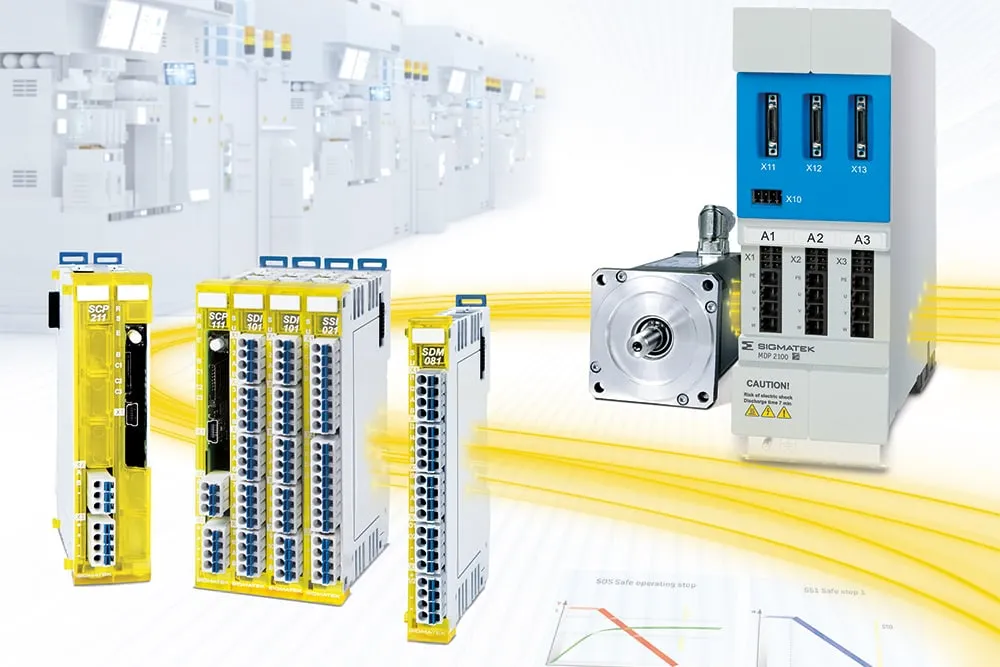
Applications are expected to provide sufficient functional safety to protect people and machines. However, safety circuits wired using conventional relay technology are very rigid structures. Their inflexible safety concepts require the system topology to be defined precisely as early as the programme design stage. This makes modular machine design more difficult and dynamic changes to the machine configuration impossible. In 2007, Sigmatek was one of the first manufacturers of industrial control and automation systems to launch a programmable safety system. It transfers signals from safety-related sensors to a safety CPU via safe input and output modules, using Black Channel over the Ethernet-based system bus. Data can also be transmitted wirelessly, for example via WLAN. Wiring the safety circuit was replaced by programming the safety controller. No in-depth programming knowledge is required, as this is done through configuration in the graphical user interface of the user-friendly LASAL SafetyDesigner software tool.
Macro technology
Development in LASAL SafetyDesigner is based on certified function blocks (FUBs). The FUB library in LASAL contains more than 50 PLCopen-based blocks. Taking inspiration from object-oriented programming, which has characterised Sigmatek controls on the application side for 25 years, Sigmatek created the option of customer-specific macro libraries. A special feature of Sigmatek’s LASAL safety macros is that they can be structured in a multi-level hierarchy. Each macro is encapsulated and can be tested independently because it has its own CRC check value. This significantly reduces the time and effort required for general testing to obtain certifications.
Parameterisation
Simply using parameter lists to create large safety applications significantly reduces engineering work for machines in a range of variants. In addition, seamless data exchange with the “grey” control system makes it possible to automate test sequences. The time savings are considerable, particularly for large modular machines whose safety programmes can contain up to 10,000 FUBs.
Safe dynamic system concept
However, the most interesting feature of configurable safety using a parameter list is that it is not only suitable for quickly and easily producing different variants before delivery. This method makes it possible to change the safety controller’s parameterisation during operation by replacing the parameter list. This means that machines and systems can be operated much more flexibly than before. Thanks to a Dynamic Link Library (DLL) developed by Sigmatek, a non-safe application in the machine control system or an edge device can transfer a new parameter list via a safe connection. To ensure the necessary safety, machine personnel must manually confirm the data exchange.
More flexibility
The ability to change the configuration of a safety application dynamically completes the hot-swap functionality that has been available for some time. This makes it possible to log individual machine modules in or out of the safety application during production. Machine sections with their own safety CPU can thus be added, removed or regrouped flexibly. Here too, the user must actively register and remove machine sections to ensure orderly and safe operation. If a unit is disconnected from the central safety controller without first logging out, this triggers an emergency stop for all connected machine modules once the configurable watchdog time has elapsed.
Safe drives
Sigmatek’s DIAS 2000-series servo drives combine high power density and flexibility for controlling servo motors in a very compact housing. They integrate a power supply, power filter, braking resistor and DC link alongside one to three axes, in a housing measuring just 75x240x219 mm in size 1 and 150x240x219 mm in size 2. Very short controller cycle times of 62.5 μs give the DIAS Drives excellent servo performance and the ability to respond quickly to safety-related protection limit violations.
These actions must be carried out reliably and quickly, preferably directly in the drives. The MDD 2000 drives were previously equipped with integrated safety functions certified by TÜV to SIL 3, PL e, Cat. 4, including Safe Torque Off (STO), Safe Stop 1 (SS1), Safe Operating Stop (SOS), Safe Brake Control (SBC) and Safely Limited Speed (SLS). Following the latest upgrade, they now come with eleven additional safety functions as standard. These include Safe Speed Monitor (SSM), Safe Maximum Speed (SMS), the acceleration functions Safe Maximum Acceleration (SMA) and Safely Limited Acceleration (SLA), the position functions Safely Limited Position (SLP), Safe Position (SP), Safely Limited Increment (SLI) and Safe CAM (SCA), as well as Safe Direction (SDI).
SigmaControl is exhibiting at WoTS, stand 11E062, Jaarbeurs Utrecht, from 24 to 27 September.

A business enquiry for SigmaControl? Get in touch
Companies in this story
Keep following this
Get an email when a new story is published. No account needed.
- ThemeFrom design to flexible machine
- SubjectSoftware, IT, OT & cybersecurity
- CompanySigmaControl







