












Software, IT, OT & cybersecurity
Faster, more efficient engineering with AI
Text Valérie CouplezImage Beckhoff Automation
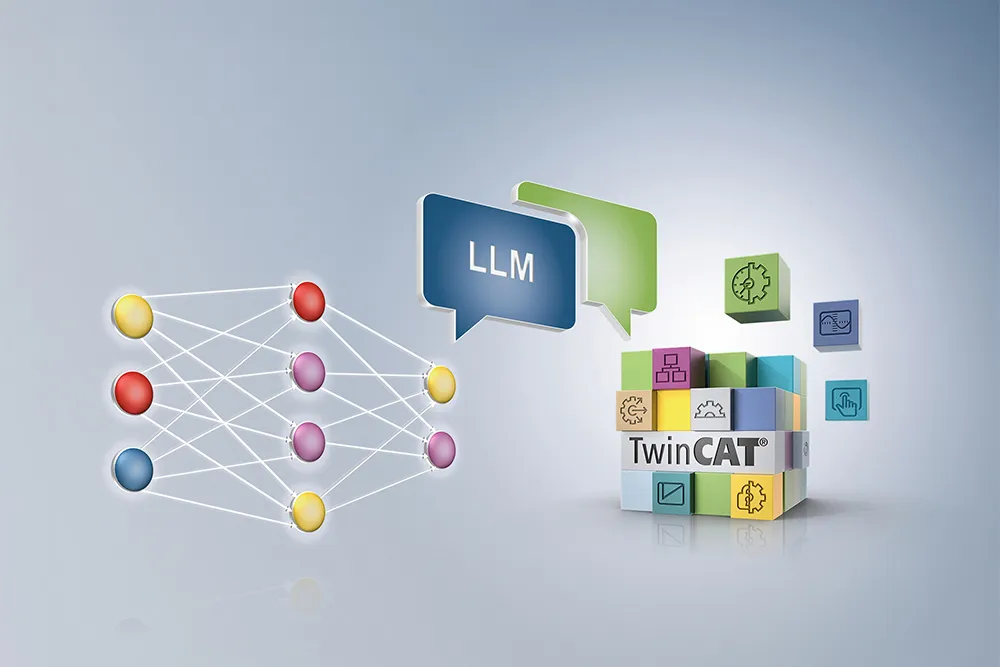
Even those who spent 2023 living under a rock will have heard of ChatGPT. That is how ubiquitous it became. Beckhoff Automation is introducing TwinCAT Chat, which harnesses the power of large language models to help engineers benefit from their potential. TwinCAT Chat can generate and complete PLC code quickly and efficiently. It is certainly no silver bullet. Engineers still need the expertise to evaluate and validate the results. But you can find out how this tool can boost their productivity at the demo at Indumation.
You may even have tried generating code with large language models (LLMs) in your web browser. Enter a prompt, a description or a photo of what your application needs to do, and program code is generated automatically. A neat trick, but copying and pasting it straight into the machine? Probably best not.
Kim Robbens, automation specialist at Beckhoff Automation, is nevertheless convinced of the value it can bring: “Automatic code generation can significantly speed up the development process. At Hannover Messe, Beckhoff already demonstrated the benefits of direct integration into the TwinCAT XAE engineering environment. TwinCAT Chat uses fine-tuned prompts: for example, the system knows that the code is expected to run in the TwinCAT context. Its knowledge of the entire Infosys knowledge base, and potentially other sources, also makes it much quicker and easier for TwinCAT Chat to produce useful results.”

Engineers will not be replaced
Does this mean the chronic shortage of engineers is over? Can LLMs solve everything? “Not at all. Expertise is still needed to determine whether the generated output is actually useful, and what steps to take next. But it is certainly a useful tool.” In April, Beckhoff showed that TwinCAT Chat could be used not only to generate code, but also to optimise code and create documentation. “These are not the most complex tasks, but they are tasks LLMs already handle well.” At the SPS trade fair last November, it was time for phase two, which is now in full development. “Users will be able to interact with the existing TwinCAT Automation Interface using natural language. For example, you can describe in natural language what you want your HMI to look like and have it generated in full, including the correct translations. The product manager will be there on Thursday to show everyone who is interested what it can do, and looks forward to your feedback.”
Openness above all
As you would expect from Beckhoff, the approach here is resolutely open. “Our chat interface is an open interface to LLMs. We will not tie ourselves to a specific one, such as ChatGPT, but will focus on commercially available open LLMs. In time, this will also give users the option of adding their own database of individual data and using it as an additional knowledge source for the LLM.”
With TwinCAT Chat, engineers will therefore have a digital assistant at their side. Code will no longer need to be written line by line. The assistant can take over routine tasks that are often time-consuming and repetitive. This gives engineers more time and freedom to focus on their core tasks: designing and developing software. There is no shortage of possibilities. Beckhoff is nevertheless building in the necessary safeguards. “TwinCAT Chat will not be officially launched on the market until Europe has finalised its regulatory framework for artificial intelligence and the feature has been assessed against it. But it is definitely on the way, and attracting a lot of interest!” Robbens concludes.
BECKHOFF AUTOMATION: Stand 623
Een zakelijke vraag aan Beckhoff Automation? Get in touch
Companies in this story
Keep following this
Get an email when a new story is published. No account needed.
- SubjectSoftware, IT, OT & cybersecurity
- CompanyBeckhoff Automation
- CompanyHANNOVER MESSE







