












Software, IT, OT & cybersecurity
DNA unchanged after 35 years
Text and images Sigmatek
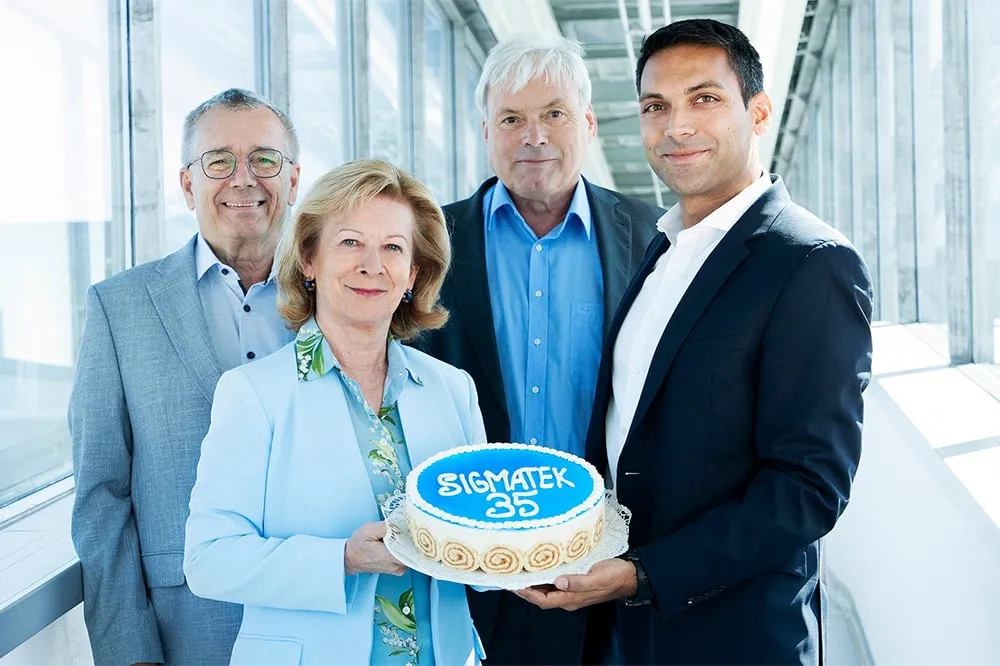
Salzburg-based automation manufacturer Sigmatek has celebrated its 35th anniversary. At the end of 2022, founders Andreas Melkus and Theodor Kusejko stepped down from active management. Since then, the company has been run by Alexander Melkus, Andreas’s son. However, the change of generation at the top has brought few changes. On the contrary, the original intention of developing and implementing flexible yet fully integrated, modular, complete automation solutions for machine builders remains the top priority.
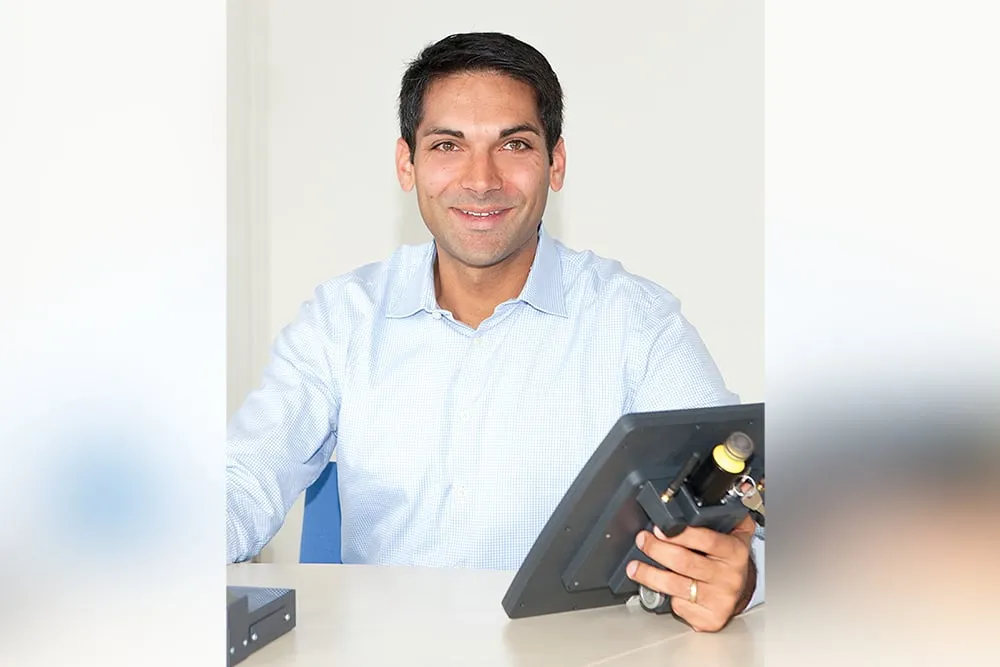
Alexander Melkus: “In principle, we are still doing the same thing as we did back then: we offer series machine builders in medium to highly complex environments not just components, but complete solutions, with hardware and software. The software is not built as a ready-made package, but can always be freely configured, allowing customers to make changes and adjustments themselves. To support them, we provide comprehensive assistance from our qualified application engineers, who have in-depth technical know-how and specialist industry expertise. We also develop customer-specific hardware. In a nutshell, this is our ‘Sigmatek DNA’, which has not changed in 35 years and will not change in the future.”
Was Lasal, as an ‘all-in-one’ tool, part of Sigmatek’s philosophy from the outset?
“The original idea was to create clearly defined interfaces between control, drive and visualisation, so that users could work independently of the hardware. This led to the development of Lasal, an engineering software platform that combines all disciplines in one place. The key was, and still is, encapsulating functions. In object-oriented programming, code and data are combined into logical units, known as objects. Behind each object is a class that acts as a blueprint, defining the program code and data elements. The data is encapsulated within the objects, which communicate with the outside world via interfaces. Thanks to these clearly defined interfaces, encapsulated software modules can be replaced very quickly and easily. In series machine building, there are usually certain core functions within a machine series that are always structured in the same way. We provide these, properly programmed and tested, through various libraries. For users, this means that programming is greatly accelerated, because they can build on a solid, reliable foundation rather than starting from scratch every time. If an error occurs, they do not have to search through the entire code, but only the part configured specifically for the application.”
But what exactly does working independently of hardware mean?
“Our current S-Dias series is the third generation of controllers to be programmed with the same Lasal tool, making it fully compatible. For users, this means they can install a programme they wrote fifteen years ago, for example for the C-DIAS control system of the time, on a spare part from the latest generation. That is why we can easily connect different generations of controllers.”
To what extent can object-oriented, hardware-independent programming be combined with virtualisation and digital twins?
“Thanks to the consistently object-oriented structure of our software platform, the move to the digital twin was not too great a leap, even though we were relatively late compared with other manufacturers. But this is nothing unusual for us, because many of our developments are based on specific customer requirements, and digital twins were not something our customers had been asking about. In general, we do not look at the competition or immediately chase emerging trends. Instead, we focus solely on our users’ needs. This was also the case with model-based development, where we recently worked with Munich-based software company Machineering to connect its iPhysics simulation tool with Lasal in response to a specific customer request. To do this, we upgraded the I/O object classes in Lasal, paving the way for model-based development. Lasal can now distinguish between real and simulated hardware, so iPhysics and other simulation tools are fully supported and virtual commissioning is possible.”
So there is already a virtual S-Dias control system?
“Our control system can be simulated in its entirety, just as machine functions can be simulated. Sigmatek has had simulations in its portfolio for around twenty years. For example, application programmes or unfinished system components can be simulated, shortening development time. Users can write and test their programmes without real hardware, in other words, they can programme in a completely hardware-independent way. Because Lasal is generally event-driven and, to put it simply, responds only to changes rather than recalculating the entire code each time, it is extremely resource-efficient. As a result, compared with other system environments, the controllers operate with relatively low CPU utilisation, which ultimately has a major impact on power consumption and therefore on size. Thanks to their compact design, passive cooling is usually sufficient.”
What about Single Pair Ethernet (SPE) and OPC-UA?
“Customer requirements also drive us in the area of communications. Yes, SPE reduces the amount of cabling required, needs smaller connectors and is easier to install in the field. However, it requires internal signal converters and physical hardware, which makes the communications technology somewhat more complex. In short, it remains to be seen whether it offers real added value for machine and plant builders. In any case, none of our customers has actively approached us about it yet. We are at the forefront of OPC UA and have introduced various industry-specific adaptations. OPC-UA enables manufacturer-independent communication, whether between machines, with ERP and MES systems, or with the cloud. To make it quick and easy to use this communications standard in applications, Lasal offers various OPC UA packages, including packages for the Euromap 77 and Euromap 82.1 interfaces for plastics processing machines.”
Is Sigmatek feeling a drop in demand given the current situation?
“Although our total revenue was still at a record level in 2023, much of this was due to long-standing existing orders. In some sectors, we have already recorded a relatively sharp decline of more than 30% since spring, so we are feeling the recession very clearly too. I expect 2024 to start just as weakly, but also for orders to be placed at shorter notice in the future. Machine builders will no longer hold such high stocks as they did recently, during the period of widespread delivery problems. Although we also faced component shortages and consequently delays in deliveries, I think we managed to maintain availability fairly well compared with the market. We cannot afford to be complacent about the economic downturn. We expect a significant fall in sales, but cannot yet predict how much. Our warehouse is well stocked. If we were part of a large group, this probably would not be the case. Even so, the availability of individual components remains problematic in some cases. In the recent past, marked by bottlenecks, Sigmatek made a clear decision to invest heavily, and many of our assemblies were redesigned. This has put us in a good position for the future.”
A business enquiry for SigmaControl? Get in touch
Companies in this story
Keep following this
Get an email when a new story is published. No account needed.
- SubjectSoftware, IT, OT & cybersecurity
- CompanySigmaControl







