












Software, IT, OT & cybersecurity
Detecting and locating pallets in warehouses: 50% faster operations
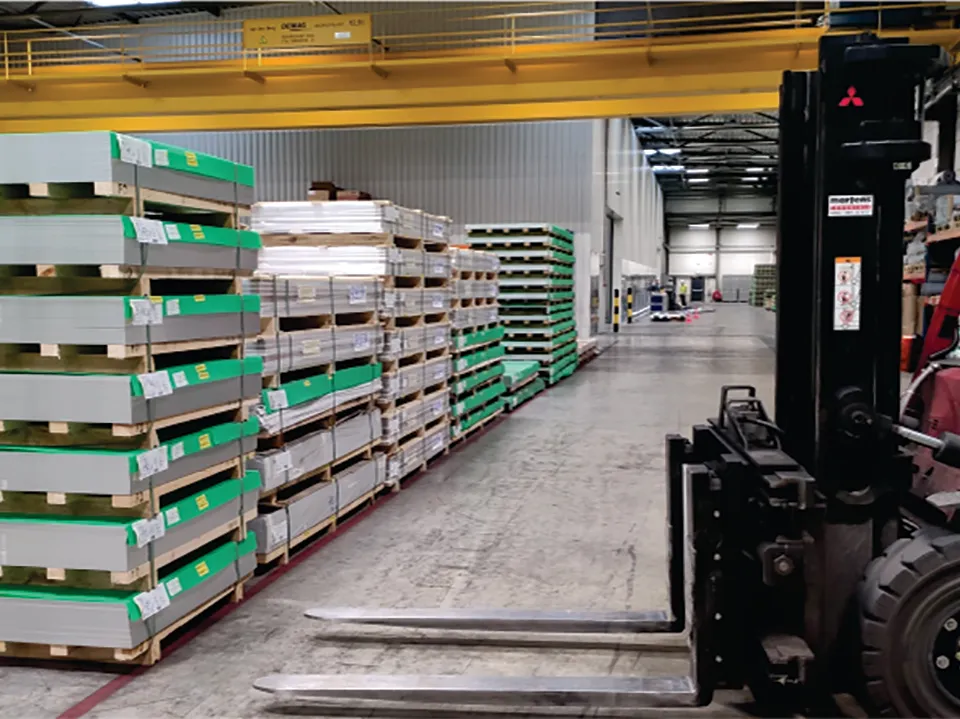
The Dutch company Roba Metals supplies steel, stainless steel, aluminium and other non-ferrous semi-finished products to customers around the world.
Keeping track of everything is no easy task. But thanks to the ATLAS Forklift Track&Trace solution supplied by Aucxis, every pallet movement is monitored throughout the logistics flow, from storage after production to loading onto lorries for transport. The solution has increased operating speed by 50% and improved picking accuracy. What’s more, operators, warehouse staff and transport planners can now work under less pressure and with less frustration.
Text and images Aucxis
Roba Metals’ various European sites employ more than 600 people in total. Aucxis was commissioned to roll out an RFID pilot project at the Roba Metals service centre and sales office in Genk. Across 20,000 m², divided into four halls, coils of stainless steel are processed into cut-to-size sheets and then packaged. The pallets are shipped from stock or on demand to customers, who in turn process the stainless steel sheets into finished products such as commercial kitchen and shop fittings, machine parts and drums. Roba Metals Genk holds an average of 7,000 pallets in stock, more than 1,000 of which are delivered each week. A total of 35 employees are involved in the production and logistics flow.

Gert Machon, Roba Metals
Automated location and load verification
To locate and retrieve the correct pallets for despatch to customers, Roba Metals used a conventional barcode scanner and an Excel file. As more storage space was added and pallet locations were not always recorded, search times increased considerably. Meanwhile, delivery lead times were getting shorter: customers often expect delivery just one day after placing an order. Roba Metals therefore set out to find a real-time detection and location system that could be linked to its WMS. Aucxis proposed implementing the ATLAS Forklift Track&Trace solution. It provides an accurate, up-to-date overview of internal logistics movements through automated location and load verification. RFID UHF technology was chosen because it allows bulk scanning. Unlike barcodes, tags do not need to be in line of sight to be read.
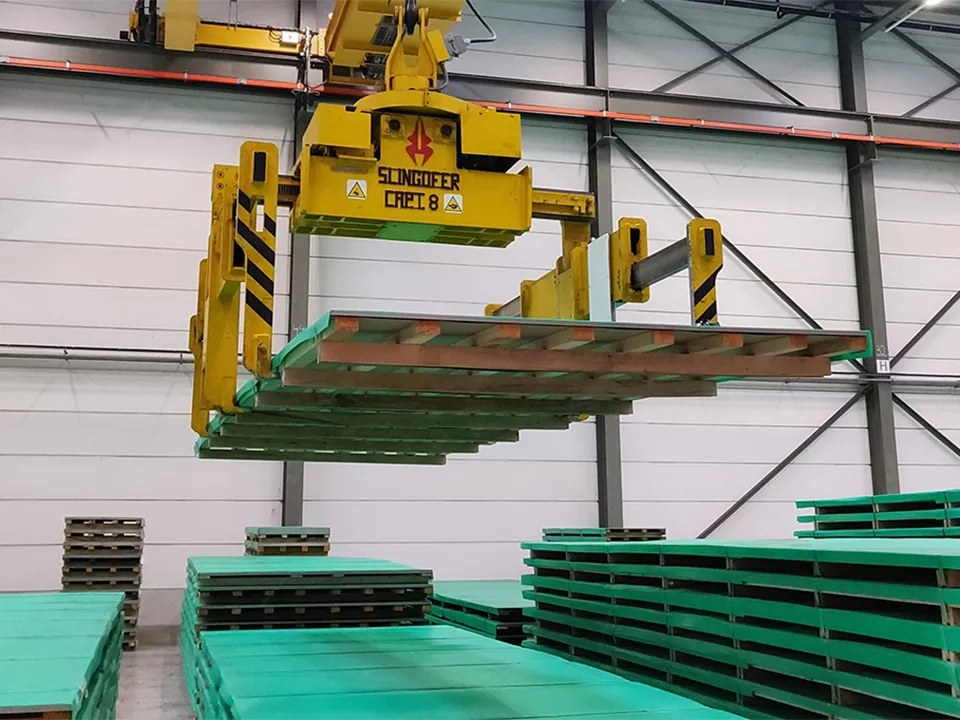
Antennas on the overhead crane and grab scan the load of sheets.
Tagging pallets
Once the cut-to-size stainless steel sheets have been placed on a pallet, they are covered with protective paper or plastic film. A barcode label bearing the customer details and a unique number is always attached to the film. Using this number, which is read by a PC with a barcode scanner, we print two RFID tags, both programmed with the product ID. These two RFID tags are also attached to the protective film. Two tags are needed per pallet because pallets can be lifted in different ways during loading, either by forklift or overhead crane. Roba Metals Genk estimates that around 100,000 pallets will be tagged this year. Once tagged, the pallet is left in a drop-off zone by a forklift. From there, the overhead crane moves it to its designated storage location. Picking pallets for transport involves the reverse movement.
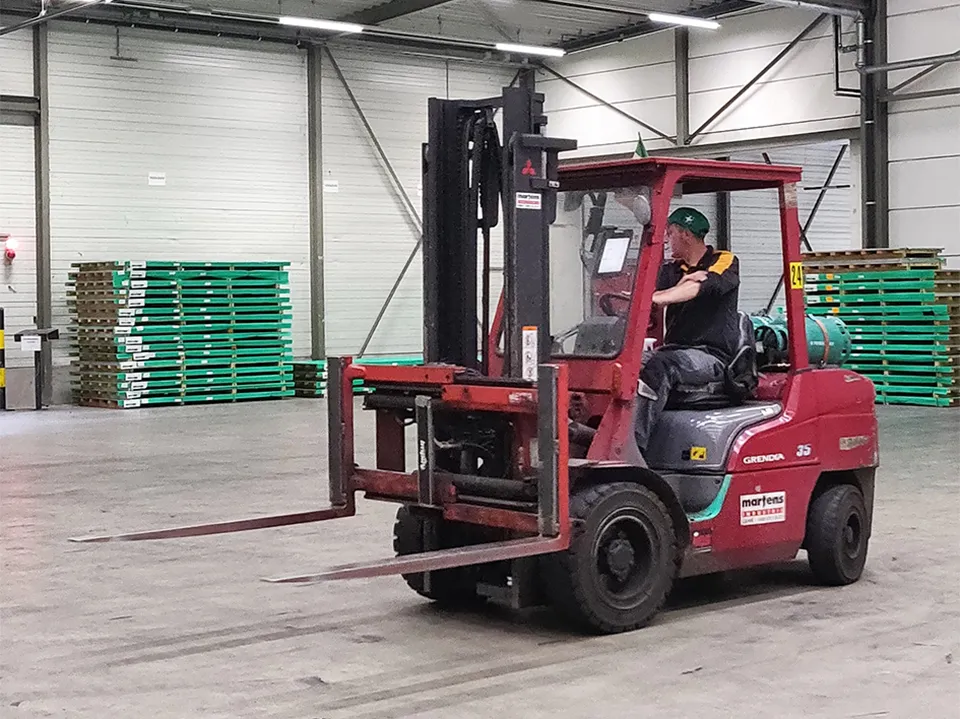
Antennas at the front and underneath the forklifts scan the floor tags and transmit the forklifts’ locations.
Detection equipment on overhead cranes and forklifts
At the top of each hall, an overhead crane travels along a rail from front to back. Its grab moves from left to right to load the pallet. Each hall is divided into a grid, with each grid cell representing a drop-off point or passageway. The five overhead cranes were fitted with an antenna to scan the load and two distance sensors to determine its exact position in the hall using X and Y coordinates. Six forklifts were fitted with an antenna at the front to scan the load and an antenna underneath to scan the floor tags, allowing their position in the hall to be determined. This equipment enables the forklifts to read several pallets at once. Since the forklifts travel at 12km/u across grids fitted with floor tags, tag read speed was a key factor in selecting the tags.
Data processing
The overhead crane or forklift operator carries out the same tasks as before, but can now also see on a screen which pallet to pick up at which drop-off location. The operator then confirms this on a touchscreen. Once the user has confirmed, the data is automatically sent to Roba Metals’ WMS. The key advantage of the concept is that the same hardware and technology, the HERTZ middleware, can be used for both identification and location.
For more information
Aucxis RFID Solutions
Zavelstraat 40-9190 Stekene
Tel. +32 (0)3 790 17, [email protected], www.aucxis.com/nl/rfid
Question about this story? Ask your question
Keep following this
Get an email when a new story is published. No account needed.
- ThemeSmart manufacturing and logistics
- SubjectSoftware, IT, OT & cybersecurity







