












Software, IT, OT & cybersecurity
Communication and safety challenges for mobile robot manufacturers
Keep moving
Mobile robots are everywhere, from warehouses to hospitals and even on the street. Their popularity is easy to understand: they are cheaper, safer, easier to find and more productive than real workers. They are easy to scale up or combine with other machines. Because mobile robots collect large amounts of real-time data, companies can use them as a starting point for their IIoT activities.
However, to operate efficiently, mobile robots need safe and reliable communications. This article outlines the main communication and safety challenges facing mobile robot manufacturers and offers a straightforward way to address them and keep mobile robots moving.
What are mobile robots?
Before we begin, let’s first define what we mean by mobile robots.
Mobile robots transport materials from one location to another and come in two types: automated guided vehicles (AGVs) and autonomous mobile robots (AMRs). AGVs use guide infrastructure (wire reflectors, reflectors or magnetic strips) to follow predetermined routes. If an object blocks an AGV’s path, the AGV stops and waits for the object to be removed.
AMRs are more dynamic. They navigate using floor plans and data from cameras, built-in sensors or laser scanners to detect their surroundings and choose the most efficient route. If an object blocks an AMR’s planned route, it chooses another route. Since AMRs do not depend on guide infrastructure, they are quicker to install and can adapt to changes in logistics.
What communication and safety challenges do mobile robot manufacturers face?
1. Ensuring a wireless connection
The first challenge for mobile robot manufacturers is choosing the most suitable wireless technology. The usual advice is to define the requirements, evaluate the standards and choose the best combination. Unfortunately, this is not always possible for mobile robot manufacturers, as they often do not know where the machine will be located or the exact details of the target application.
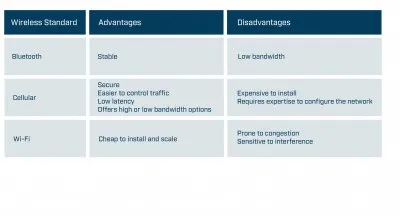
In some cases, a Bluetooth connection is ideal because it provides a stable, uncongested connection, while other applications require a fast, secure mobile data connection. What mobile robot manufacturers need is a network technology that can easily be adapted to specific requirements.
Figure 1. Wireless standards: pros and cons
The second challenge is ensuring that the installation works as planned. Before installing a wireless solution, a site survey based on drawings must first be carried out to ensure that mobile robots have sufficient signal coverage throughout the site. This site survey should identify the optimal locations for the access points, the right antenna type, the optimal antenna angle and how to suppress interference. After installation, use wireless sniffer tools to check the design and adjust access points or antennas if necessary.
2. Connecting mobile robots to industrial networks
Mobile robots must be able to communicate with the controls on site, even though mobile robots and controls often use different industrial protocols. An AGV, for example, may use CANopen, while the control system uses PROFINET. In addition, mobile robot manufacturers may want to use the same AGV model at multiple sites where the control system uses a different industrial network, such as EtherCAT.
Mobile robot manufacturers must also ensure that their robots have sufficient processing capacity for the required data volumes. The amount of data required depends on the size and type of installation. Large installations often use more data because their routing algorithms need to cover a larger area, more vehicles and more potential routes. Navigation systems such as vision-based navigation process images and therefore require more processing power than installations using other navigation systems, such as reflectors. Mobile robot manufacturers therefore need to find solutions to the following challenges:
1. Ensure that the network technology supports all major fieldbus and industrial Ethernet networks.
2. The network technology must be easy to adapt, so that the mobile robot can communicate over the same industrial network as the control system without changing the hardware design.
3. Ensure that the network technology has sufficient capacity and functionality to process the required data.
3. Creating a safe system
Building a system in which mobile robots can safely transport materials is a critical but challenging task. Mobile robot manufacturers must develop a system that takes account of all possible types of mobile robots, structures and people in the environment. They must ensure not only that mobile robots respond to external actions, such as someone opening a safety door or pressing an emergency stop button, but also that the network solution can handle different safety protocols and interfaces. They must also take into account that AMRs move freely and therefore manage the risk of collisions. Sensor technology is constantly evolving, so mobile robot manufacturers must keep up with developments in this field to ensure that their products remain as efficient as possible.
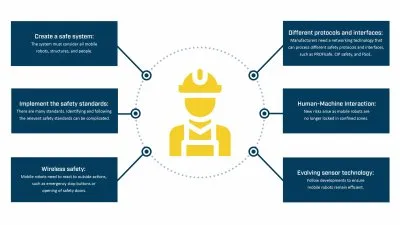
Figure 2. Overview of safety challenges for mobile robot manufacturers
Safety standards
Safety standards provide guidelines for implementing safety-related components, preparing the environment and maintaining machinery or equipment.
Although compliance with the various safety standards (ISO, DIN, IEC, ANSI, etc.) is generally voluntary, machinery manufacturers in the European Union are legally required to comply with the safety standards set out in the Machinery Directive. The Machinery Directive 2006/42/EC always applies to mobile robot manufacturers, and Directive 2014/30/EU may also be relevant in some applications, as it regulates the electromagnetic compatibility of installations. The Machinery Directive 2006/42/EC sets out requirements for the design and construction of safe machinery placed on the European market. Manufacturers may only affix a CE mark and supply the machine to their customers if they can demonstrate in the declaration of conformity that they have met the requirements of the directive.
Although the other safety standards are not mandatory, manufacturers would be well advised to follow them, as they help meet the requirements of the Machinery Directive 2006/42/EC. For example, manufacturers can follow the guidance in ISO 12100 to reduce identified risks to an acceptable residual risk. They can use ISO 13849 or IEC 62061 to determine the required safety level for each risk and then ensure that the corresponding safety-related function meets the defined requirements. Mobile robot manufacturers can decide for themselves how to achieve a given safety level, for example by reducing the mobile robot’s speed to bring the risk of collisions and the severity of injuries down to an acceptable level. Alternatively, they can ensure that mobile robots operate only in segregated zones where human access is prohibited (defined as restricted-access zones in ISO 3691-4).
Identifying the right standards and implementing their requirements is the best way for mobile system manufacturers to create a safe system. But, as this summary suggests, it is a complicated and time-consuming process.
4. Ensuring reliable CAN communication
As a reliable and easy-to-implement standard since the 1980s, CAN-based communication continues to grow in popularity, particularly because it is used in a range of booming industries, such as e-mobility and battery energy storage systems (BESS). CAN is simple, energy-efficient and cost-effective. All devices on the network have access to all the information. It is also an open standard, which means users can customise and extend messages as required.
For mobile robot manufacturers, CAN connectivity is becoming increasingly important, as it enables them to monitor the lithium-ion batteries increasingly used in mobile robot drive systems, both in retrofit systems and new installations. Mobile robot manufacturers are advised to take the following steps in this regard:
1. Ensure a reliable connection using CAN or CANopen communication standards so they can monitor their devices, including battery status and performance.
2. Protect systems against electromagnetic interference (EMI), which can damage a system’s electronics. The risk of EMI is higher in retrofits, as adding new components, such as batteries close to the communication cable, can cause high-frequency electromagnetic interference.
5. Remote access to mobile robots
The ability to access a machine’s control system remotely enables mobile robot vendors and technicians to troubleshoot and resolve most issues without having to visit the site.
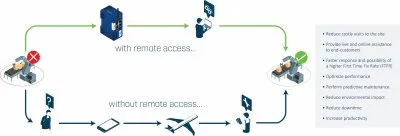
Figure 3. Benefits of remote access
The challenge is to create a remote access solution that strikes the right balance between the needs of the IT department and those of the technician or supplier.
The IT department needs to be able to ensure that the network remains secure and reliable and retains its integrity. The remote access solution must therefore include the following security measures:
Prefer outgoing rather than incoming connections to minimise the impact on the firewall.
Separate the relevant traffic from the rest of the network.
Encrypt and protect all traffic to ensure its confidentiality and integrity.
Ensure that suppliers comply with, or are certified to, relevant security standards such as ISO 27001.
Ensure that suppliers carry out regular security audits.
The technician or supplier needs a user-friendly and reliable system. Users must be able to connect easily to mobile robots and access the information they need. If the installation changes, the number of robots must be easy to adjust. If the mobile robots are in a different country from the suppliers or technicians, the network infrastructure must provide sufficient coverage and redundancy to guarantee global availability.
Conclusion
As we have seen, mobile robot manufacturers face a wide range of communication and safety challenges. They need to establish a wireless connection, transmit data across different networks, ensure safety, connect to CAN systems and enable the robots to be operated remotely in a safe manner. To make matters even more complex, every installation must be assessed and adapted to local requirements all over again.
The best approach to implementing mobile robot communications
Mobile robot manufacturers are rarely experts in communications or safety. As a result, trying to develop the required communications technology themselves can be time-consuming and costly. Turning to third-party communications solutions not only addresses the communication challenges, but also offers other benefits.
Modern communications solutions have a modular design. This allows mobile robot manufacturers to remove a network product designed for one standard or protocol and replace it with a product designed for another standard or protocol, without affecting other parts of the machine. For example, Bluetooth may be the most suitable wireless standard in one installation, while Wi-Fi may provide better coverage in another. Similarly, one site may use the PROFINET and PROFIsafe protocols, while another uses different industrial and safety protocols. In both scenarios, mobile robot manufacturers can use communications products that allow the network technology to be adapted to local requirements without having to change the hardware design.
Question about this story? Ask your question
Keep following this
Get an email when a new story is published. No account needed.
- ThemeRobots on the shop floor
- SubjectSoftware, IT, OT & cybersecurity







