












Software, IT, OT & cybersecurity
Advances in PLC technology
Text Valérie CouplezImage iStock
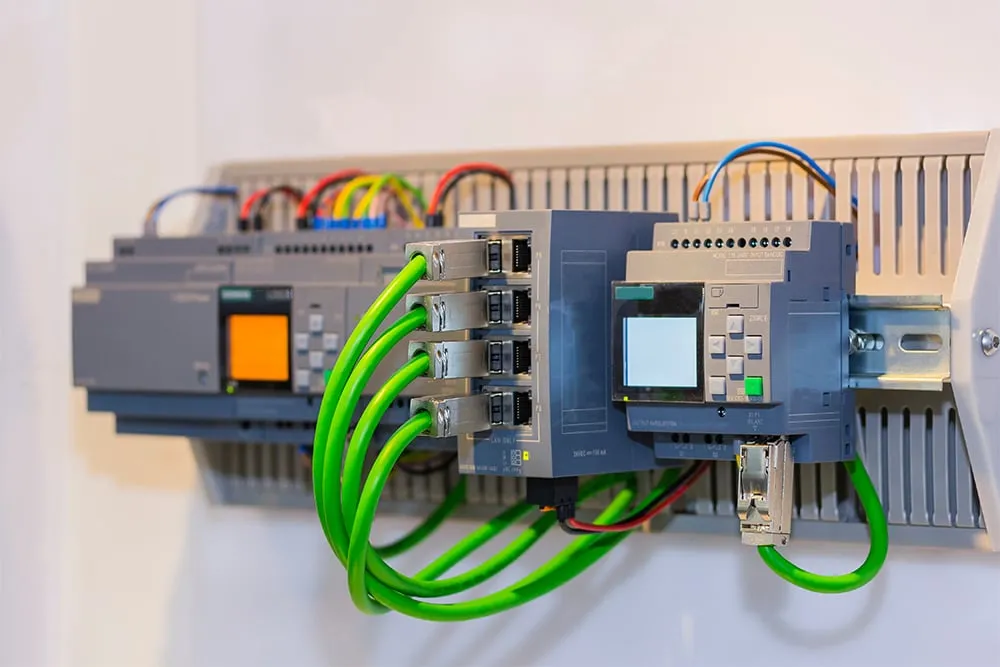
The Programmable Logic Controller is far from obsolete. PLCs have been a crucial component since the advent of modern manufacturing, and they are not about to relinquish that role. This robust, industrialised computer can continue to serve as the primary operator in millions of industrial processes. PLC technology, too, continues to evolve.
Choosing a PLC was not always so straightforward. Traditionally, PLCs have relied on their own programming languages to control field devices. PACs (programmable automation controllers), by contrast, use more standardised and modular programming languages and are more commonly used to control entire production lines or factories. Today, these differences are much less clear-cut, as PLCs control a far wider range of automation equipment and processes. The number of programming languages used in PLCs has also fallen, with those still in use becoming much more standardised. In the past, every PLC manufacturer spoke its own language.
Standardisation for greater future-proofing
This greater standardisation in programming is beneficial for several reasons. It means technicians have fewer programming languages to learn, allowing them to apply their skills more widely. From an engineering perspective, standardisation also broadens the range of applications for a PLC. Like computers, PLCs have become much more powerful in recent years. Without standardisation, they would not be able to make the most of that potential. A third advantage is that users can base their choice of PLC on more important factors, such as its suitability for I/O expansion, its speed and the amount of processing data it can handle.
Getting more out of data
The Internet of Things, or IoT, is increasingly shaping the manufacturing landscape. And while IoT technologies make it possible to collect vast amounts of data from equipment and sites in real time, collecting data on this scale can affect the performance of a traditional PLC. Consider how labour-intensive it is to collect data several times a second from a factory full of machines operating on two dozen axes, summarise it and send it over the network. It quickly becomes clear that improving the speed and processing capabilities of modern PLCs so they can handle such high data loads is a top priority for manufacturers.
Taking applications to the edge
However, data does not necessarily have to be processed in the PLC. Vision technology is increasingly used for training and fault detection in industrial processes. Machine-learning algorithms are used to assess captured images and look for issues such as tool degradation, or to ensure components are installed accurately. Edge computing or dedicated PLC modules provide an ideal platform for hosting these algorithms.
More robust variants
Although PLCs are already known as robust industrial computers capable of withstanding less-than-ideal environmental conditions, manufacturers are continually developing more robust variants that keep working whatever the conditions, including extreme cold, storms, floods and heatwaves. In these PLCs, electronic signals are replaced by optical signals, preserving performance even in locations with high levels of electrical noise. Thanks in part to the IoT, as discussed earlier, PLCs can now be installed in remote locations without electrical interference. This is beneficial for sensitive processes that require precise actions and monitoring.
PLCs are here to stay
PLCs have indeed been around for decades, but the modern PLC, and by extension the PLC of tomorrow, has come a long way from the small industrial computer that transformed manufacturing in the mid-21st century. It is fascinating to see how these computers, responsible for process automation, factory efficiency and much more, are still used in even the most advanced manufacturing processes and functions.
Question about this story? Ask your question
Keep following this
Get an email when a new story is published. No account needed.
- ThemeFrom design to flexible machine
- SubjectSoftware, IT, OT & cybersecurity







