












Software, IT, OT & cybersecurity
Accelerating digital transformation
A smart factory runs on data. But connecting data from all the different smart machines and systems in an industrial environment is far from straightforward. Yet this is precisely what will enable us to take the next steps in digitalisation. An ambition that calls for ecosystems. That is why Siemens is launching Siemens Xcelerator, an open digital business platform.
Digital transformation: it is talked about endlessly, but still happens too rarely in practice. Bart Demaegdt, business development digitalisation at Siemens, sees three major stumbling blocks. “86% of companies that embark on this kind of digital transition give up because it is too complex. Another 45% hit a wall when they try to scale their IoT projects from proof of concept to industrial application. And finally, the question arises: who can they set out on this digital journey with? Doing everything themselves is impossible today. That is why we need to start thinking in terms of ecosystems and platforms.”

Xcelerator: connecting IT and OT
Siemens, which celebrates its 175th anniversary this year and has been present in Belgium for 125 years, has been bringing the virtual and real worlds together since 2007. It was therefore keen to take up the challenge of helping companies overcome these hurdles. It was clear that the automation and digitalisation solutions of tomorrow must meet four requirements. Demaegdt: “They must be easy to use, flexible and scalable, open, and available as a service.”
This immediately became the starting point for the development of Xcelerator, an open digital business platform designed to accelerate digital transformation and create more value for customers of every size. It was officially launched on 29 June. The X in the logo does more than refer back to the name. “We want to connect the worlds of IT and OT.”
Software portfolio, platform and marketplace
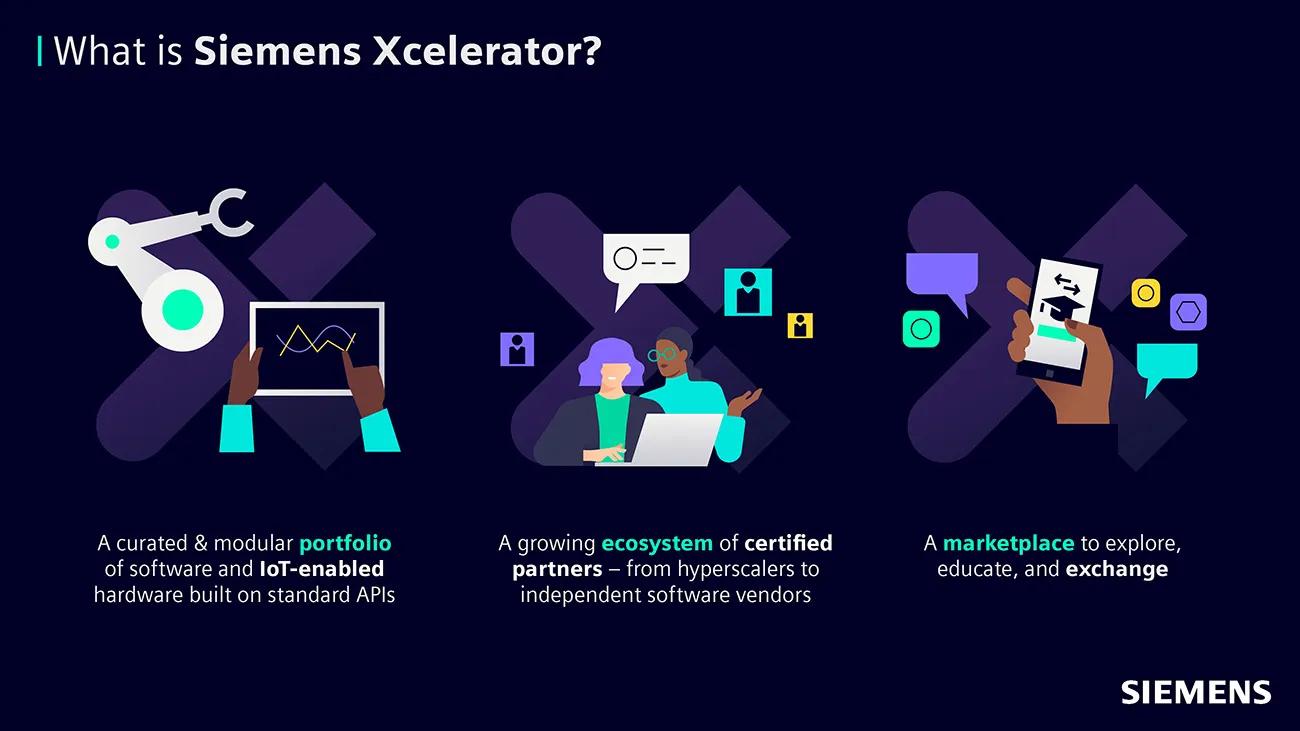
But what exactly does Xcelerator encompass? “First of all, it brings together all Siemens digitalisation software and hardware, provided they meet the requirements set out above. For part of our portfolio, this means adapting the roadmap to meet Xcelerator’s technical and commercial design principles. This also makes them ‘Future Proof’.”
“Secondly, it is an open ecosystem that brings together solutions from a range of experts. In infrastructure (SAP, Microsoft, NVIDIA…), consulting (Deloitte, Accenture…), and build & sell, where we can draw on an existing network of 4,000 partners. After all, we cannot do everything on our own, and neither can Siemens.”
“Thirdly, there is a marketplace that will work in the same way as modern retail platforms. For example, users will be given suggestions for things that may be of interest to them,” says Demaegdt.
Real-time photorealistic rendering
With Xcelerator, Siemens is providing a platform that brings together applications to help companies with their digital transformation. A good example that underlines the power of such an ecosystem is the collaboration with NVIDIA. For video gamers, the name is synonymous with high-performance graphics cards. Demaegdt: “But they do much more than that. With Omniverse, for example, they offer a platform for 3D design and collaboration. Combining it with Siemens Xcelerator gives users a platform for working together in a highly immersive way. We already had simulation software, of course, but not everyone can visualise a simulation. You find yourself in what is known as the ‘uncanny valley’. Because you can see that it is fake, it feels impersonal and even uncomfortable. Omniverse, on the other hand, offers real-time photorealistic rendering. This brings the industrial metaverse to life, allowing us to solve problems from the physical world virtually.”
Taking digital twins further
What is it all expected to deliver? “Applying artificial intelligence requires a great deal of historical data,” says Demaegdt. “That is difficult when you want to build a new plant or assess how best to optimise an existing one. With a photorealistic environment, by contrast, you can generate synthetic data and know what your production line should look like for the best possible results before a single stone has been laid. The model serves as a source for running algorithms on. The Industrial Metaverse is in fact the next logical expansion of the scope of Digital Twins, with the additional emphasis now on immersive collaboration.”
Question about this story? Ask your question
Keep following this
Get an email when a new story is published. No account needed.
- ThemeData from shop floor to decision
- SubjectSoftware, IT, OT & cybersecurity







