












More than just palletising
Text Astin de ZeeuwImage SigmaControl
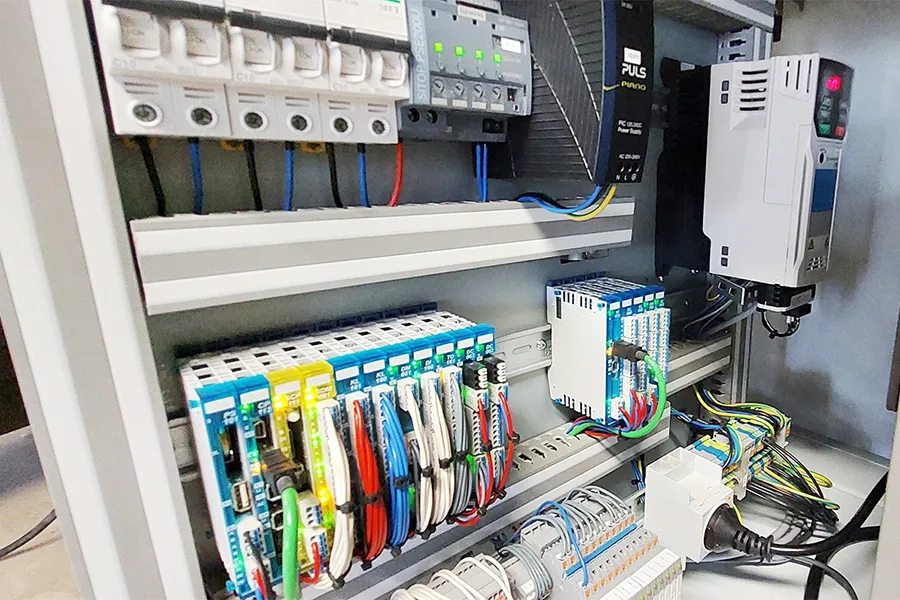
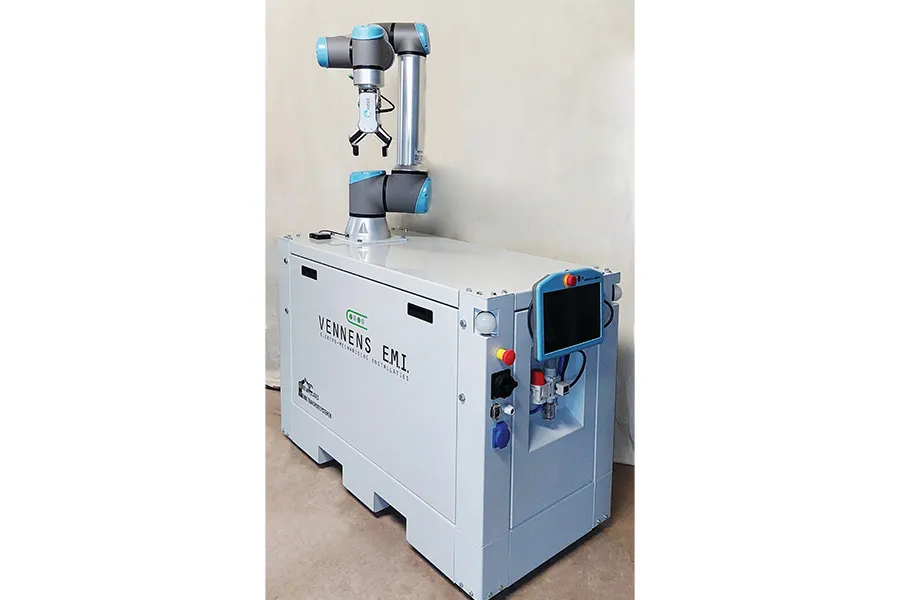
Cobots, short for collaborative robots, are a specific type of robot designed to work alongside people in an assistive capacity. In Sint-Niklaas, we find a company that builds multifunctional, bespoke applications in-house, capable of more than just palletising. These so-called Flexstackers can also be used for welding, assembly, bending and packaging. Managing director and engineer Kristof Vennens designs and builds these cobots using hardware and software from SIGMATEK, distributed and supported by SigmaControl. Engineering is carried out using the all-in-one, object-oriented programming package LASAL.
Of course, we could list all the specific advantages cobots offer compared with conventional robots. They are generally more flexible and responsive, making interactive collaboration with human workers possible. They feature intuitive interfaces and programming methods, including graphical interfaces that make programming straightforward without extensive technical knowledge. They are generally smaller and have a lower payload than conventional robots. They are also seen as a cost-effective automation solution that can increase productivity without significant changes to infrastructure. But of course, we will not do that. Instead, we talk to Kristof Vennens, someone who knows where things are heading in today’s machine-building landscape.
History
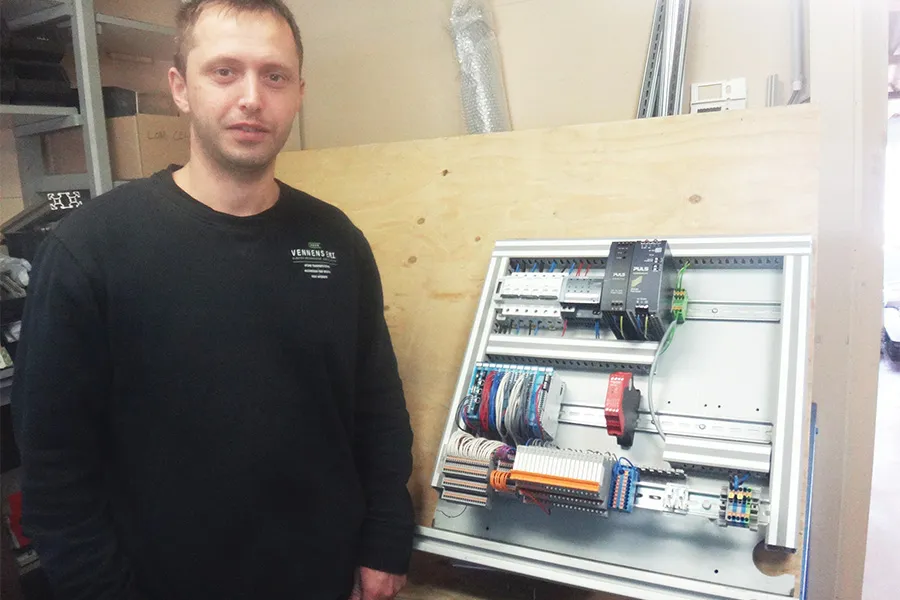
Vennens has been active in machine building for some time. He previously worked for TG Packaging, then went freelance: “I think it’s been about eight years since I left my previous employer. At the time, I kept Fridays for myself. I was getting more and more work of my own, so I cut back to three days a week and decided to start my own business in 2011.”
Vennens E.M.I. started out with electrical installations in homes and commercial buildings. This led seamlessly into automation and robotics. “Actually, I’d already been working on simple applications, conveyor belts, industrial maintenance… That’s how I started finding my own way.” Machine building picked up further from 2014, and became Vennens’ definitive focus market. Today, he is not only managing director, responsible for sales and administration, but also the machine engineer. He can leave drawing up schematics and mechanical and electrical assembly in the workshop to a colleague.
A varied mix of challenging projects
It would be an understatement to say there is no shortage of ideas and new projects getting under way. But Vennens only started programming with the SIGMATEK PLC two years ago. “One of the first projects was programming a machine to print a batch number on the caps of milk cartons. The cartons came out of the filling machine from two sides and had to be rotated onto a single sorting conveyor.” His new experience with comfortable, object-oriented programming using the LASAL Engineering Tool also led to the automation of food supply for a pigsty, namely the automatic filling and mixing of feed. “Using the PLC, we can control as many as 400 valves in the barn equipment, from field islands communicating via MQTT.” There was already a lot of interest at the recent trade fair in Ghent in a solution of this kind for accurately dosing dairy products.
Cobots that can do it all
So how did Vennens come up with a product such as the Flexstacker? He knows he is not the only one in this segment to offer a solution. He noticed that although various brands show what cobots can do, production companies in particular do not know what is actually possible. “In practice, you see cobots used mainly for palletising, even though they can be used for so many other applications.”
He came up with a modular unit the size of a Euro pallet (1200x600mm), making it very easy to automate production tasks. It is an application that can be used for multiple purposes in a small company. Modular and universally deployable, it can be connected to power and air, supports all possible data protocols, and can accommodate different types of robot. “I know several production companies in this area that have to shut down a particular production line simply because they don’t have enough people. With the Flexstacker, for example, we have a punching machine, a press brake and a welding application all in one, so metalworking companies can use all three applications. If there’s no welding work today, there’s bound to be a batch of bending work.”
Application under construction
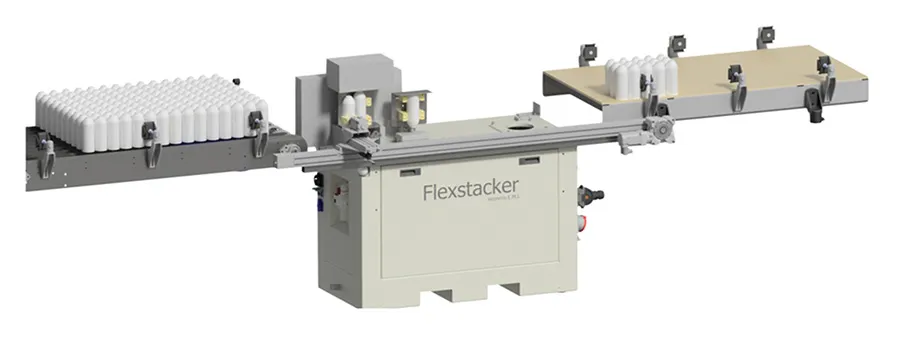
One real-world example is particularly striking. A line is currently being built in which the Flexstacker is used to fill aerosol cans with paint. It is almost unbelievable that this kind of production is still carried out manually. Vennens: “Here, a linear guide is connected to our application to fill empty aerosol cans. We pick up a can and place it in a filling station, after which the filling channel is cleaned and blown clear. The plan is to add a cobot to snap the caps on. And, of course, to put the cans into boxes at the end.”
The line will fill 600 cans a week on demand, but the station can already process five cans per minute. “It’s being built with exactly the same control system we would use for our cobot application. There are eight conveyor belts and a number of pneumatic cylinders. In the software, it’s important to know when each object needs to be started. We still have to write that for each project. Or we can add another programme to adapt it for a different application,” he says with a laugh.
SigmaControl will be at Precisiebeurs, stand 173, at Brabanthallen Den Bosch (NL) on 15 and 16 November. ■
A business enquiry for SigmaControl? Get in touch
Companies in this story
Keep following this
Get an email when a new story is published. No account needed.
- ThemeRobots on the shop floor
- SubjectServices & solutions
- CompanySigmaControl







