












Making your AGVs safe

People and machines must be able to operate in the same environment without problems or danger. Since 2020, anyone building or using AGVs has therefore had to comply with the guidelines in ISO 3691-4. This international standard defines the requirements for safety functions and specifies how AGVs’ automated functions must be validated. As a safety expert, PILZ also has this expertise in-house. The company can supply both hardware components to enable AGVs to navigate safely and a complete range of services, from designing the safety concept through to commissioning.
Safety and productivity are the two key priorities when developing AGVs. To ensure that neither comes at the expense of the other and that everything complies with the ISO 3691-4 safety standard, it is best to call on an expert. PILZ has more than earned that reputation, with the safety components and services needed for this specialist market. Nico Declerq, sales and marketing manager at PILZ, takes us through the offering.
“Safety is a crucial factor from the AGV design stage onwards. The earlier we can take safety aspects into account, the more unnecessary costs and time spent on later changes we can save. Our expertise enables us to make real progress for our customers. We find that what they particularly need is a sounding board to help them overcome the challenges they face.”
Design and build
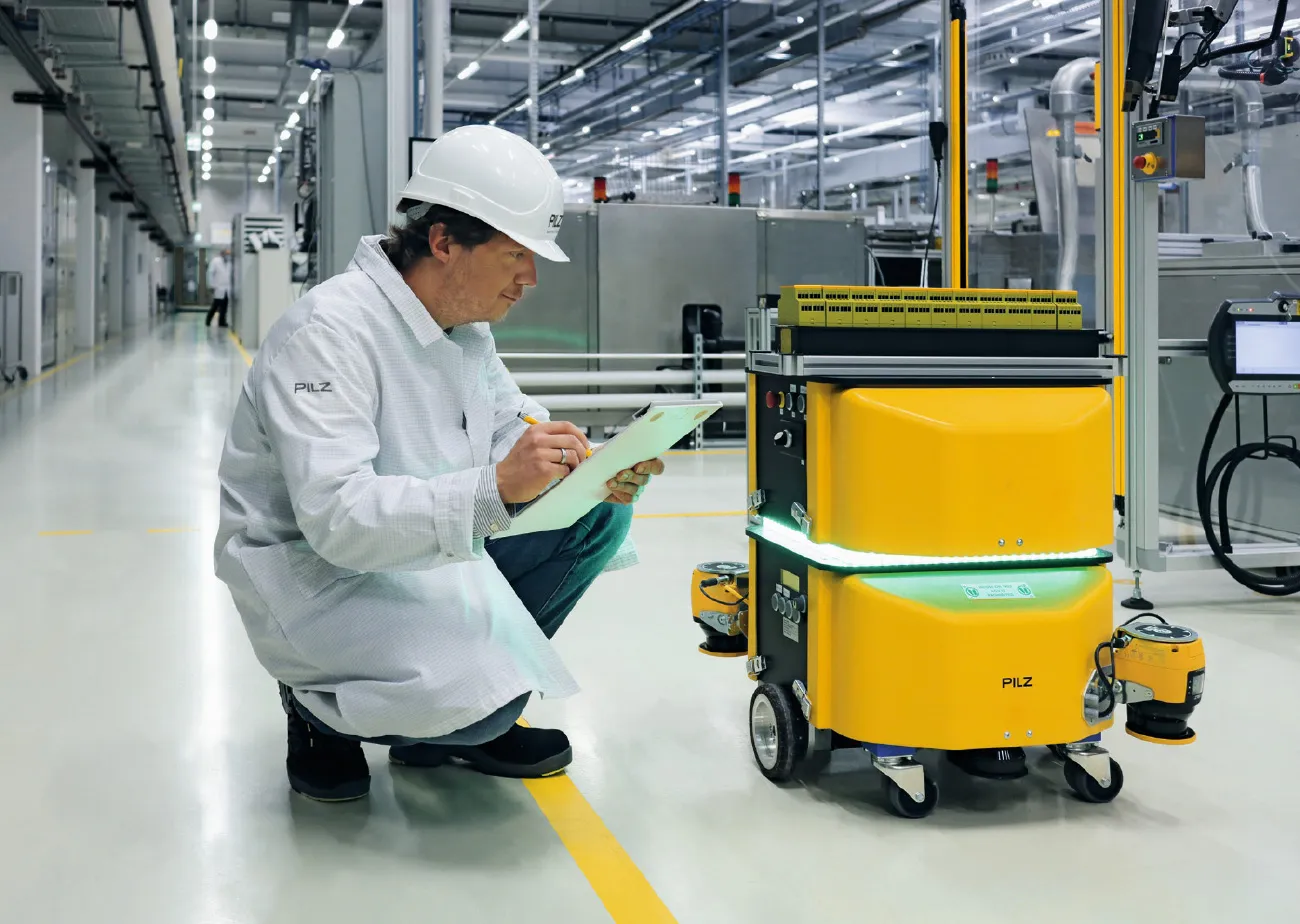
Working closely together, the first step is to determine exactly which protective measures are needed, based on both the vehicle itself (design risk assessment, factory acceptance) and the environment in which the AGV will operate (site acceptance). One of the most important elements in the safety architecture is, of course, the safety scanners on the AGV itself.
“Based on the data in the risk assessment, safety zones must be defined and appropriate actions linked to them. This can be achieved using conventional safety scanners such as PSENscan. This component is available in a basic version that uses a standard field, and an advanced version that continuously adjusts the safety zones according to certain parameters, such as the AGV’s speed,” Declercq adds. However, when the AGV has to navigate in challenging conditions, radar technology can be a good alternative. “Laser measurements can be affected by dust and dirt, whereas PSENradar is not. PILZ therefore has a solution for every situation.”
Safety controllers
A second important element in the safety architecture is the control system. The data collected by the safety scanners must also be transmitted and processed accurately and reliably to trigger the correct safety actions. PILZ can offer its customers several options in this regard too.
Declercq: “For very simple applications, a hardware-configurable safety relay such as PNOZmulti 2 is sufficient. For more complex applications, there is the software-configurable myPNOZ safety relay. Finally, the PSS4000 safety PLC provides a high-end solution. Safety encoders, PSENenco, can also be used as an option, either directly with PSENscan or via the PNOZmulti or PSS4000 safety controllers. There are several options, making it easy for customers to choose what best meets their requirements and budget.” PILZ also supplies other safety components, including PITestop emergency stop switches, light towers and a PITreader USB key system that allows authorised users to change the AGV’s operating mode,
for example for maintenance work.
A complete partner
What makes PILZ such a good safety partner is that it has the equipment, expertise, services and even training to help customers.
Declercq: “AGV builders are well aware that safety comes first. Being able to act as a complete partner is a real added value when it comes to making an application completely safe. This helps save time and costs, and users can be confident that they meet the requirements of ISO 3691-4.”
Question about this story? Ask your question
Keep following this
Get an email when a new story is published. No account needed.
- SubjectServices & solutions







