












‘Made in Belgium’: unique innovation in corner crimping presses
Text Valérie CouplezImage Beckhoff Automation
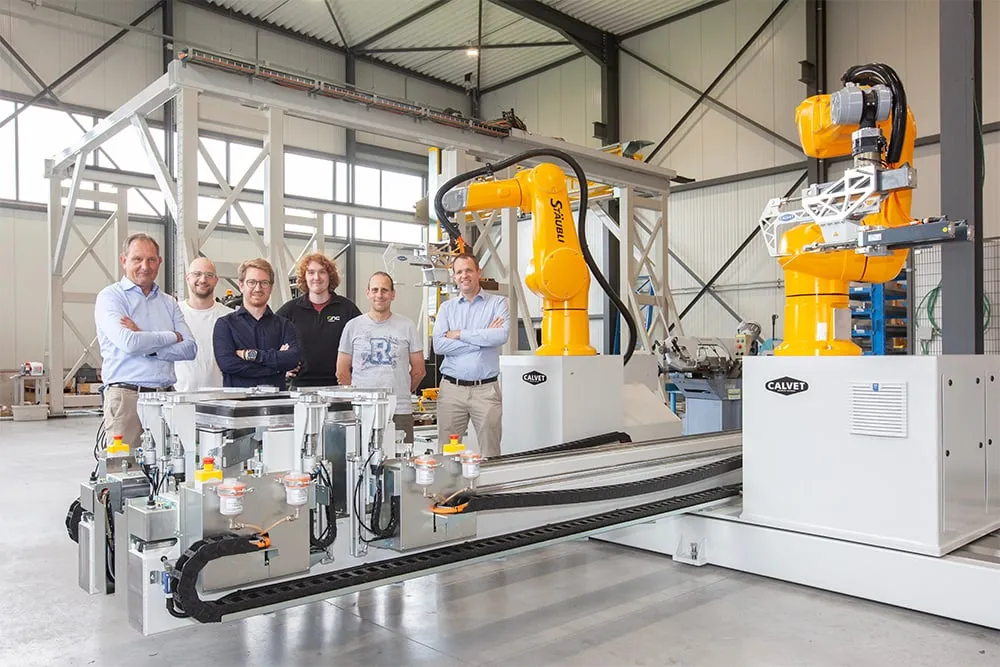
Cross-pollination. That is what happens when two creative machine builders join forces. Calvet wanted to develop its own series machine to bring more automation to the production of aluminium windows and doors. CNC Solutions helped develop and implement the concept. Beckhoff technology proved decisive in giving the machine the right feel.
Calvet, with sites in Zellik and Werkendam (the Netherlands), believes that industrial processes can be made smarter and more efficient through automation. For more than fifty years, it has done so by working with renowned brands and adapting their machines to meet customers’ specific needs. This time, its ambitions go further. “We mainly supply machines for manufacturing windows and doors. We want to build a machine that can combine various operations and processes, such as assembly, gluing, pressing and inspection,” explains managing director Stefan Nees.
Support from West Flanders
To do this, Calvet turned to CNC Solutions in Menen, West Flanders, which also specialises in custom machinery. Managing director Lander Debruyne says: “We specialise in CNC and robot applications. We build machines to control processes such as milling, sanding and blasting, working with a range of materials. We are a growing company with innovative solutions.” The best proof? The new premises they moved into in Menen 3.5 years ago have already become too small. An extension is due to be built by the end of this year. “We’re going to more than double in size. We’re adding 930 m² of production workshop space to make room to build more machines at the same time. We’ll need it if we add a series machine,” he says with a wink.
Raising quality with a unique machine
Calvet is aiming to make waves in the market with this machine. “It will be unique in our industry,” promises Nees. “A corner crimping press is used today to assemble a window. The process still involves a great many manual steps beforehand. Preparing the window, in particular, has to be done meticulously so that the crimping press can do its job. We’re bringing all these steps, assembly, bonding, pressing, inspection and cleaning, together at one central workstation, operated by a single person. This concept will not only boost efficiency, but also improve finishing quality.” Calvet and CNC Solutions have now been working on the project together for four years. Nees says Debruyne and his team’s contribution was crucial. “We were stuck with our own concept. Their clear technical perspective gave it a new direction. By combining their innovative ideas with our experience of how a corner crimping press should work, we achieved what we set out to do,” says Nees.
A gripper with a feel for the job
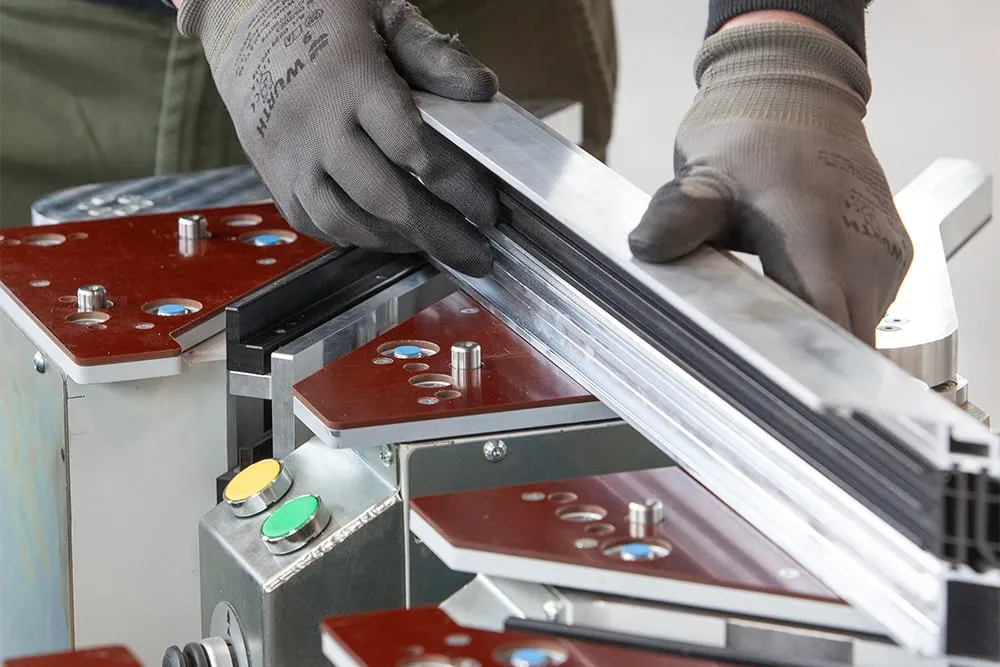
Flexibility topped the list of requirements for the machine. It had to handle different profile types, sizes, pressing positions and bonding techniques. Two six-axis robots therefore form the heart of the system. The robots adjust their positions according to the size of the workpiece, from 300 to 4500 mm. They can also change grippers automatically, depending on the production step. “The unique feature is the specially developed gripper for pressing the corners. It really embodies Calvet’s expertise,” explains Debruyne. But smart technology from Beckhoff Automation also played a part. “The new AA3000 electric cylinders have enabled us to give the machine a ‘feel’ for the job. The operator places the frame on one of the trolleys. A sensor that supplies the actuator checks whether all the parts fit together properly before clamping and pressing. Think of it as handling an egg without breaking it. This built-in intuition has helped raise the quality bar considerably.”
The logical choice
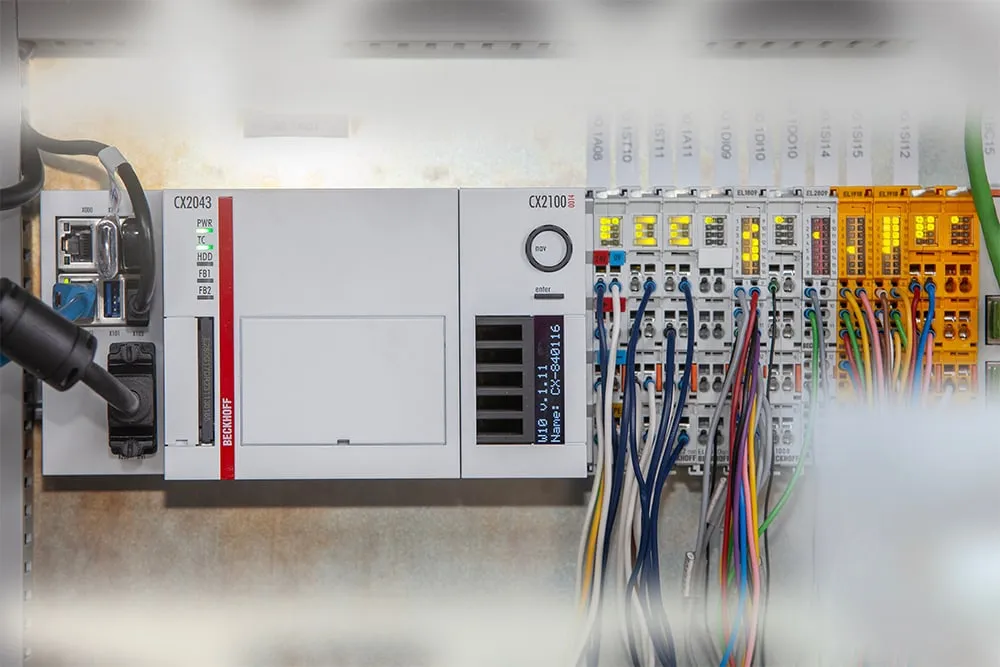
The use of Beckhoff technology in this machine is no coincidence. And it is not limited to the electric cylinders: the machine already has almost 300 I/O modules alone. Debruyne explains: “Two years ago, we switched to the Beckhoff platform, adopting the CX2043 embedded PC as our standard control system, because we were constantly running into availability issues with our previous supplier. Our choice of Staübli robots made Beckhoff the logical option. Both use EtherCAT and are on the same wavelength in terms of technology and mindset. Switching control technology is no easy matter, after all. Fortunately, we can call on application engineer Maarten Knevels. With his support, we now have around seven machines with Beckhoff controls in the field.” Beckhoff is expanding its service offering with application engineers, who help new customers get started or support existing customers in implementing new technology.
Programming fifteen CNC axes
The programming workload was also a key challenge in this project. “Alongside the robots, the machine has fifteen CNC axes. We have perfectly synchronised all the inputs from the controller, robot, sensors and motors. We use a multi-axis servo drive system. This makes for a very compact design: one power supply module is enough to handle communications, power and electronics. The motor modules, AX8000 servo technology and AM8000 motors, simply plug in. Add Beckhoff’s one-cable technology and you also need very little cabling and only a small control cabinet,” says Debruyne. Safety was another priority. Thanks to the integration of safe motion technology, there is no need to build a fence around the robots. “Safety scanners tell the control system when someone enters the area. The machine then slows down or even comes to a complete stop, depending on which zone is entered.”
Ready for real-world use
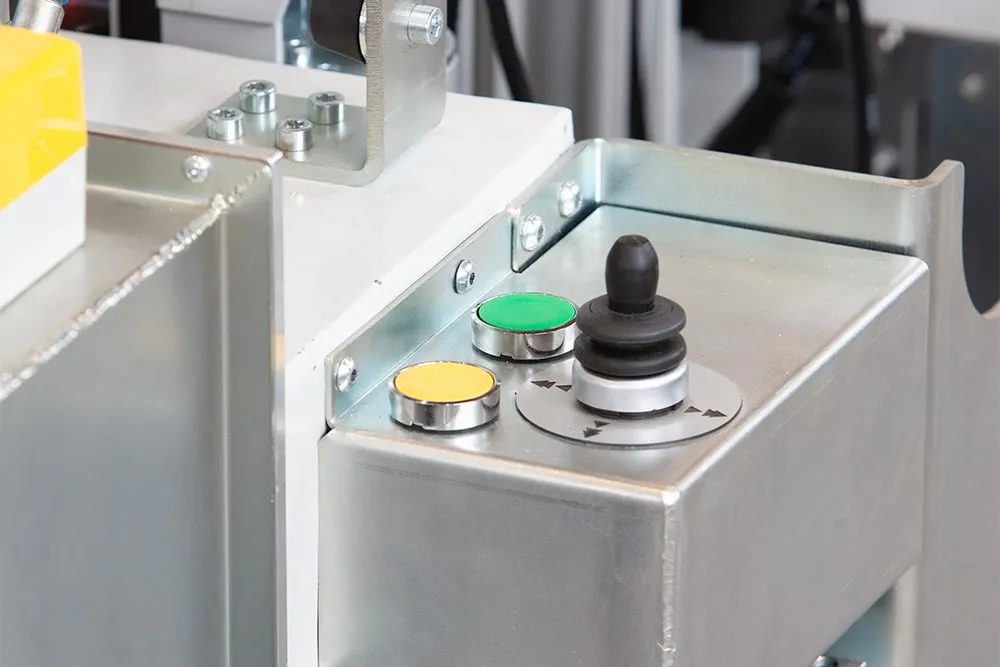
The programming is now complete. The first prototype is ready to be sent to a customer in the Brussels area. One striking feature is the large screen beside it. “The operator can follow everything on it. For us, Industry 4.0 means making complex technology as simple and intuitive as possible. The operator scans the barcode and sees the steps they need to complete. They have just two buttons for moving to the next or previous step. It could hardly be simpler.” The plan is now to test the machine extensively in real-world conditions. “That experience will help us turn it into a true standard machine. We’re convinced there’s a market for it. Automation is the answer wherever labour costs are high,” concludes Nees.
Een zakelijke vraag aan Beckhoff Automation? Get in touch
Companies in this story

Keep following this
Get an email when a new story is published. No account needed.
- SubjectServices & solutions
- CompanyBeckhoff Automation







