












Fully automated assembly for precision electronics
Text Valérie CouplezImage Vintiv
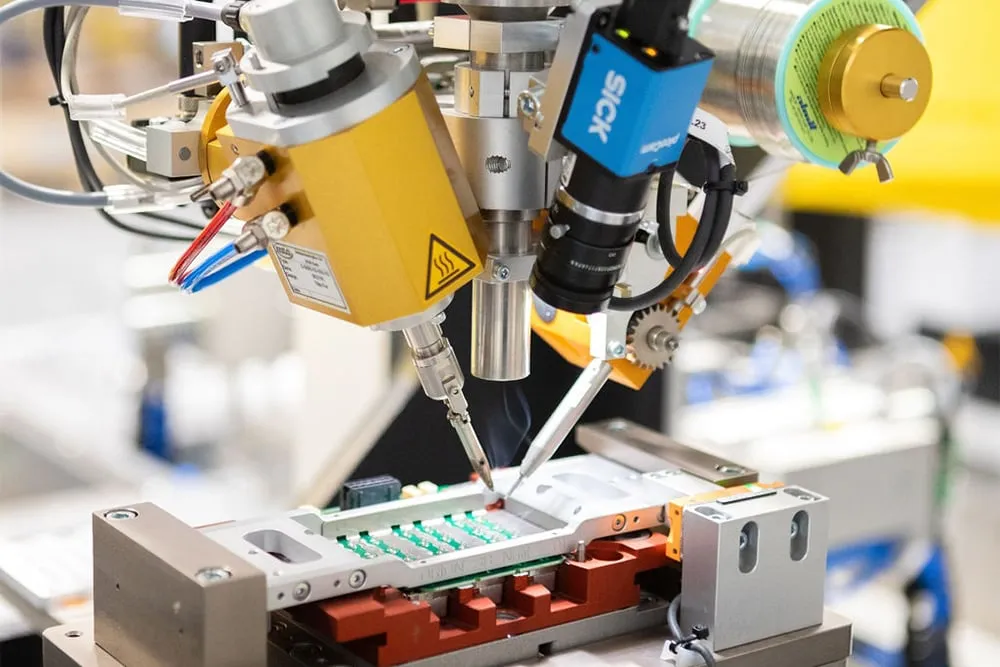
High-tech products call for a high-tech production process. To further improve its quality, a Belgian manufacturer of inspiring visualisation and collaboration solutions recently invested in a project to automate the assembly and inspection of light-emitting components. A fine example of bespoke engineering, and one that Vintiv was happy to get behind.
The assembly in question is crucial to the user experience and product quality. However, assembling the modules perfectly involves a great deal of work. They consist of four parts. The base is a backplate to which cooling fluid is applied. The light-emitting components are first soldered onto the PCB material and then screwed onto the backplate. Rubber seals are also fitted during finishing. “Until recently, this was done semi-automatically. A machine handled dispensing, soldering and screwing, but the operator had to remain on standby throughout to move everything on to the next step,” explains Timen Floré, describing the starting point.
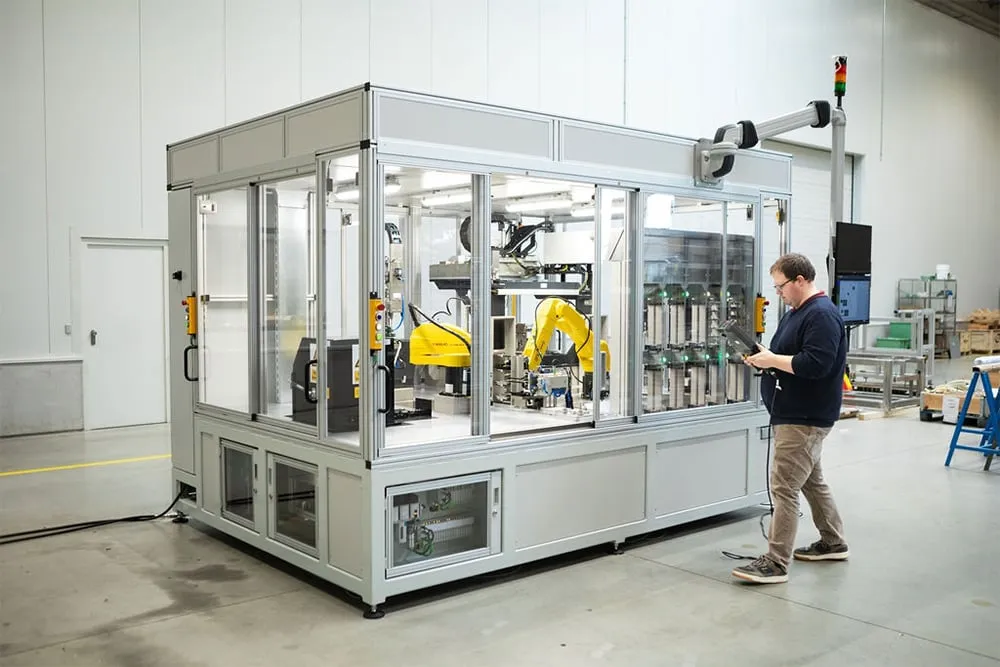
Greater flexibility and quality in a shorter cycle time
With a new generation coming on stream and demand expected to rise, that solution would no longer be sufficient. Floré explains: “The cycle time had to come down. The new solution also had to process both the old and new versions flexibly. Finally, the customer wanted quality inspection fully integrated from the outset. The previous process did not always run smoothly.” The Vintiv team set to work on a new concept. This was the first project for this customer at the Waregem hub. “Our expertise in precision engineering and our own turning and milling workshop helped build the necessary trust,” says Floré.
Challenges posed by product variations and positioning
One challenge was the range of variations. “There are different types of assemblies, with different designs, components and process steps. The addition of the new generation also meant that soldering had to be done differently.” Precision was another crucial requirement. “Positioning has to be accurate to within a fraction of a millimetre,” says Floré.
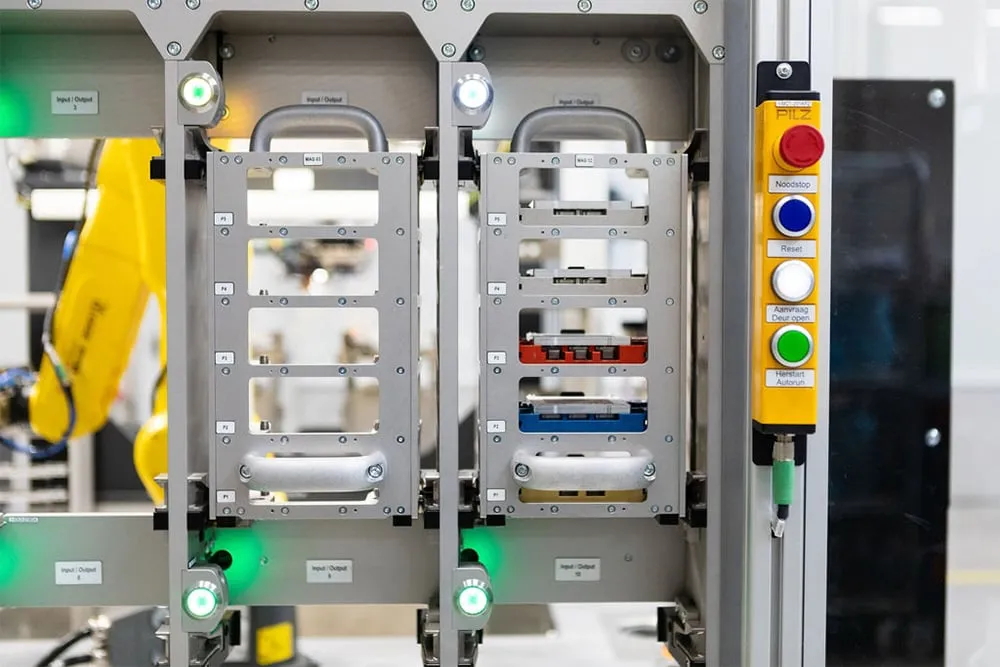
To make all this possible, Vintiv proposed a new concept. By using fixtures made in the Vintiv workshop and equipped with programmed RFID tags, the machine always knows exactly which product is next and which production steps it requires. The fixtures, together with the robots’ precision, ensure the required accuracy for every product variation.
New concept
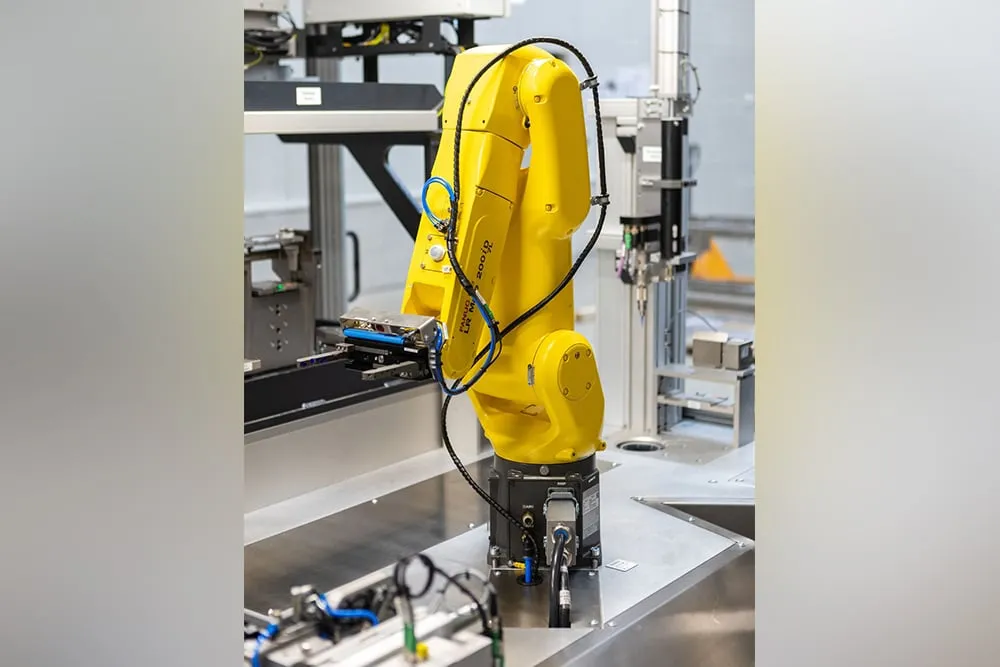
Production is now fully automated. Operators simply prepare the ‘raw materials’ (the fixtures holding the components) in the preparation cell, which is controlled by the ERP system, and then place them in the buffer, which has fifty positions. The machine takes care of the rest. Inside, the two robots, a six-axis robot and a SCARA robot, act as conductors, orchestrating movement and positioning. The six-axis robot takes the PCB material to the soldering process and the backplate to the dispensing unit, before delivering them to the turning station. There, the material is rotated through 180° and transferred to a new fixture from a separate storage cabinet. The SCARA takes over and places the fixture in the screwdriving station, followed by laser engraving, an additional step to ensure perfect traceability. The final stop is the inspection station, which meticulously checks that everything meets the required specifications and that all connections work correctly. From there, the products follow the reverse route, all the way back to the buffer.
Blood, sweat and tears
“Everything is based on RFID, so the customer always has the latest information on the status of each product. When the parts are turned, all the data is immediately written to the RFID tag on the new fixture. Positioning is ensured by the locating pins on the fixtures. This also allows us to process every possible variation with the same degree of accuracy.”
The cycle time has been cut to under four minutes, fully meeting the customer’s expectations. “Programming all the sequences took blood, sweat and tears because of the wide range of variations and the fine positioning required. But we’re incredibly proud of the result. Thanks to the line’s design, new developments and generations can also be assembled on the same line by making additional dedicated fixtures. The aim is to deliver every assembly 100% correctly,” concludes Floré.
Een zakelijke vraag aan VINTIV? Get in touch
Companies in this story

Keep following this
Get an email when a new story is published. No account needed.
- SubjectServices & solutions
- CompanyVINTIV







