












‘Fleximatise’
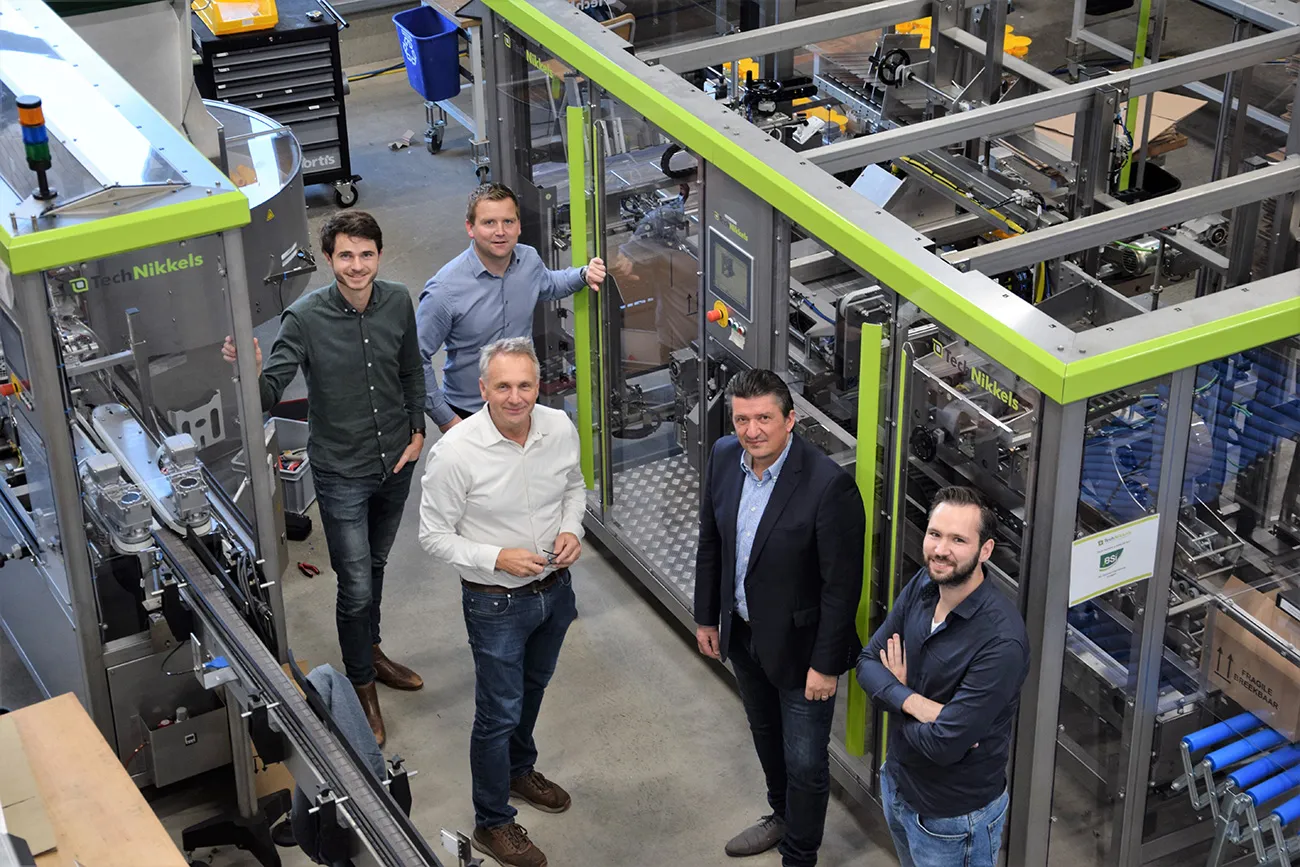
At TechNikkels, ‘fleximatising’ is their motto: automation, but with flexibility. They develop and build machines for feeding, filling and closing bottles, jars and (jerry)cans, as well as American-style folding cartons, specifically for companies that handle a wide variety of these packages. Lenze is their partner for automation projects.
Managing director and founder Henk Nikkels has built up extensive experience in special-purpose machine building at several large industrial companies. He founded TechNikkels in 2003 and began developing its own filling and packaging line in 2011. The company is now well established and is investing heavily in servitisation. “Initially, our focus was mainly on building high-quality flexible machines. Now we also focus on helping customers get the most out of our machines. Because we operate locally in the Netherlands and Belgium, we can respond to enquiries very quickly. We prefer to do that remotely, but if necessary we can be on site quickly. In five years, things may look quite different. We may be able to serve new markets more easily, having further developed our remote support using all the tools available.”
Performance is key
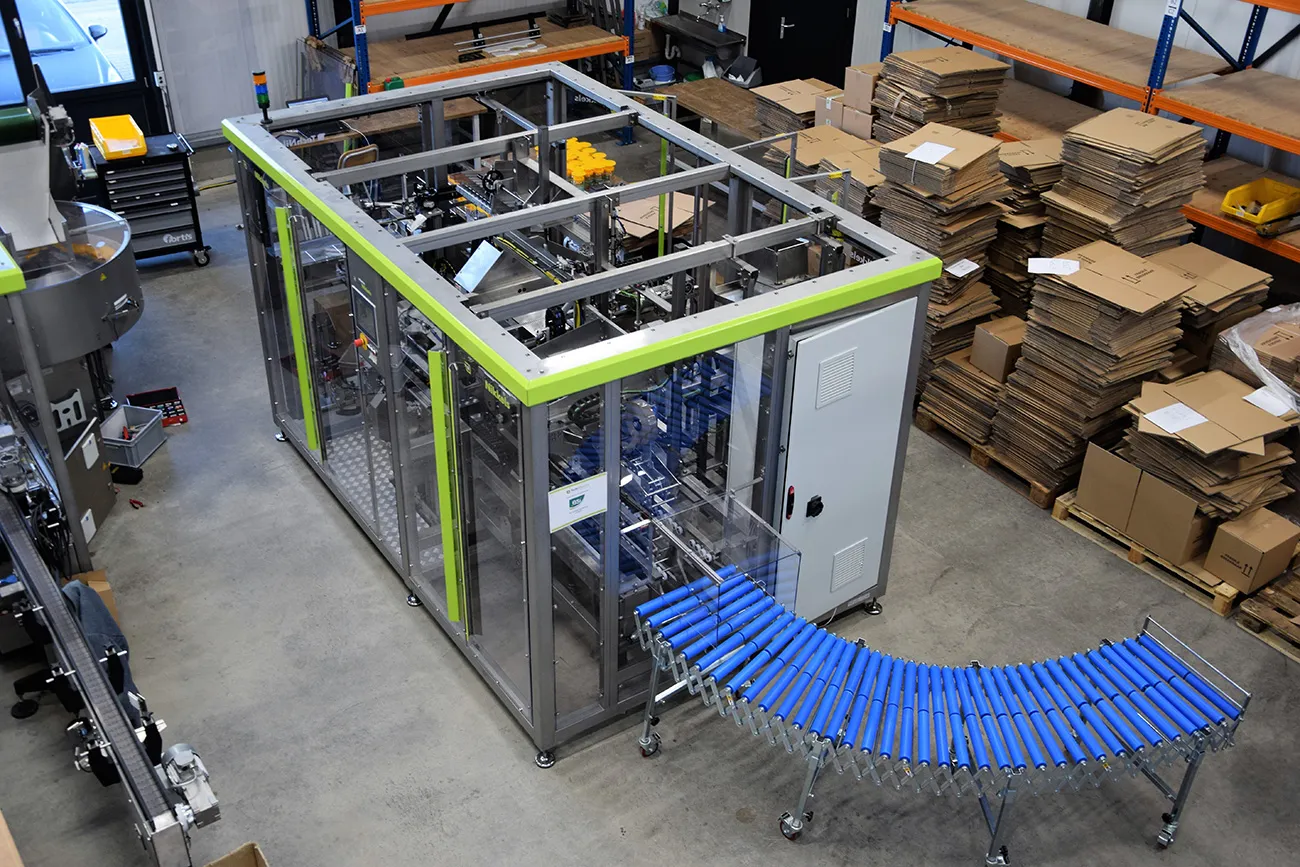
TechNikkels’ machines fully automate various stages of the packaging process, such as feeding packaging, filling it, closing it and packing it into a box. “Packaging can vary considerably, not only in shape and size, but also in the material used and the tolerances on its thickness,” explains Thijs Krijgsman, sales and service manager at TechNikkels. A transparent plastic bottle is being tested on a machine at high speed. “We want to deliver not just a machine or a line, but also optimal machine performance and a smaller carbon footprint. That means we also take a proactive advisory and development role in monitoring.” Industry 4.0 and digitalisation can help with this. One example is creating dashboards to improve OEE. “We have a wealth of data at our disposal that informs further development and optimisation. Data from the machine is purely factual. You can use it to analyse production and see exactly where improvements can be made. It provides objective data to support your OEE. The aim is not to tell customers how to do things, but to give them tools that help focus on the right areas.”
Flexibility
TechNikkels’ flexibility is reflected not only in the types of packaging its machines can handle, but also in how they are used: operation, changeovers, control … “Our machines are specially designed for a broad product range, and that is what sets us apart,” says Krijgsman. “That is why all our machines can be changed over very quickly, or even fully automatically. Batches are often small these days, and product life cycles are short. Being able to switch quickly and easily without errors is essential. Everything is designed to make the line easy to operate. That matters when staff turnover is high, and means virtually anyone can operate the machine.” Nikkels explains that “everything in the machine is geared towards handling variation. We select the right technology for each process, such as placing bottles in a box. We try to use as many components as possible from a single supplier, so that everything is aligned from the outset.”
Remote support
For remote support and condition monitoring, the PLC effectively acts as a gateway to the outside world. It becomes both actuator and communicator. Lenze project manager Stefan van Dooren explains how it works: “All the data is displayed in a dashboard. That adds real value because everything is aligned: it’s a true end-to-end solution. And the dashboard is an excellent tool for OEE monitoring.” Krijgsman adds: “Showing figures is not the hard part. What matters is information and context. Customers want dashboards that are as simple as possible, presenting information clearly and in a way that everyone can understand. We ask customers what information matters to them and build a clear dashboard based on their requirements, populated with objective information. That gives production managers something they can act on.” Nikkels sees further opportunities: “The HMI can make a real difference to an operator’s job satisfaction. But for us, what matters is reducing downtime by being able to look in remotely. That way, we can provide support very quickly when a machine stops.”
Maximum support
Another example comes to mind. In 2014, TechNikkels built a large special-purpose machine for packing wrapping paper. At the same time, the company was already working on an order for a large line. “It was a matter of working smart. Both projects had very short lead times, and you can’t just conjure up extra staff. We contacted Lenze about the controls for those two projects, and we hit it off straight away. We received all the support we needed to complete both projects on time. That was at the start of our partnership, and I have to say we’re very pleased with Lenze as a partner, both in automation and in operational technology. We’ve worked together on many projects since then, and we’re very satisfied.”
Installed base management
OEE is clearly in good shape. But asset management also benefits from objective data and information. Daan Nikkels, who is responsible for service business development at Nikkels, says: “If you can keep track of your installed base effectively, you can build up organisational learning based on a history of enquiries and incidents. All inspections are visible, in short, you have the complete history of your installations. We’re running a pilot with Lenze in which customers send us all their enquiries through a single portal. It’s very accessible, but it only works if customers embrace the new solution too.” Van Dooren is leading the pilot for Lenze: “The platform enables us to provide remote maintenance and log all information, for example about faults. All documentation is stored there too. Everything is centralised, with a comprehensive historical overview.” Developments are moving ahead rapidly. Nikkels says: “Automation will become increasingly important, not only to save costs, but out of sheer necessity, because production lines will have to operate with fewer people. There is a shortage of people, resources and materials, so it’s a real advantage to have a supplier nearby.”
Question about this story? Ask your question
Companies in this story
Keep following this
Get an email when a new story is published. No account needed.
- SubjectServices & solutions
- CompanyLenze BV







