












Energy management and production are no longer separate worlds
Text Valérie CouplezImage Schneider Electric
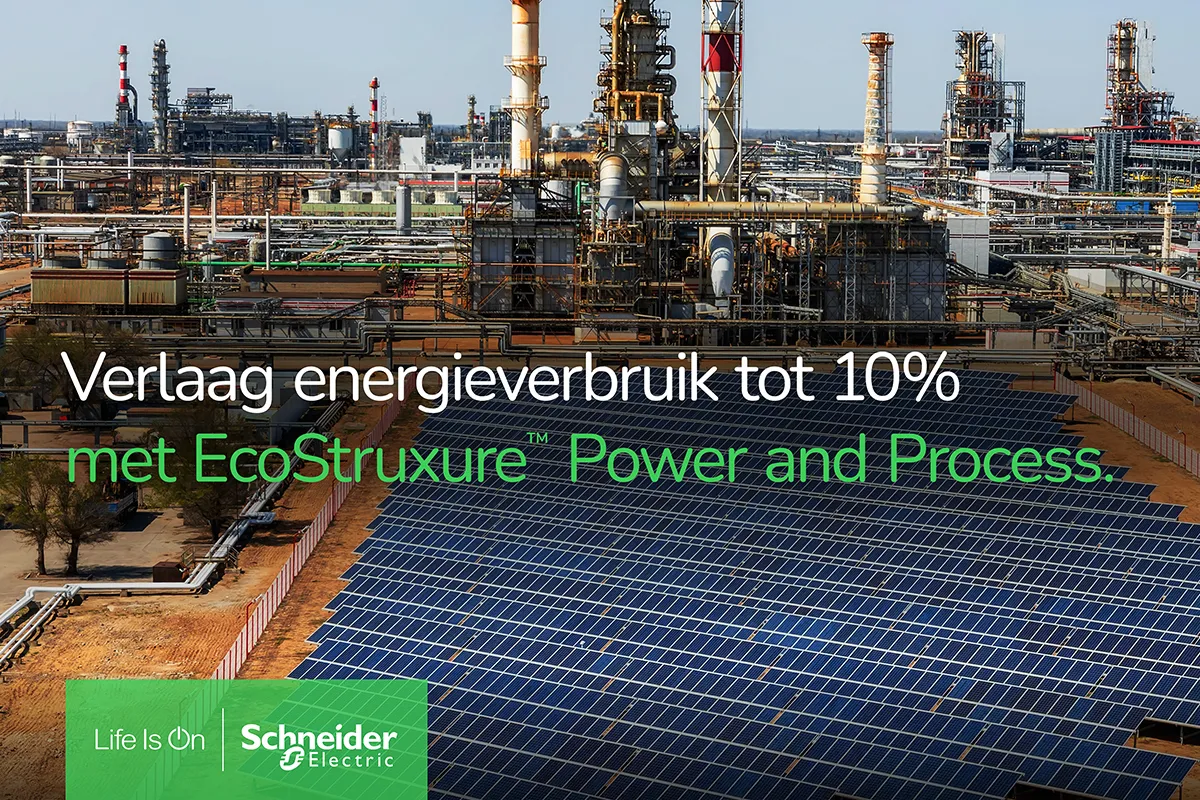
It used to be simple. You plugged into the mains and your production ran at an affordable cost. Today, the situation is far more complex. “Regulations call for decarbonisation and therefore electrification. At the same time, companies are grappling with higher energy prices and, in some cases, even the availability of electricity itself. The energy question is firmly on the agenda,” says Sander van Reijzen, vice-president for Industrial & Process Automation at Schneider Electric. “And Schneider Electric is uniquely positioned to come up with effective solutions.”
In other words, companies need to rethink how they manage energy, especially now that renewable energy and dynamic tariffs are adding new pieces to the puzzle. “When does it make sense to produce energy, and when to consume it? And how can I guarantee availability? Energy management is increasingly becoming part of the bigger picture. It is best fully integrated into production and across the entire lifecycle of a machine, line or plant. Only then can you really optimise,” van Reijzen believes.
A portfolio for both worlds
This ever-closer integration makes Schneider Electric a natural partner for many customers. “Our portfolio has always covered both worlds: power and process, energy management and automation. There are plenty of software start-ups offering tools for working with renewable energy. But if, for example, you want to produce hydrogen, you also need to understand how an electrolyser works and what its impact will be. We can bring both sides of the equation together and integrate them seamlessly, with hardware and software, but above all with a wealth of expertise.” That is precisely the barrier preventing many companies from making progress with power and process. With so much more to consider, it is difficult to see the wood for the trees. “There are so many variables to take into account …
you can no longer capture it all on paper. That is why we believe strongly in digital twin technology to make the energy question manageable.”
Rethinking engineering
So the sooner we can get round the table, the better. Van Reijzen gives an example to illustrate the point. “You cannot simply replace a gas boiler with an electric one. You need to think carefully about the impact on the rest of your process. Traditional engineering often involves oversizing equipment, just to make sure there is always enough capacity. That may not be necessary at all in your new business case. Could you choose a smaller boiler, for example? Does it need to operate 24/7, or does it need to meet different requirements? We look not only at the design, but also at the best decisions to make over the entire lifecycle. The earlier we are involved in those discussions, the more of our expertise we can share. And the more the customer can tell us about their process, the more value we can bring to a project. It really is a two-way process.
Success stories
A Dutch potato processor has already carried out this exercise with Schneider Electric. The aim was to install a new electric boiler, keep consumption below 10 MW and compare the electricity bill with the actual values recorded by the relays. By linking Aveva software with EcoStruxure Power and Process technology, the starch and protein producer created a single integrated solution combining energy and process control. It now has all the tools it needs to align production and energy management perfectly: load-shedding capability, overload alarms, network analysis and stability improvements, and safe remote switching. Scalability for future improvements is also guaranteed.
For every customer
Whether it is a brownfield or greenfield project makes no difference to Schneider Electric. “Both can deliver substantial savings. The advantage of a greenfield project is that you can start with a clean slate and make the best choice for every process step. With a brownfield, on the other hand, more data is already available to build your statistical model. Companies can also decide for themselves how far they want to go with such a model and with optimisation. Any customer working on electrification or optimisation can benefit from an integrated approach to power and process. You do not even need to be a huge operation. We help customers turn their ambitions into concrete investments in hardware and software,” van Reijzen concludes.
Een zakelijke vraag aan Schneider Electric? Get in touch
Companies in this story
Keep following this
Get an email when a new story is published. No account needed.
- SubjectServices & solutions
- CompanySchneider Electric







