












Corona ventilator becomes 44% more energy-efficient
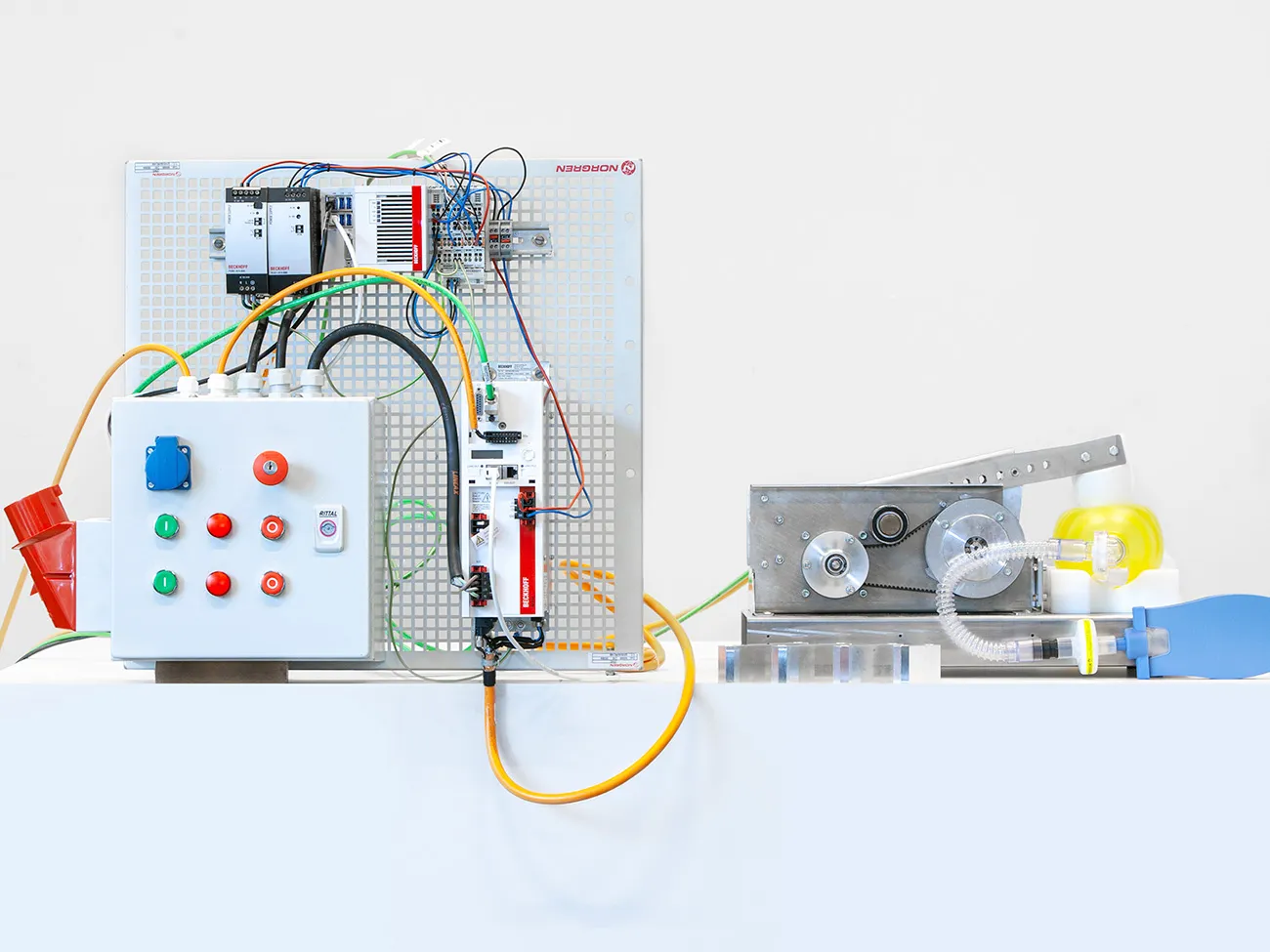
The drive train has a major bearing on a machine’s energy consumption and productivity. In most cases, percentage gains in these areas deliver a better return on investment, but when it comes to ventilators, they can save lives. Researchers from Universiteit Antwerpen and UGent drew on their experience from an earlier project to further optimise the design of the corona ventilator developed by Gear Up Medical vzw, achieving an impressive 44% energy saving. Beckhoff Automation’s technology and support proved to be one of the keys to this success.
A CAD package can do more than just draw. During the TETRA research project AMoCAD, a team from UGent learned how it could be used to optimise a drive train. Project leader Bart Vanwalleghem: “Modern CAD packages have the necessary capabilities to simulate movement. By combining these with smart algorithms, we can determine how to dimension the drive train and select and tune its various components optimally. We bring the CAD design to life, as it were, with motion simulations. This is important because correct dimensioning can result in a more energy-efficient or smaller drive.”
Developing an alternative ventilator
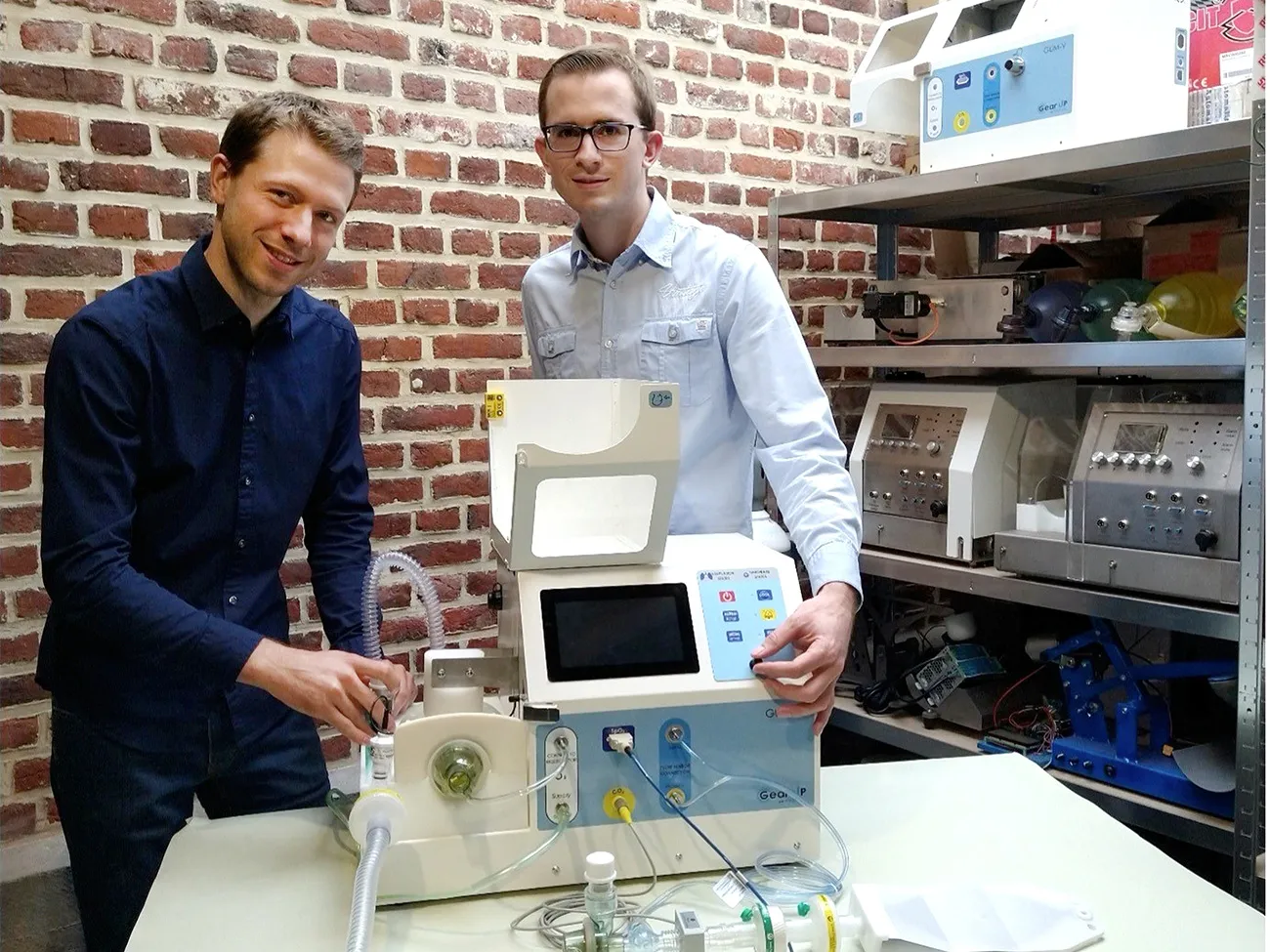
The methodology developed had already proved itself in six industrial case studies, but recently found a new application. The potential shortage of ventilators during the first wave of coronavirus and the fear of distressing situations such as those in Italy affected everyone. Stijn Herregodts, a doctoral researcher in robotic surgery at UGent, and his brother Jan, a medical student at UGent, therefore developed an alternative ventilator, the corona ventilator, under the Gear Up Medical vzw banner. They focused on the essential functions needed to support the breathing of a coronavirus patient or, if necessary, take over ventilation completely. To build an initial prototype quickly, they chose commercially available industrial components. With support from, among others, Kim Robbens of the Beckhoff support team, they were able to test drives and motors very quickly. The team at the CoSys lab of Universiteit Antwerpen, led by Stijn Derammelaere, got in touch to ask whether they could contribute by helping to optimise the design.
The importance of energy efficiency
Derammelaere: “At the start of the project, we did not know for certain whether it could be improved. But experience tells us that it usually can. That is precisely because the drive train is rarely the starting point when designing a machine. We, however, focus on it. We use the CAD environment to assess how much energy each movement requires and the impact of changes through simulations, in other words, virtual engineering. In the case of ventilators, energy efficiency can mean the difference between life and death, since power is not always available everywhere. The less energy ventilators consume, the longer emergency generators will last.”
State-of-the-art motor technology
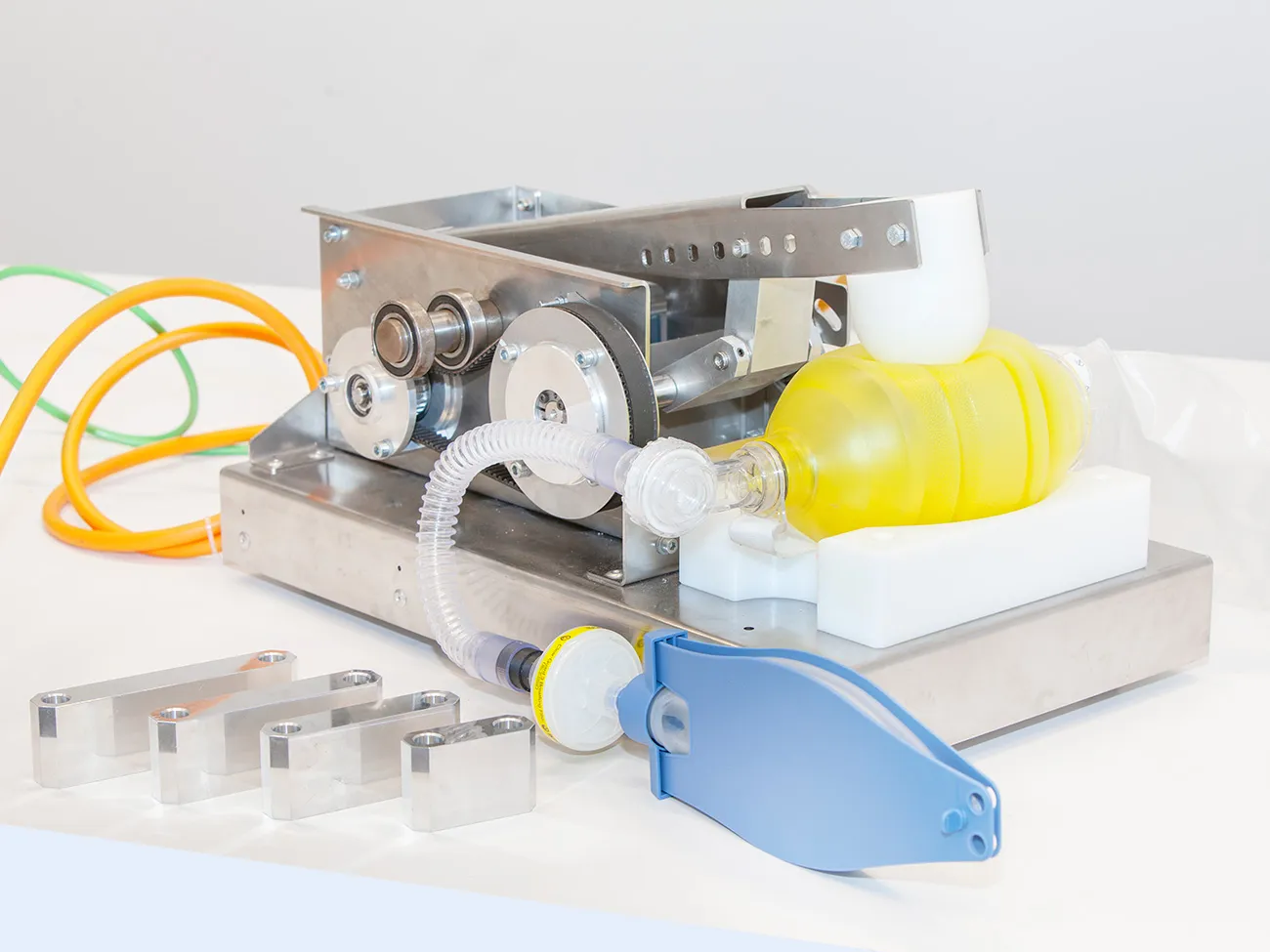
The partners’ contributions were crucial to making this possible. “This allows everyone to play to their strengths. Our colleagues in Ghent are skilled in CAD, while our strength is the optimisation algorithm,” Derammelaere continues. Beckhoff Automation was chosen as the technology partner. “First and foremost because of the breadth and depth of its product range. For example, it offers both stepper motors and permanent-magnet motors. Whichever option we choose, we have access to state-of-the-art motor technology that we can test on the same platform,” says Vanwalleghem. “We can also count on excellent support. We involve our students in the projects too. That support is particularly valuable for their learning, for example when tuning motors to build intelligence into the drive. It ranges from improving parameters to sharing best practices.”
The methodology
But how exactly does the methodology work? Project engineer Simon Houwen explains: “It all starts with the customer’s needs. In this case, how could we move from point a to point b as efficiently as possible in 0.7 seconds, the time needed to compress the bellows? The CAD model first examines the machine concept. Are connecting rods the best solution from a drive engineering perspective, or would a robot, a spindle or … be a better choice? Motion simulations give us an initial idea. Then we run the optimisation algorithm. It calculates the exact torque for every trajectory and geometry.” This is where the team’s knowledge and experience make all the difference. Simulations take a long time to explore all the possibilities. “We can filter out anything unrealistic in advance,” says Houwen

The importance of motor selection
The next step involves motor selection and drive tuning. Vanwalleghem: “It is particularly convenient for us to work this way because we know that the Beckhoff platform can handle whichever electric motor we choose and whichever controller we select. Feedforward control was important, for example, because of the dynamic performance required by the corona ventilator. That calls for a controller capable of delivering it.” The team ultimately focused mainly on improvements to the lengths of the connecting rods and the mounting points. “In fact, these are small adjustments that have little impact on the original machine design but greatly improve energy use: by an average of 43.61%, and by as much as 47.13%. By varying the inertia, you can achieve many improvements: lower torque, reduced consumption, a smaller motor …”
Bringing theory and practice together
Virtual engineering is only one side of the story. Two new prototypes were also built to demonstrate the results. “The difference between our approach and machine learning and artificial intelligence is that we can prove beyond doubt that our proposal is the best possible solution. Machine learning and artificial intelligence require a great deal of data but cannot yet guarantee the very best result. Today it may be 30% better, and next time 34%. With the procedure we have developed, we can guarantee that the design we arrive at is the most efficient. What’s more, you have to build realistic models. You can come up with the most brilliant ideas, but the machine builder ultimately has to put them into practice. That is why the contribution of a partner such as Beckhoff, with its industry-proven technology, is so important,” concludes Derammelaere.
Question about this story? Ask your question
Companies in this story

Keep following this
Get an email when a new story is published. No account needed.
- SubjectServices & solutions
- CompanyBeckhoff Automation







