












A bright future for bespoke industrial machinery
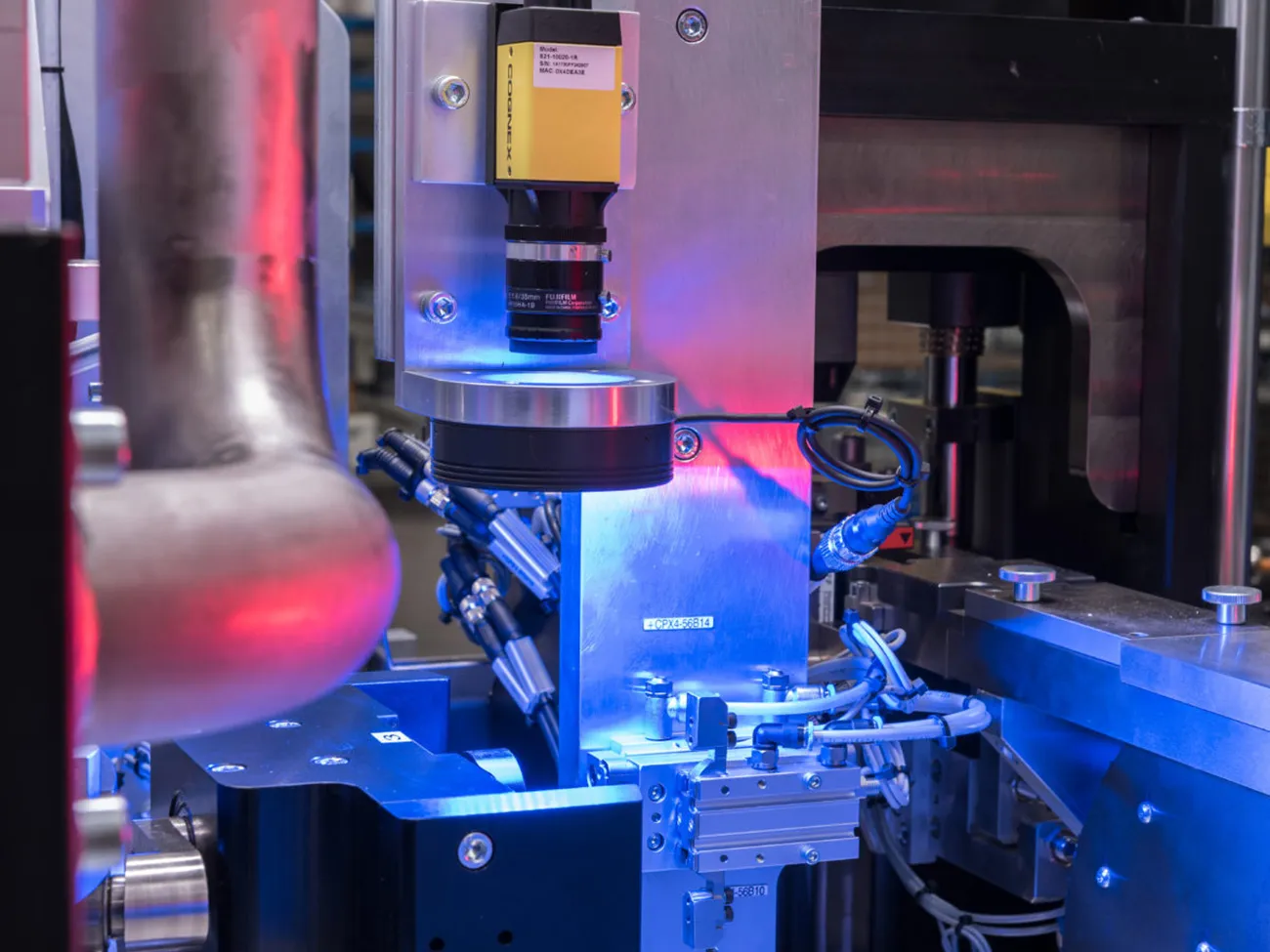
From bespoke machine builder to full-service developer for the manufacturing industry. From IMA Beringen to VINTIV. And from Limburg to West Flanders. This company has come a long way. And there is plenty more to come, judging by how much VINTIV has evolved in just two years. We caught up with Joris Ceyssens, Steven Geudens and Johan Doucé, three of the many people helping to drive the company forward.
IMA Beringen changed its name to ‘VINTIV’ almost two years ago. How do you look back on that change?
Joris Ceyssens: We had been operating as IMA Beringen for some time and realised that our outward image no longer reflected what was happening inside the company. We looked like a traditional Flemish SME, but we were building highly advanced machines for renowned international customers. So we chose a brand identity that better reflects what we do. It needed to feel fresher and more modern: ‘VINTIV’ brings to mind ‘inventiveness’ and ‘innovation’. And the word ‘business’ in our strapline ‘Businesslike machines’ shows that we always take a commercial approach to projects. ‘Like’, in turn, points to the human side of our company and the enjoyment we get from our work. Although we are shareholders, there are no CEOs or CFOs here. We are a flat organisation.
Steven Geudens: Admittedly, there was some uncertainty and trepidation. In the past, we had something familiar to fall back on; now we were starting from scratch again. But in the meantime, we have already reached a higher level than before. The three of us have invested a great deal in the company, so we sometimes have to pinch ourselves when we see where we are now.
“There are no CEOs or CFOs here. We are a flat organisation.”
A MANUFACTURING INDUSTRY IN FLUX
The past two years have been challenging for many companies. How have you seen the market evolve?
Joris Ceyssens: Since we build bespoke machines, we work for companies that are willing to pay a premium over a standard solution. Our customers are therefore active in sectors that are doing well, or are so innovative that no solutions are available yet. In recent years, we have seen strong growth in the pharmaceutical sector. The pandemic generated a lot of work for us, including further development of existing machines for making plungers and packaging for injection needles. The entertainment industry, including card and board games, is also doing well. The automotive sector, by contrast, has almost ground to a halt, partly because of the shortage of raw materials and the war.
“The pandemic generated a lot of work for us.”
Are you also seeing different demands from the market?
Steven Geudens: We are increasingly being asked to retrofit machines. This involves upgrading obsolete machines with new control software and hardware to improve their performance. Employers are also paying much more attention to safety and wellbeing these days, so their assets need to be modified in that respect too.
Johan Doucé: Energy will probably become a factor in the future too: machines will be retrofitted to operate more energy efficiently.
Joris Ceyssens: Digitalisation and connectivity will also become more important. Partly as part of Industry 4.0, and partly to make machines less dependent on operators, as skilled operators are becoming hard to find.
“More and more machines are being retrofitted to improve safety, energy efficiency and digitalisation.”
BESPOKE AUTOMATION IN THE PHARMACEUTICAL INDUSTRY
Where is there still significant potential?
Johan Doucé: Pharma will certainly continue to grow. Not much has been automated in this sector yet, unlike in automotive, for example. That is also because the latter sector thinks in terms of processes, which are easy to automate. Pharmaceutical companies tend to think in terms of recipes instead. As a result, for now we mainly see standard machines in that sector.
Steven Geudens: But our pharmaceutical industry will face increasingly stiff competition from abroad, and that will inevitably create a need for bespoke automation.
“Stiffer competition is driving demand for bespoke automation.”
Joris Ceyssens: Automation helps keep costs under control. And what matters most today is that it helps maintain production levels when there are so few operators and quality requirements are becoming ever stricter. It also fits with the shift towards reshoring: products are once again being made closer to home, but automatically, so that production remains affordable.
GROWING ORGANICALLY
Your new building in Beringen is already being expanded. Why?
Johan Doucé: It is a matter of scaling up and needing more space. We used to build mainly prototypes here. Now we are also producing initial production runs, so space is getting tight. We also want to be able to respond quickly and make as many components in-house as possible. Lead time depends on the last component to become available, so we want sufficient in-house production capacity. Customers see that as a strength too.
Joris Ceyssens: Prototypes always involve risk. There is always a problem somewhere, so we need to be able to intervene quickly. That is easiest when everything is done in-house. The expansion will also allow us to separate precision mechanics production from heavier machinery production. We will do the same in Waregem.
Speaking of Waregem, you opened an Engineering Hub there last year. Why set up there?
Joris Ceyssens: From Waregem, we serve companies in East and West Flanders, the heart of the Flemish manufacturing industry. So it made sense to work with people from the area who know the region inside out.
Steven Geudens: It is practical too. Collaboration relies on close contact, from the initial discussions through to delivery and any subsequent interventions. It helps to be physically nearby.
Johan Doucé: It soon became clear that an office in Waregem alone would not be enough. So we have now also set up a workshop there to build installations and test set-ups.
How is VINTIV doing in terms of staffing?
Steven Geudens: We now have around 60 employees: 15 people joined us over the past year. We are growing particularly in Waregem. It may sound strange in the current climate, but we find it less difficult to recruit staff. The vast majority of our employees have a technical background. Once they see our workshop, they are sold. Few companies can offer them what we have here.
“Once candidates see our workshop, they are sold.”
Joris Ceyssens: We pay a lot of attention to the overall package for our people: they receive a fair salary, have a good work-life balance, and there is a cafeteria plan and a cycle-to-work scheme. Everyone has flexible working hours and the freedom to plan their own day … that is quite unique for an SME.
Steven Geudens: We run this company by trusting people rather than monitoring them. That creates a sense of connection. Everyone wants the best for each other and trusts one another.
THE FUTURE OF FLEMISH INDUSTRY
Let’s look ahead. What do you see in the future?
Joris Ceyssens: In the short term, we want to complete the expansion in Beringen and further develop our Waregem site. Growth in itself has never been our ambition; what matters is enjoying what we do. And we are having a great time here. This is a challenging sector, and you can feel the enthusiasm, ambition and enjoyment of work among the team.
Steven Geudens: Our employees are Champions League standard. Young and old, experienced or not, everyone gives it their all. And every year brings new opportunities our way.
Joris Ceyssens: We also believe there will continue to be a market need for bespoke solutions. And as long as that is the case, we have a future.
“The market will continue to need bespoke machines.”
Johan Doucé: And the trend towards moving all production out of Europe is likely to reverse too.
Can we expect more sites after VINTIV Waregem? Perhaps abroad?
Joris Ceyssens: That is certainly a possibility for the future, but my first thoughts are Wallonia and the Netherlands, Eindhoven, for example. In any case, we have gained a great deal of experience over the past 35 years. If we can use that to run other hubs, it will certainly be an advantage. So I definitely see a future for satellite offices.
Steven Geudens: Waregem will teach us what works and what does not. As I said, something happens at our company every year.
Joris Ceyssens: We are also only in our early forties and have a long way to go, which means we can make decisions quickly while thinking long term.
Question about this story? Ask your question
Companies in this story
Keep following this
Get an email when a new story is published. No account needed.
- SubjectServices & solutions
- CompanyVINTIV







