The benefits of intelligent digital sensors
Text Evi HussonImage Elscolab

Industry is going digital. More and more systems are gradually being connected, with intelligence added, bringing a range of benefits. Intelligent digital sensors, including those used for pH measurement, also offer added value to businesses. Martin Hoogedoorn, business unit manager Process, and Dirk Vleminckx, application specialist at Elscolab, explain.
“Digital sensors have been on the market for several years and are now well established. Digital communication is replacing its analogue counterpart. Data from the transmitter is no longer sent in analogue form, but digitally via Profinet, Ethernet IP, HART, Modbus … But if you really want to make a difference, you
need to use intelligent digital sensors,” says Hoogedoorn. Elscolab has been a distributor of analysis, measurement, control and laboratory equipment for more than forty years.
More data
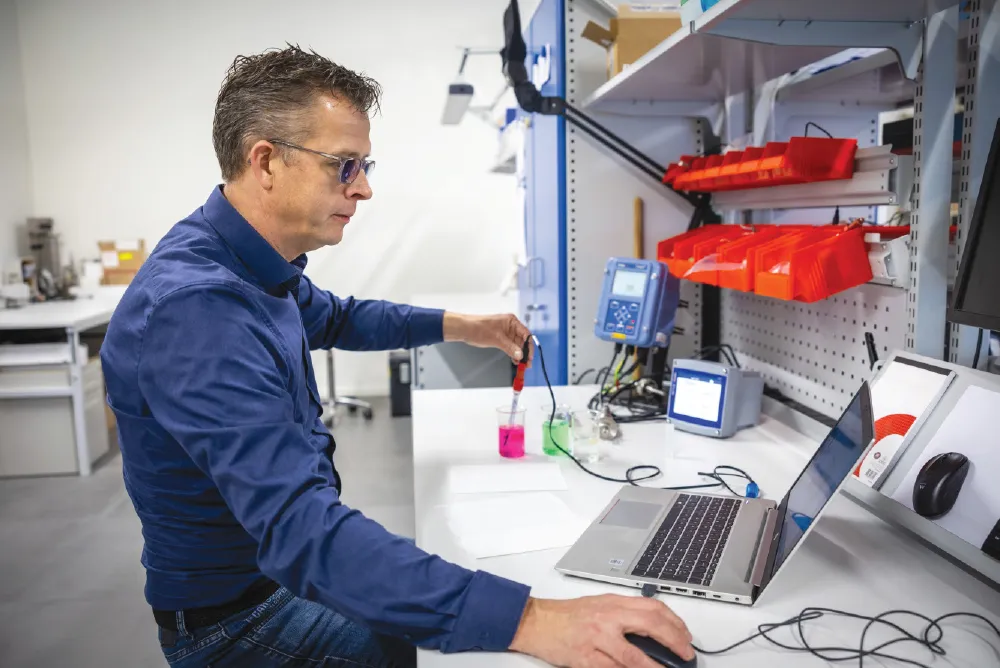
A wide range of digital sensors is available for all kinds of applications, from measuring pH, gas analysis and refractive index measurement to monitoring dissolved oxygen. “Intelligent sensors provide more than just measurement values: they collect information on measurement quality, history, calibration and fouling, and communicate this to the control room,” explains Vleminckx. He outlines the benefits.
Insight into status
Vleminckx: “The main advantage of an intelligent digital sensor is that you know its status at any time. You can see how often and when it has been calibrated and, in some cases, even who calibrated it, and whether the calibration was successful. You also know how long the sensor has been in use, when it needs replacing and the process conditions it has operated under … This makes it easy to identify temperature peaks or other anomalies, for example. An analogue sensor only transmits measurement values, without taking history or operating conditions into account.”

Self-learning algorithm
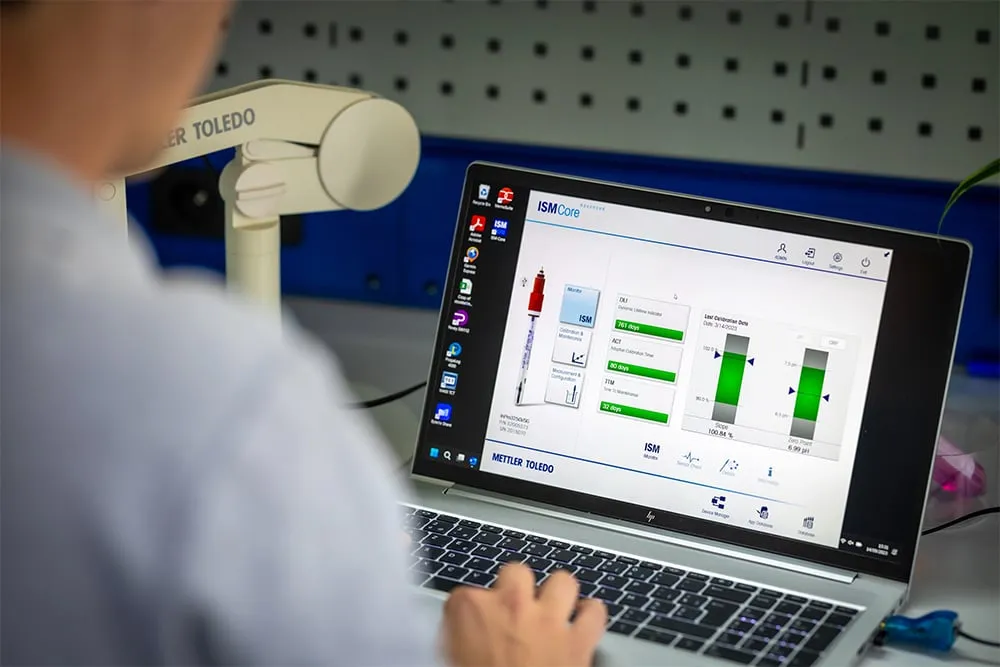
Hoogedoorn adds: “Intelligent digital sensors use a self-learning algorithm that takes process conditions into account. If maintenance is required, the sensor will alert you. This makes predictive maintenance possible. The sensor also indicates when it is time for calibration (ACT, Active Calibration Timer) or when it needs replacing, so you can replenish your stock in good time.”
Save time and money
“Intelligence can save you a great deal of time and money,” agrees Vleminckx. He explains with an example. “A company with 100 pH measurement points in its production process decided to switch from analogue to intelligent sensors. In practice, the service life of the electrodes, the core of the intelligent sensors, was almost doubled, cutting costs by half. Why? Analogue sensors are generally calibrated on site at the production facility. Intelligent sensors, by contrast, can easily be swapped out and then calibrated offline in a workshop or laboratory under ideal conditions. This results in a longer service life and more accurate measurement results. Poor calibration can also lead to rejection, meaning analogue electrodes have to be replaced sooner. In short, intelligent sensors can save both time and money.”
Elscolab offers two platforms for easily reading data from intelligent sensors: ISM (Intelligent Sensor Mangement) and Memosens. Vleminckx: “With Memosens, signal transmission is inductive, while ISM uses a physical contact. Both platforms have proven themselves in the market.”
A business enquiry for ELSCOLAB? Get in touch
Companies in this story

Keep following this
Get an email when a new story is published. No account needed.
- ThemeProcess measurement and control
- SubjectSensors & vision
- CompanyELSCOLAB