Temperature sensor monitors its own calibration
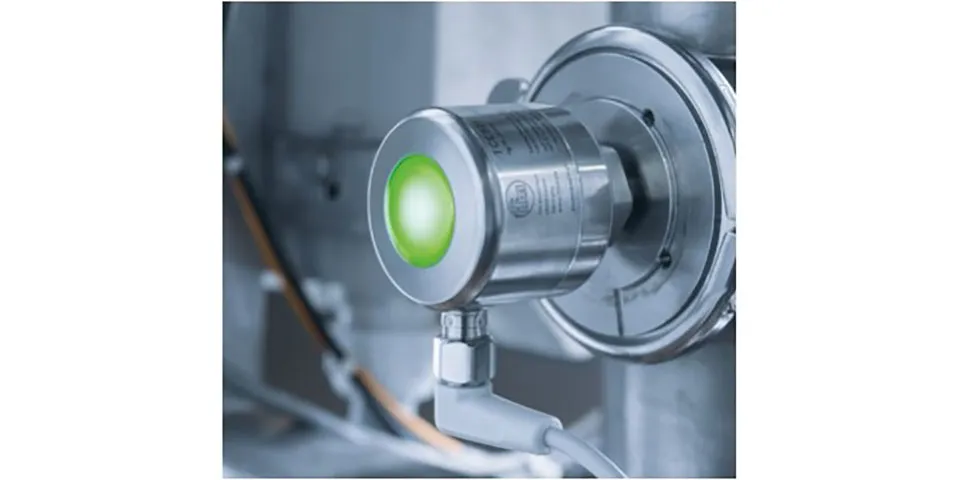
Accurate temperature monitoring is crucial in many applications. When exact temperature values determine product quality, temperature variations must be avoided. The new TCC temperature sensor from ifm, which continuously monitors its own calibration, is ideal for these applications.
The new TCC temperature sensor continuously compares the measured temperature with a reference value measured at the same time. If the deviation exceeds the tolerance range, which can be set between 0.5 and 3 K, the TCC gives an optical signal and sends a notification to the control system. Any fault is also signalled. Communication between the sensor and the control system is based on the digital IO-Link protocol. The LED on the sensor head indicates the current status: green means the device is operating reliably, blue indicates a temperature deviation outside the tolerance range, and red indicates a serious fault, such as a fault in the sensing element.
Transparent communication with the sensor
The temperature sensor can transmit additional data via IO-Link to support thorough diagnostics. This includes the installation date, operating hours, temperature histogram and logs of notifications and calibration monitoring status. Sensor settings are also configured via IO-Link, including the tolerance range. A simulation mode is also available, allowing the process and reference temperatures to be selected freely to check whether the sensor is correctly integrated into the controller.
Robust design
Thanks to its fully welded, sealed housing and a new sensing element design, the TCC is permanently resistant to external influences such as moisture, thermal and mechanical shocks, and vibration. The integrated calibration process ensures an accuracy of +/- 0.2 K across the entire measuring range. This makes the TCC ideal for use in temperature-sensitive processes such as food, rubber or carbon processing. In production processes where exact temperature values determine product quality, it is particularly important for measured values to be absolutely accurate. The new temperature sensor enables plant operators to take action if drift occurs, rather than waiting for the next scheduled calibration interval. This reduces the risk of losing entire production batches due to incorrect production temperatures.
Question about this story? Ask your question
Keep following this
Get an email when a new story is published. No account needed.
- SubjectSensors & vision