Smart sensors for efficient applications
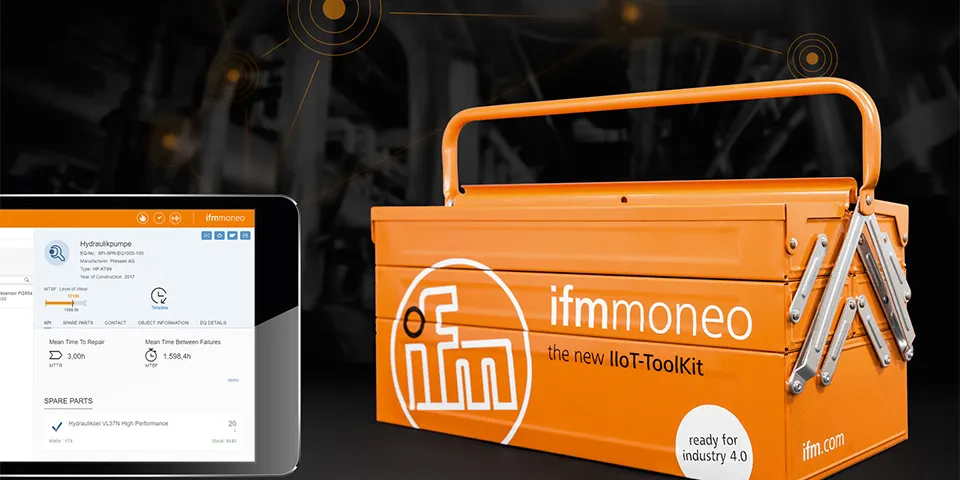
The SPS trade fair in Nürnberg is traditionally an important event for discovering new products in the industrial market. ifm electronic certainly had plenty to show. Its stand was packed with innovations. The common thread running through all these developments? Developing smart sensors that work with smart software to let you get started straight away, plug and play, and transform your production into a factory of the future. Here are some of the standout innovations.
The cloud is one of today’s buzzwords. But it can already be used to achieve a great deal in industry. The obvious prerequisite is a network for transferring data. Thanks to the IO-Key, even that is no longer necessary. With its embedded SIM card, the IO-Key is the easiest way to send data directly from devices to the cloud. Users can choose from four subscription plans: daily, hourly, per minute or every 10 seconds. Once the data is in the IO-Key cloud, the IODD, the electronic signature of IO-Link devices, is recognised automatically, allowing the data to be presented in a plug-and-play cockpit. Typical applications for the IO-Key include remote tanks where no IT infrastructure is available. It also gives machine builders a way to gather specific information from a machine without using the company network.
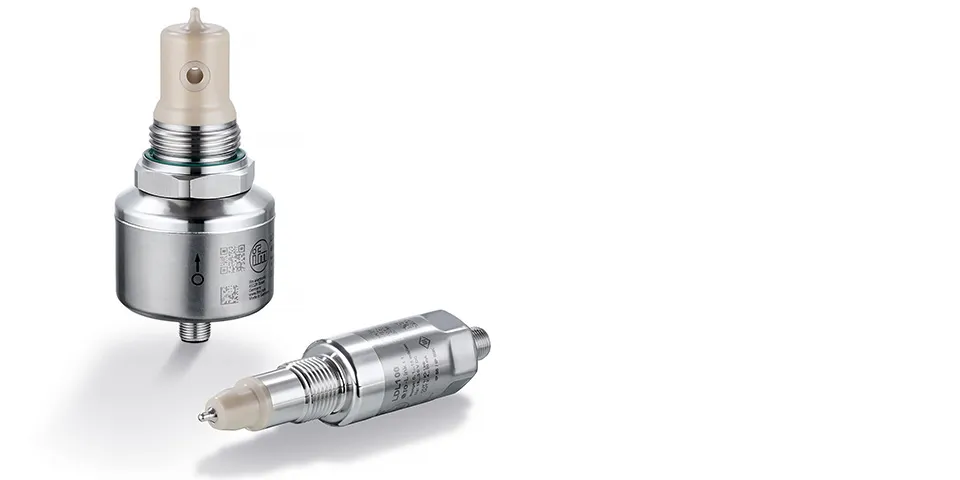
LDL100, LDL200
New LDL 100 and 200 conductivity sensors
Conductivity sensors are often too large, too complex or too expensive for the application. Yet distinguishing between different media plays a crucial role, for example in the food industry during CIP cleaning processes. It will come as no surprise that ifm has equipped these sensors with IO-Link, taking them from analogue to digital measurement with all the benefits that brings. Other key advantages of these conductivity sensors are their robust, compact design, plug-and-play operation, significantly reduced commissioning time (no additional processing unit required and no troublesome wiring) and highly competitive price. The LDL 100 uses resistive measurement, has a measuring range of 100 to 15,000 µs/cm and is particularly suitable for distinguishing between media. The LDL 200, by contrast, uses inductive measurement, making it ideal for measuring concentrations, with a measuring
range of 100 to 1,000,000 µs/cm. Both are, of course, certified for hygienic applications.
PMD Profiler for precise profile recognition
A completely new addition to the extensive ifm electronic portfolio is the PMD Profiler. Using laser line projection, this sensor sits between a distance sensor and a low-cost vision solution. The gap it fills is largely due to the demands that vision systems bring with them. Many environmental variables need to be taken into account to achieve the right lighting, and therefore the right image. The PMD Profiler does not have this requirement. It needs no external light: its laser beam alone enables quality inspection with an accuracy of up to 200 µm over a range of 30 cm. The PMD chip in the sensor creates the line projection used to detect edges. The sensor is then taught which patterns the user considers good or bad, and what tolerances are acceptable. It can also use two markers to inspect a segment in detail and carry out depth measurements. Everything is controlled via the three buttons or IO-Link, making it easy for users to get started without complex positioning. The PMD Profiler opens the door to a host of new possibilities in applications such as sorting, orientation, assembly and machining inspection …
Question about this story? Ask your question
Keep following this
Get an email when a new story is published. No account needed.
- ThemeProcess measurement and control
- SubjectSensors & vision