Leuze introduces the new BCL 200i stationary barcode reader.
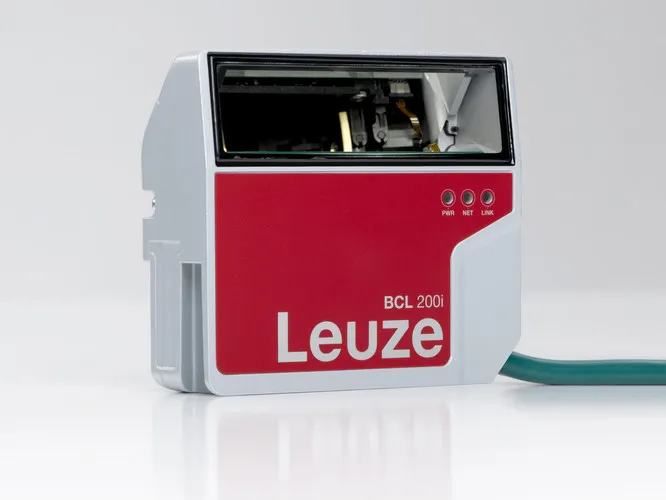
The new barcode reader supports guided container and tray identification and is particularly well suited to confined installation spaces alongside conveyor belts.
As an identification expert, Leuze has been manufacturing barcode readers for decades. The company has continually expanded its product portfolio in this field. Leuze barcode readers meet a wide range of intralogistics requirements and are therefore suitable for a broad range of applications.
Small but powerful
The BCL 200i reads barcodes with ease, thanks to integrated industrial fieldbus communication and simple PROFINET configuration. The BCL 248i can be configured directly in the controller via the GSDML file. Alongside its compact size, installation is made even easier by the cable outlet on the side of the device and a dovetail connection for quick mounting.
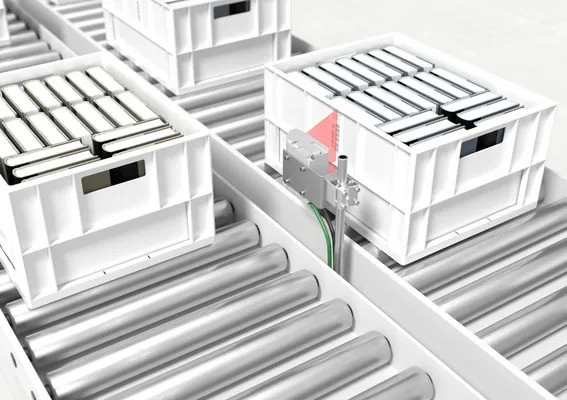
Specialised in guided container and tray identification
The new BCL 200i is particularly well suited to detecting 1D codes during tote transport. Whether the barcode is printed vertically or horizontally on the label, it is simply a matter of mounting. The device has integrated Ethernet TCP/IP or PROFINET fieldbus communication. The web-based configuration tool enables remote diagnostics from anywhere in the world.
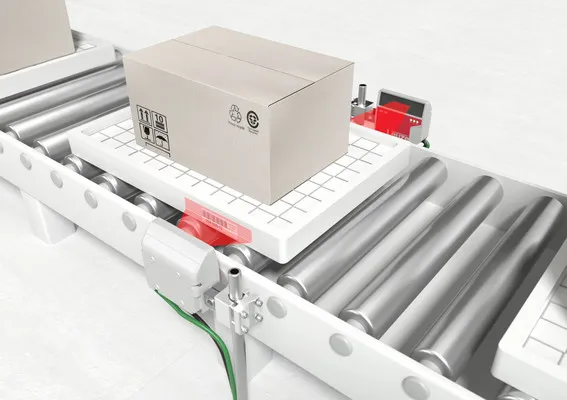
Detection using Code Reconstruction Technology
The integrated Code Reconstruction Technology (CRT) enables the BCL 200i to read even barcodes with short bar lengths, as well as damaged or dirty labels. The CRT decoder can also read barcodes at a wide angle. The resulting reduction in no-reads significantly increases system availability.
Activation without an additional sensor
Thanks to automatic reflector activation (autoReflAct), the new stationary barcode reader can be activated without an additional trigger sensor. This is achieved by pointing the scanner, with its adapted narrow scan beam, at a reflector mounted on the other side of the conveyor belt. As long as the scanner is pointing at the reflector, the reading gate remains closed. If an object such as a bin with a barcode label covers the reflector, the scanner is activated to read. The reading process is complete as soon as the scanner has an unobstructed view of the reflector again.
Question about this story? Ask your question
Keep following this
Get an email when a new story is published. No account needed.
- SubjectSensors & vision