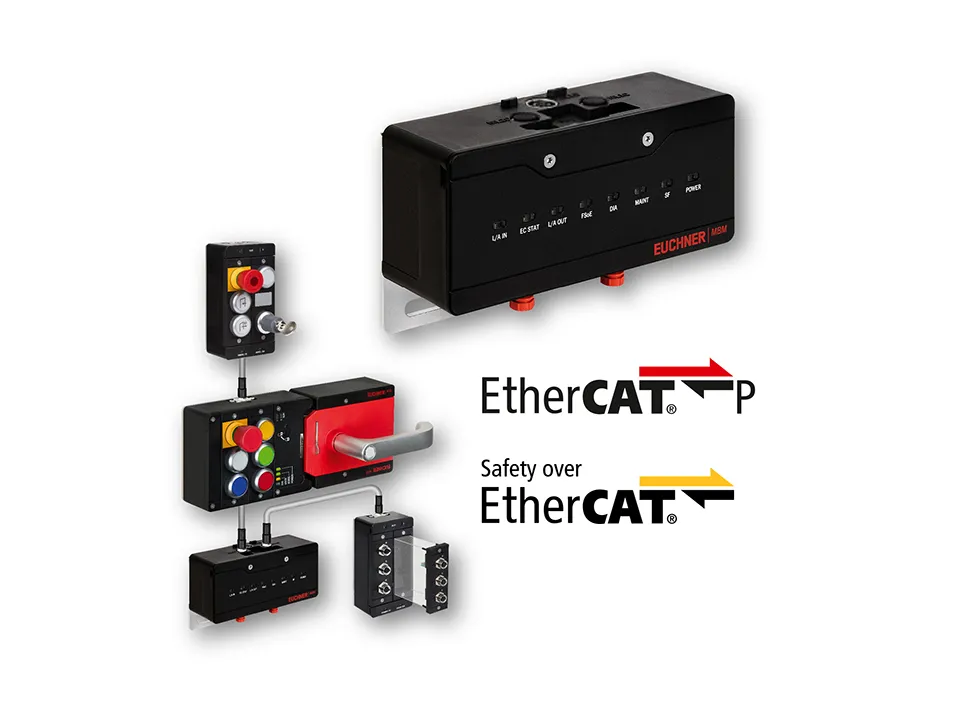
EtherCAT P with FSoE is the latest interface for Euchner’s MGB2-Modular door interlock.
Bus systems bring simplicity to the complex world of machine safety. That may sound surprising, but configuring safety systems is easier with bus systems than with traditional hardwired systems. There is a bus solution for every platform: alongside EtherCAT P with FSoE, other interfaces have been available for longer, including ProfiNet with ProfiSafe and EthernetIP with CIPsafety. Each bus platform is suited to a particular world of control systems. Preferences differ across Europe, North America and Asia. The MGB2-Modular door interlock can be used with any control system.
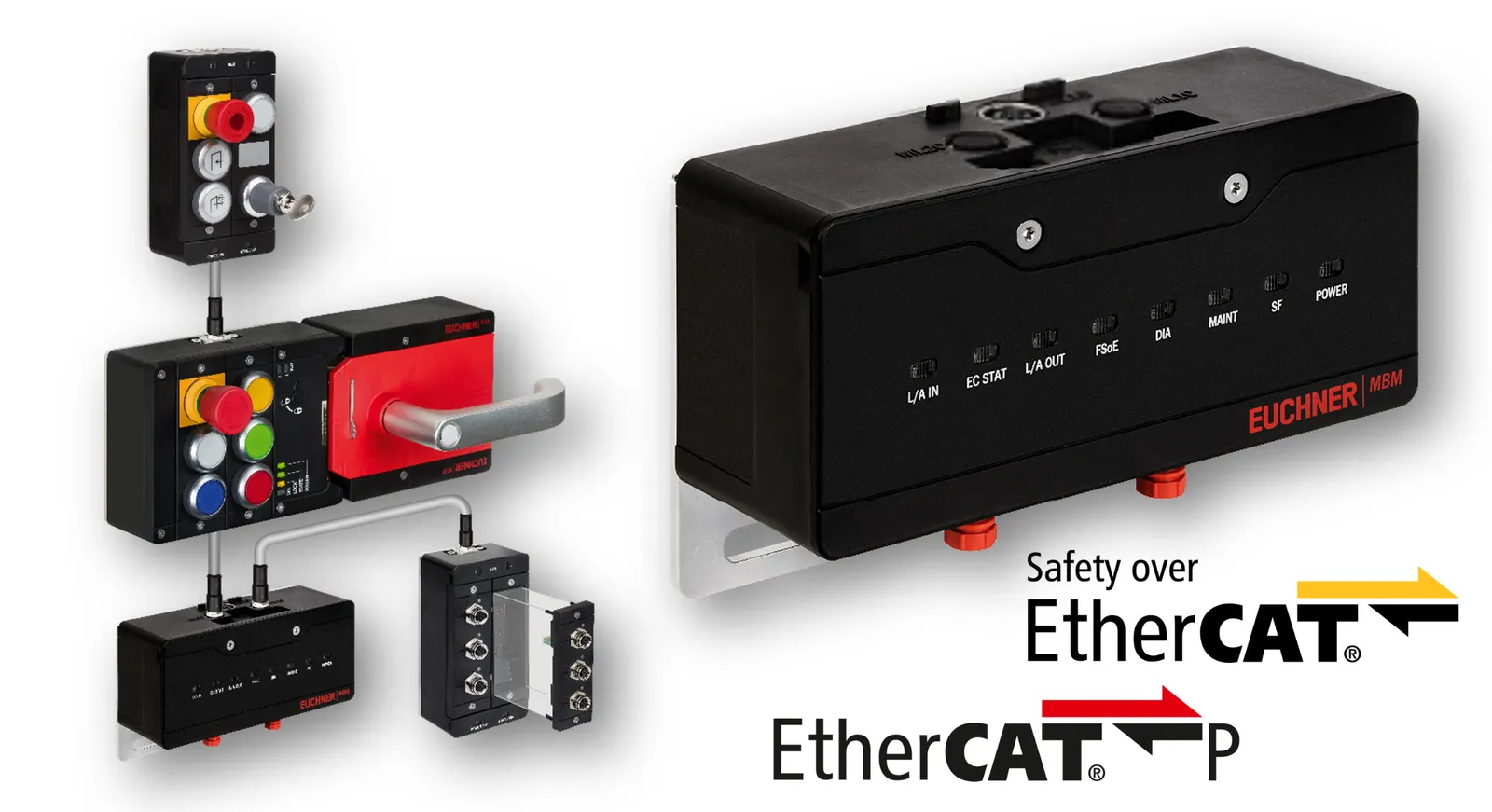
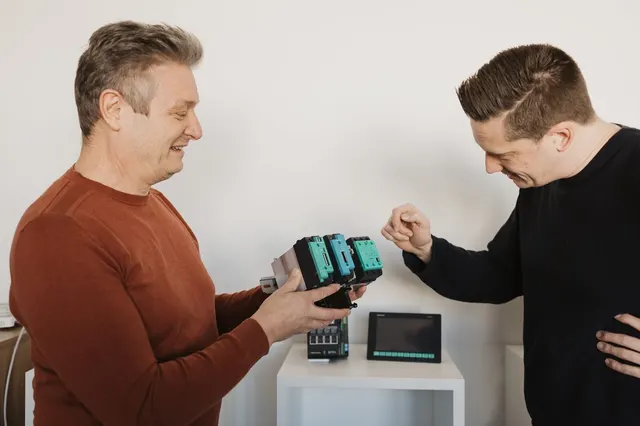
Thanks to the modular design of this door interlock, the bus interface is housed in just one module, known as the ‘bus module’. This determines which bus platform the door interlocks connect to. The bus module contains, among other things, the chipset for the relevant bus. DIP switches are used to assign an address to the bus module manually.
Demand for this new interface came from the EtherCAT user community, led by its control system manufacturer. Their combined input shaped the development process, resulting in this latest innovation.
Euchner’s MGB2-Modular EtherCAT P with FSoE door interlock:
- Up to 4 door interlocks can be connected to one bus module.
- There is room for 36 safety-related elements, including the 4 door interlocks (buttons, functions, etc.).
- Every safety function achieves PL e, Cat. 4 and SIL 3.
FSoE stands for Fail Safe over EtherCAT. It is a transmission protocol for safety data over EtherCAT. Under this protocol, safety data is delivered within a defined time and is unambiguous, or unique.
This bus system uses a traditional master-slave structure. It can be branched almost indefinitely, but you need to keep an eye on the maximum amount of data the bus can process. Transmitting safety data over bus systems uses a fair amount of bandwidth, putting the bus under heavy load. The door interlock on an access door continuously reports its status: ‘the door is closed, the door is closed, the door is closed…’, along with its address so the receiver knows which door it refers to. Other safety-related messages are transmitted in the same way.
Replacing a bus participant, such as a door interlock, or expanding or reducing the system is straightforward. You simply need to update the topology. Naturally, this must be done by an authorised programmer with knowledge of functional machine safety.
Functional safety is fairly straightforward, but you need to learn how to approach it. That is why Euchner offers training courses that explain how safety components communicate with each other. A lot has changed over the past ten years: Industry4.0, Internet-of-Things, Big-Data, and so on. Yet the bus telegrams themselves have remained essentially unchanged. The course compares different communication methods. Functional safety is fairly straightforward, but you need to learn how to approach it.
More information at www.euchner.nl / www.euchner.be / www.euchner.lu
Question about this story? Ask your question
Companies in this story

Keep following this
Get an email when a new story is published. No account needed.
- ThemeSafe and resilient installations
- SubjectSensors & vision
- CompanyEUCHNER