Eliminate jitter in angle measurement
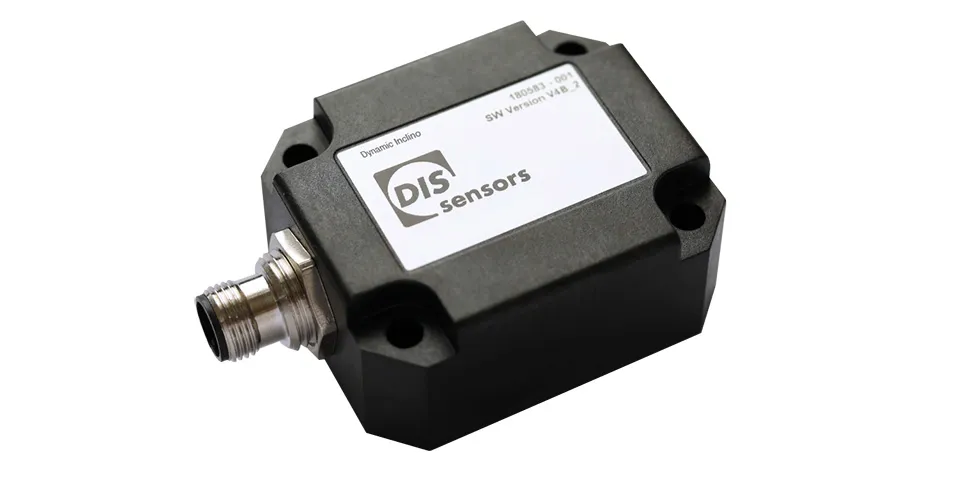
An inclinometer measures the angle relative to a horizontal position, using the imaginary line to the centre of the Earth as its reference. So much for the theory. In practice, vibration and shock ‘contaminate’ angle measurements with irrelevant peaks. The usual solution is to add filtering algorithms and/or extra sensors, but this increases complexity and cost. A newly developed dynamic tilt sensor based on MEMS technology offers a much more cost-effective option for controlling and monitoring machines and structures in dynamic conditions.
Inclinometers are indispensable in many industrial applications. They are used wherever accurate position determination and/or continuous monitoring of the angle relative to gravity is required. Inclinometers have a wide range of applications, from aviation and shipping to mobile equipment in agriculture, mining, ports, logistics and civil engineering. Robotics and mobile automation are also making increasing use of inclinometers.
The right angle
The geometry of a working machine, whether a crane, forklift, excavator or mobile elevating work platform, is not static. All parts of the machine are constantly moving as a result of operator commands or external factors. Ideally, the control system receives perfectly clean and reliable angle data continuously in real time, enabling it to determine the exact geometry at any moment. This information allows the control system to interpret the operator’s commands and ensure safe operation. A one-, two- or three-axis inclinometer is ideal for this purpose, combined with an accelerometer to measure G-force accelerations relative to gravity as a universal directional reference, both when the sensor is moving and when it is stationary.
Eliminate ‘jitter’
When used on an object subject to sudden, intermittent shocks or vibration, such as the arm of a mobile excavator, these non-functional accelerations generate numerous peaks in the angle signal sent to the control system. To compensate for this ‘jitter’, filtering algorithms and/or additional sensors, such as gyroscopes, are used. Unfortunately, each additional sensor and filter makes the system slower and more expensive. The advent of affordable MEMS (microelectromechanical systems) technology and intelligent software algorithms now makes it possible to solve these problems with a single sensor module: the dynamic inclinometer. MEMS are miniaturised systems containing various electronic and mechanical components, embedded in a device such as an accelerometer, gyroscope or inclinometer. They are built using the same techniques as those used to manufacture chips.
Dynamic inclinometer
The new dynamic inclinometer is a hardware platform based on an advanced MEMS chip that combines a three-axis accelerometer with three-axis inertial angle measurement. Its powerful integrated controller can be configured externally and processes all input and output signals. The angle is passed to the control system as a separate CANopen / J1939 object for each axis. It is already gyro-compensated, so the signal is clean and unaffected by false accelerations or shocks. To make configuration easier, predefined application profiles are available, along with a user-friendly configuration tool.
With thanks to DIS Sensors and Rotero
Question about this story? Ask your question
Keep following this
Get an email when a new story is published. No account needed.
- SubjectSensors & vision