A clean solution
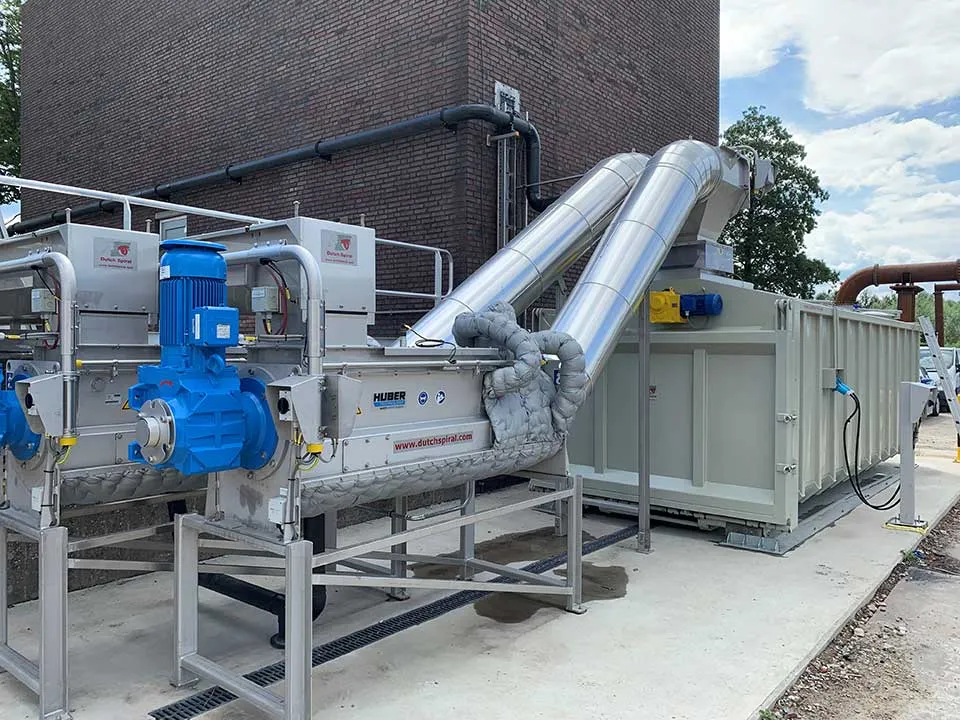
VEGAPULS C 11 provides reliable measurement in containers for residues from wastewater treatment plants.
Residues from wastewater treatment plants are removed safely, cleanly and with minimal odour, thanks to a container solution with an integrated screw conveyor. Compact radar sensors from VEGA monitor the level, enabling containers to be replaced in good time.
In wastewater treatment, all eyes are naturally on the end product: treated water. Many individual process steps are needed to get there. These processes also generate a range of residues that must be removed. For example, what should a company do with the screenings, sludge and sand left over?
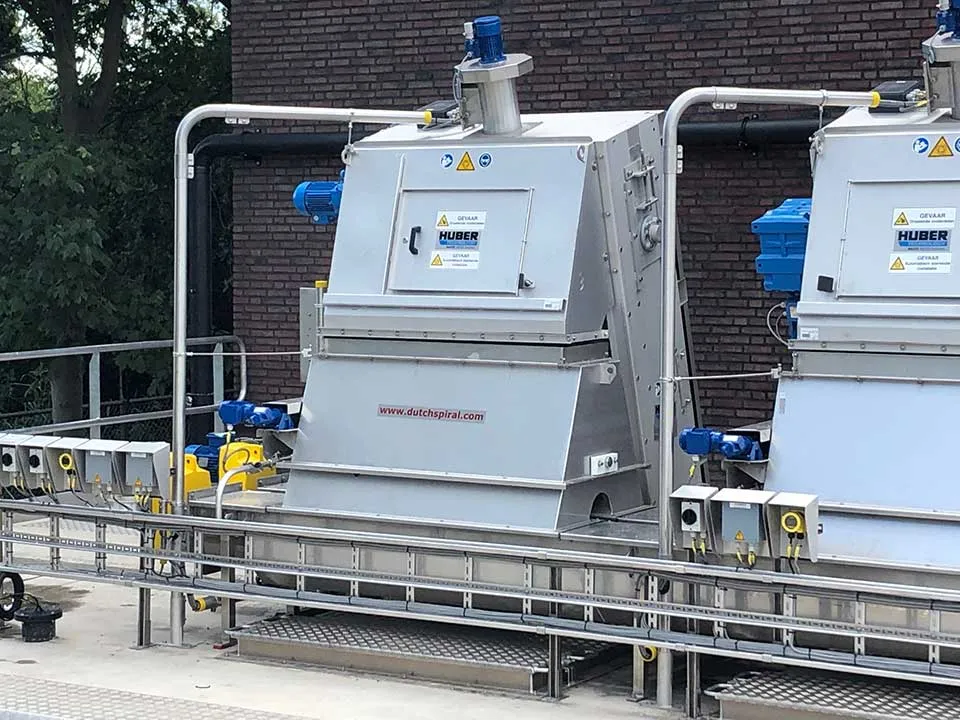
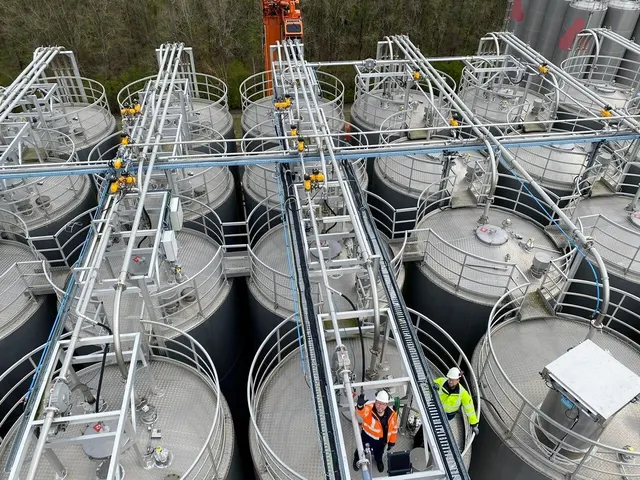
Based in Groot-Ammers, Dutch Spiral offers an optimal and, above all, clean solution. The Dutch family business’s main product is its shaftless screw conveyors. In the field of wastewater treatment, Dutch Spiral also works with German company Huber SE to provide a sophisticated solution for handling screenings, sand and sludge. This solution is used in almost every wastewater treatment plant in the Netherlands. It consists essentially of a container that is filled automatically by an integrated screw conveyor. More than 230 such containers are already in use in the Netherlands. While ready-to-use compact solutions are available, the containers can also be adapted to suit any site-specific requirements.
Automatic filling
These containers, which can be filled automatically, are used to process screenings, sand and sludge. The ‘sludge-tainer’ STC, for example, is specially designed to transport dewatered sludge. Minimising odour was a particular consideration in the development of this sludge container. Depending on its size, it can hold up to 30 cubic metres of sludge. The Dutch Spiral screenings container RGC, by contrast, is specially designed to transport screenings.
The systems’ main advantage is that the containers are filled autonomously, with the fill level and therefore the transport volume adjustable remotely. The container is positioned using wheel guides. It is filled via a hopper or screw conveyor. At the end of the conveyor, at the container inlet, there is a gas-spring-operated slide gate. The slide gate is fitted with a proximity switch that detects the container’s position and whether the gate is open. Beneath the inlet is a Dutch Spiral shaftless screw conveyor, driven by a right-angle gearbox.
Safe stop
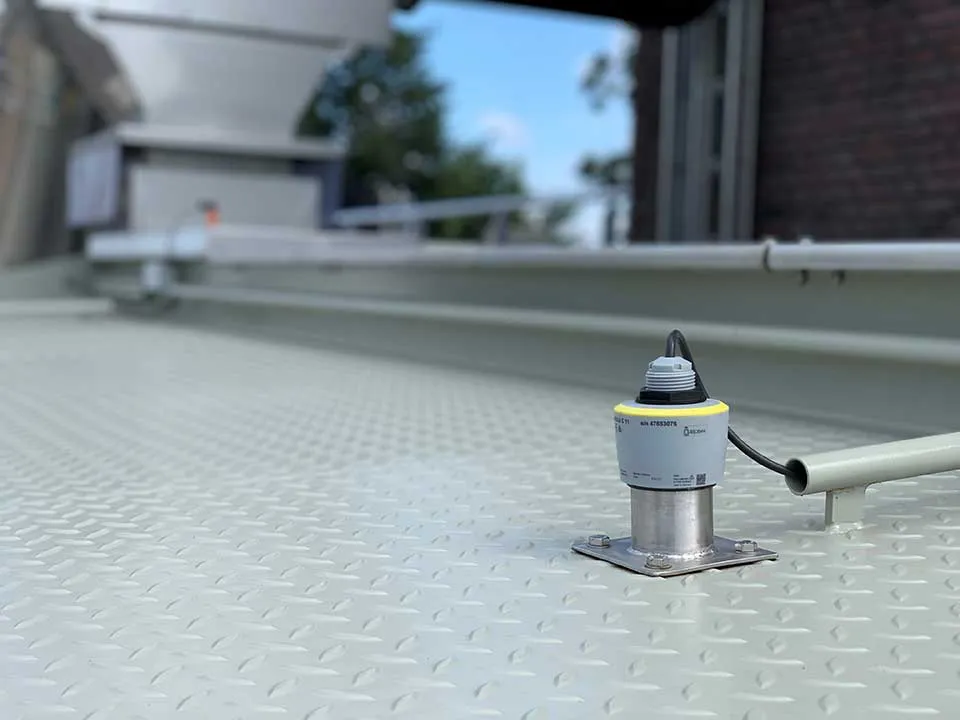
The container fill level is monitored by a level measurement system. This is where VEGA’s sensors come in, reliably signalling when the container is 75% full. This gives operators enough time to plan a container change.
“We have been working with VEGA for more than 16 years and have had good experience with sensors from the VEGASON series, which use ultrasonic measurement,” says Mr Aart-Jan Brussee, Commercial Director at Dutch Spiral. So when a compact radar sensor came onto the market last year, the company was very interested. “With the launch of the new VEGAPULS series, radar technology became affordable for our systems, and from that point on we could offer our customers an even better, more reliable solution for the same price. We therefore had no hesitation in switching to the new sensors.”
A smart radar solution
A new range of compact radar level sensors came onto the market in early 2020. At their heart is a radar microchip newly developed by VEGA and optimised specifically for the requirements of level measurement. These small microchips have made it possible to produce very compact sensors. They are also so competitively priced that they are replacing the ultrasonic sensors used to date across all applications. The VEGAPULS C 11, C 21 and C 22 series have a fixed cable connection and an IP66/IP68 protection rating.
Radar sensors are not only unaffected by temperature fluctuations, gases, vacuum and pressure, but are also particularly resistant to contamination. These are all factors that often cause problems for ultrasonic level instruments, as Mr Aart-Jan Brussee knows all too well: “Non-contact measurement is simply ideal for our application. Normally, build-up on the sensor makes accurate measurement much more difficult. There is usually also condensation, hydrogen sulphide and extreme mechanical stress from the screenings. In short, these are all conditions that make radar technology the obvious choice.”
Continuous level measurement is also essential because this is a continuous process that runs 24/7. However, the composition of the wastewater stream is not always the same, as the material separated from the treated water consists of a wide variety of residues. Accurate level measurement is therefore crucial, reliably indicating when the container needs to be emptied. This makes the application ideal for sensors from the new VEGAPULS series, which measure at a frequency of 80 GHz and therefore provide excellent signal focusing. The radar signal can be aimed at the medium being measured with near-millimetre accuracy. As a result, interfering signals are avoided even when there are internal obstructions or build-up on the walls. Unlike ultrasonic sensors, radar sensors usually require no interference signal suppression at all. Measurement signals are also easier to distinguish from interference, making measurement far simpler and more accurate than with other methods.
The containers now use the fully encapsulated VEGAPULS C 11. The sensor is simply mounted on top of the container and monitors its entire volume, right up to the top edge. This allows wastewater treatment plant operators to respond quickly to unusual events. The entire container volume can also be used to the full, as the new compact sensors measure right up to the container edge without a blocking distance, which is not possible with ultrasonic sensors. A proximity switch is also installed as a failsafe, signalling when the container is completely full.
Reliable remote monitoring
The new compact VEGAPULS series is of course suitable not only for this container solution, but also for a wide range of applications in the wastewater industry. The new sensor range is a genuine alternative to ultrasonic sensors not only because of its competitive price, but also because of its high reliability and long service life. Mr Aart-Jan Brussee sees a particular advantage in the ease with which the sensor can be configured wirelessly via Bluetooth, using the VEGA Tools app on a smartphone or tablet. Parameterisation, visualisation and diagnostics can therefore all be carried out remotely. This makes day-to-day work much easier in the often harsh and difficult-to-access conditions found in the industry. “This is where you can see that VEGA focuses on practical relevance. That is an approach that is in our DNA too. It is based on sound know-how and expertise. What sets VEGA apart from other manufacturers? VEGA always offers a little more support, and its employees know what they are talking about,” concludes Mr Aart-Jan Brussee. Ultrasonic solutions are still used on older containers, but in future only the compact radar series will be selected, specifically the VEGAPULS C11.
Question about this story? Ask your question
Companies in this story

Keep following this
Get an email when a new story is published. No account needed.
- SubjectSensors & vision
- CompanyVEGA N.V.