












Where is Ethernet heading?
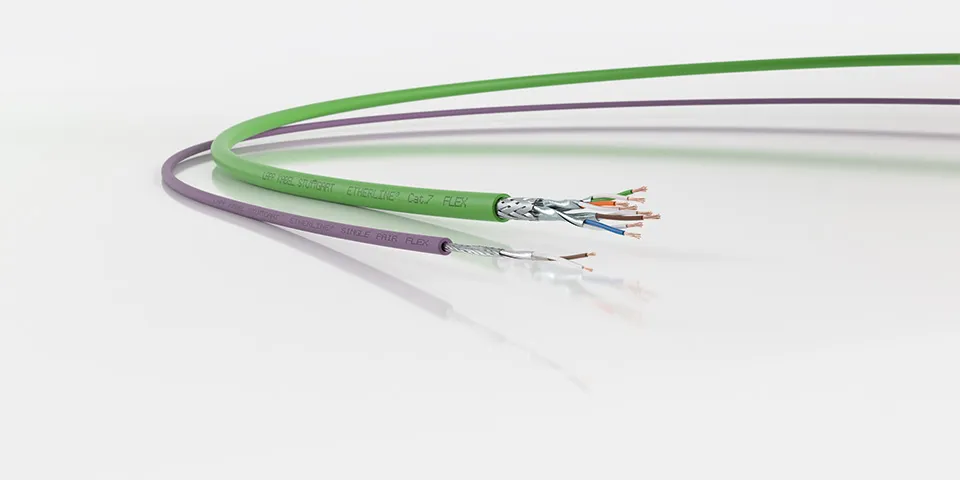
The advent of Industry 4.0 has led to a sharp increase in data communications. Companies are therefore increasingly opting for Ethernet connectivity solutions. However, the requirements in an industrial environment differ from those in an office. Speed is not the most important factor. What matters are simple, cost-effective solutions for reliable data transmission.
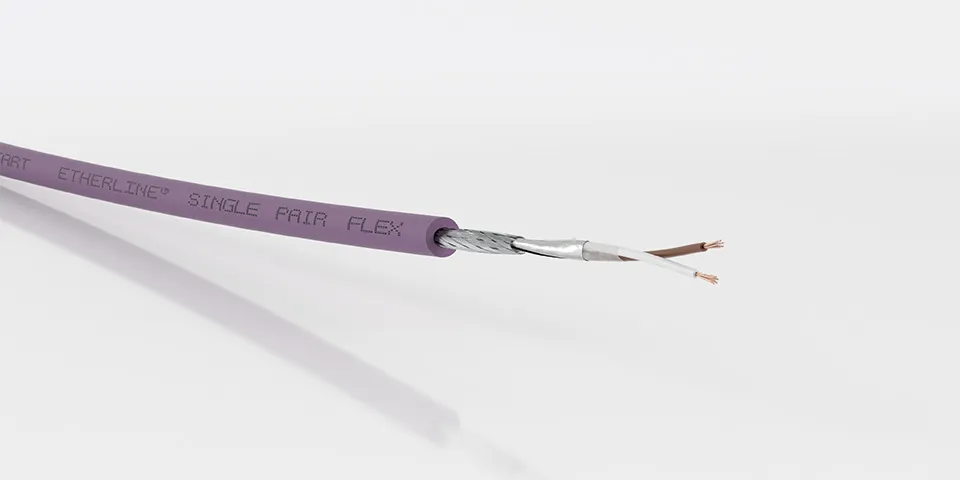
Ethernet originated at Xerox PARC, where Robert Metcalfe was asked to connect the company's computers in a network. He developed a technology that could transmit data through the ‘ether’. Not literally, since although the solution has its roots in radio technology, it uses cables. But the name Ethernet stuck and went on to become one of the greatest success stories in computing. Today, it has become the undisputed leader in local area networks, with bandwidths of up to 10 Gbit/s and, with new standards, even up to 400 Gbit/s. In offices, everything is neatly governed by the same standards. Factories are a different story. There are more than twenty different industrial Ethernet systems, each with different technical characteristics. Automation engineers, meanwhile, prefer fieldbus systems, with more than fifty options to choose from. Their advantage is that they can operate in real time, which is crucial for time-critical machine processes.
Ethernet outpaces fieldbus
Ethernet is set to make inroads here too. The IEEE is working hard to develop standards that will provide the same standardised real-time capabilities. Industrial Ethernet is currently growing by an average of 22% a year, while fieldbus systems are seeing growth of just 6%. In 2018, Ethernet installations outnumbered fieldbus installations for the first time. This is all down to the rise of networks and digitalisation in the Industry 4.0 era. One consequence is that the automation pyramid has flattened. Whereas previously each level had its own function and therefore its own programmes, communications now need to operate in a flat hierarchy. Everyone must be able to communicate with everyone else, from the highest level to the lowest. This is the only way to predict where and when problems might arise. Connectivity technology must therefore also be able to think creatively, which is why Ethernet is now making its way onto the factory floor, built with more robust components suited to the environment.
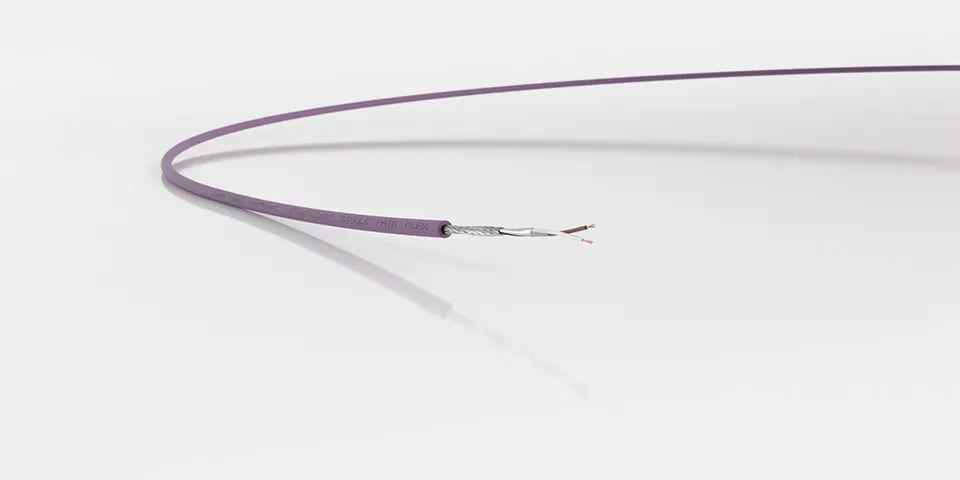
Single-pair Ethernet cables are more compact, lighter, easier to install and cheaper than traditional Ethernet cables with four pairs, and are sufficient for many field applications.
Two trends: hybrid cables and single-pair Ethernet
Two trends point to what Ethernet systems of the future will look like. The first is the rise of hybrid cables, which combine different functions in a single housing. One example is the conventional connection cable for servo drives with integrated feedback cables for monitoring sensors. The second trend is reduction. Whereas earlier Ethernet required two or four cable pairs, a single pair of Ethernet cables can now transmit data at speeds of up to 1 Gbit/s. The benefits for users are clear: less installation work, more space and lower costs. This also required technological advances in chips. The automotive sector was a particularly strong driver. Single-pair Ethernet will become even more important in the future because it allows longer cable runs, is robust and costs less. There is, of course, a trade-off in terms of data transfer rates, but users are gradually realising that not every sensor needs a 10 Gbit/s cable. For many field applications, 1 Gbit/s is enough, since sensors provide only small amounts of information, which often does not need to be reported continuously. However, industrial standards for these cables are still awaited. They are expected to be available within two years.
Wireless technology still has limited uptake
Wireless technology is also advancing in industry (32%). But with a market share of 6%, its presence remains limited for now. WLAN, Bluetooth and mobile communications do offer advantages in terms of flexibility and mobility. However, when it comes to robust data communications, energy efficiency and latency, they fall well short of cable technology. Cables are also harder to hack. Nevertheless, wireless technology is set to prove an important addition for specific requirements in the coming years.
Question about this story? Ask your question
Keep following this
Get an email when a new story is published. No account needed.
- ThemeData from shop floor to decision
- SubjectNews







