












The right cooling solution improves efficiency, prevents downtime and saves significant energy
A little cooling always helps. This certainly applies to machines and electrical enclosures in the metalworking sector. Production losses caused by overheating or failure to maintain tolerances can cost a company a great deal.
Rittal is a leading supplier of solutions for industrial enclosures, power distribution, IT infrastructure and system climate control. Its system solutions are used across a wide range of sectors. Headquartered in Herborn, Germany, the company has developed a range of cooling solutions under the Blue e+ name, including chillers and cooling units. They offer many benefits in terms of flexibility, reliability and maintenance, and above all guarantee energy savings of up to 75%.
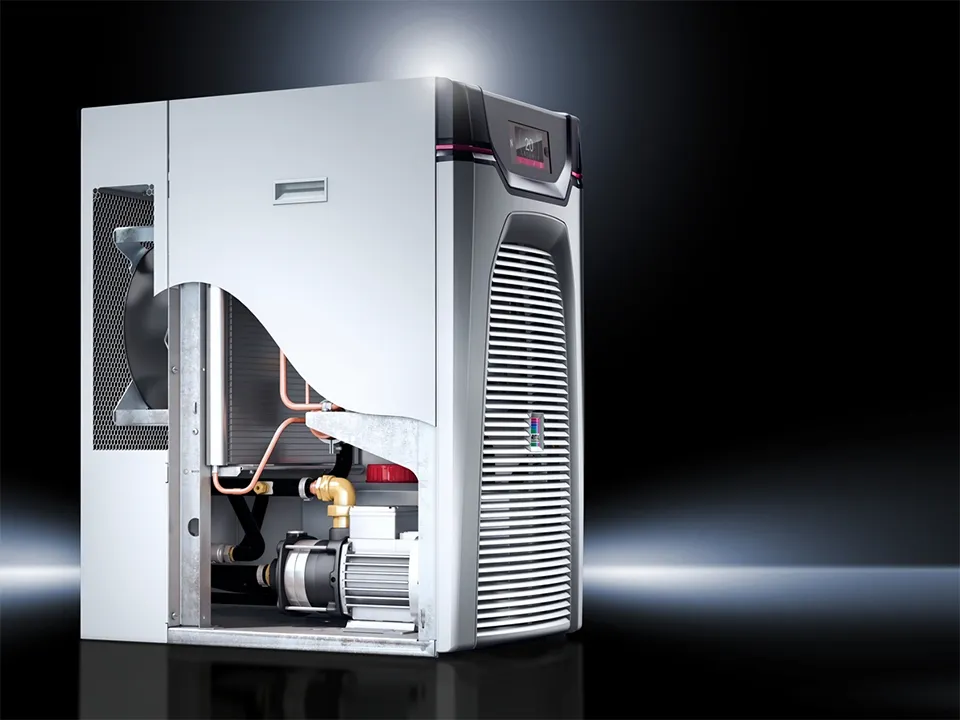
Cooling accounts for up to 15% of a metalworking machine’s total energy consumption. To machine metal with high precision, machine tools must be able to regulate their coolant very accurately. Large temperature fluctuations cause thermal expansion of the components, leading to changes in shape. With its Blue e+ series of chillers, Rittal introduced a solution that enables these precise temperatures to be maintained. The chillers are available in three power classes, with cooling capacities of 2, 5, 4 and 6 kW, and can be used flexibly at ambient temperatures from -5 °C to 50 °C. They are also highly energy-efficient.
Cooling capacity when it is needed
“Conventional chillers with hot-gas bypass control have an EER of 1, whereas the new Blue e+ chiller can achieve an EER of 3. With hot-gas bypass control, the cooling compressor runs at full capacity and a large proportion of the cooling capacity is lost. The inverter-controlled DC cooling compressor in the Rittal chiller delivers cooling capacity only when it is needed. This keeps temperature fluctuations in the cooled medium particularly low without wasting cooling capacity unnecessarily,” says Product Manager Danny Forré. “We use synchronous DC motors to drive the compressors, which are more efficient than conventional asynchronous AC motors. Compared with chillers using hot-gas bypass control, this innovative drive and control technology saves up to 70% energy. The components also have a longer service life because the motors are switched on and off only rarely.”
Cooling units with innovative hybrid technology
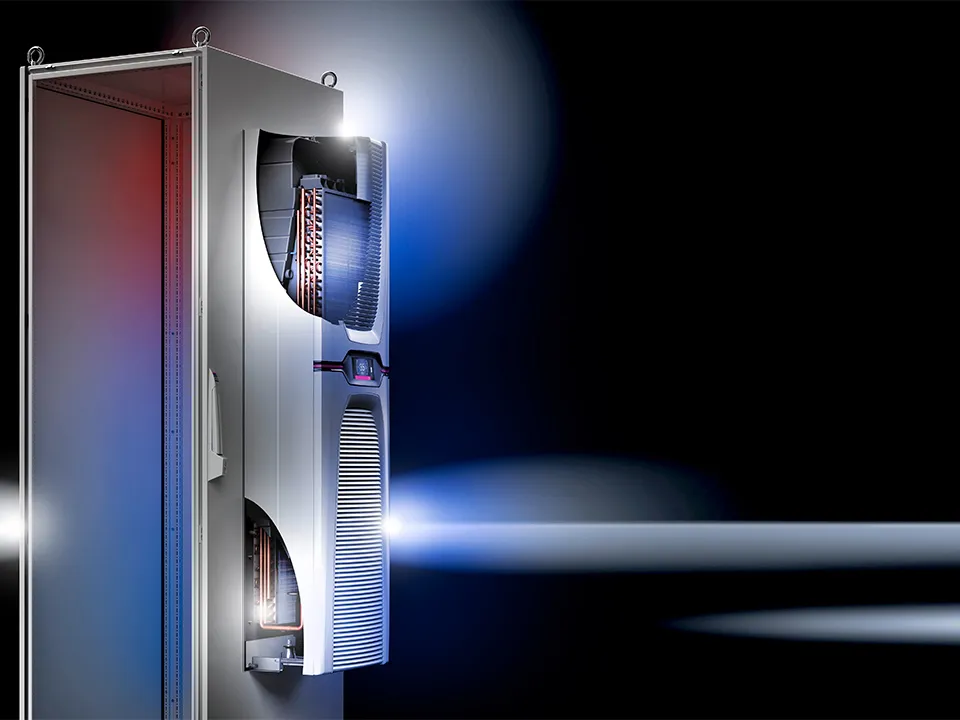
Millions of cooling units for electrical enclosures are connected to the power grid worldwide. They consume a great deal of energy and are responsible for significant CO2 emissions. Rittal is known for its advanced cooling solutions and has developed a series of extremely efficient cooling units for electrical enclosures under the Blue e+ name. The range includes systems with a power range of 2 to 6 kW and more compact units with a lower power rating of 1.6 kW, suitable for temperatures from -30 °C to 60 °C. “To increase energy efficiency, we use an innovative hybrid system that combines a compressor-based cooling unit with a passive-cooling heat pipe. The hybrid mode’s control strategy boosts efficiency. In heat pipe mode and at a partial load of 15%, this cooling unit is six times more efficient than a standard model. At a partial load of 65%, both modes operate, making the system four times more efficient,” explains Forré. “DC motors are used for the fans and compressor. As with the Blue e+ series of chillers, the cooling units use inverter technology, ensuring that the right cooling capacity is available at all times. Tests have shown that our Blue e+ cooling units save up to 75% energy.”
Intelligent operating concept
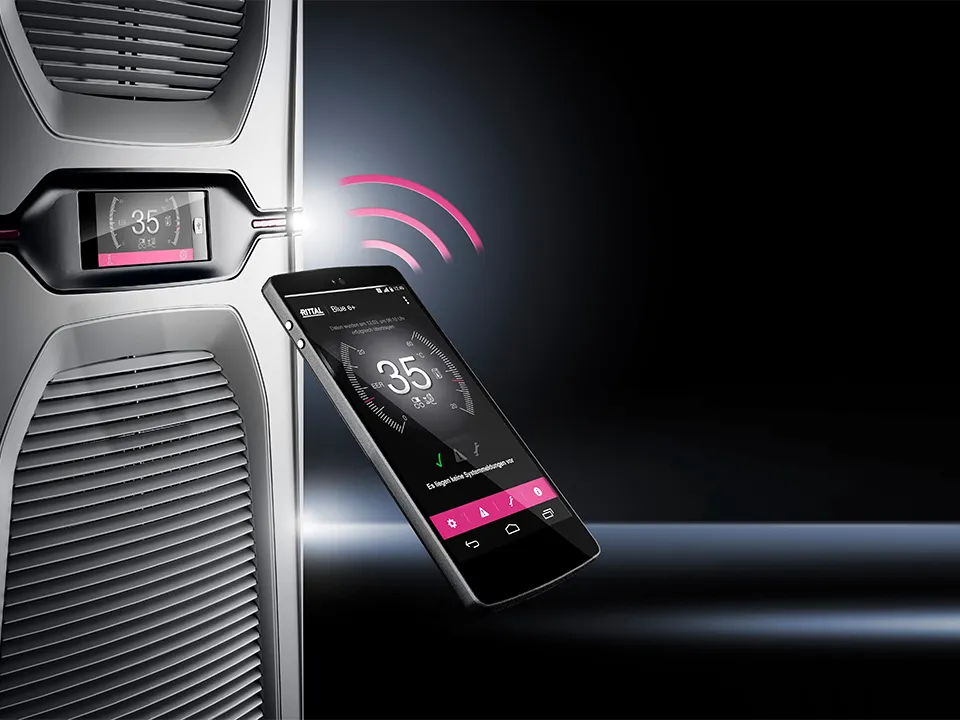
Both the chillers and the cooling units are equipped with a graphical touchscreen that displays all relevant information in text form at a glance. The Blue e+ app communicates with the cooling solutions via NFC and allows data to be sent wirelessly. Thanks to standardised communication interfaces, the units can easily be integrated into the control systems of production systems. Using its IoT interface, Rittal connects Blue e+ units to customers’ monitoring, energy management and/or higher-level systems via OPC-UA, Profinet, SNMP, Modbus TCP and CANopen. This enables applications such as predictive maintenance and data analytics.
Question about this story? Ask your question
Keep following this
Get an email when a new story is published. No account needed.
- ThemeFrom design to flexible machine
- SubjectNews







