












The importance of Machine / Deep Learning in process analysis, monitoring and lifetime prediction

Recent developments in microchip design are expanding the potential applications of machine learning (ML) and even deep learning (DL). Estimating machine states that are difficult to measure has been a problem for engineers for decades. Research shows that machine monitoring can be carried out more efficiently using state-of-the-art data-driven techniques. A case study from the TETRA project WearAI clearly demonstrates the added value of classification algorithms.
I. THE RISE OF DATA-DRIVEN INSIGHTS
The use of advanced signal processing methods to monitor critical processes is considered a highly promising field. Monitoring anomalies reduces material costs, while adding the calculated RUL to maintenance schedules can increase production. The result is greater efficiency.
In the past, developing process models was a complex and time-consuming task. Staff with in-depth process knowledge often start with the ‘first principles’ method. By combining their knowledge and experience with physical laws, they can describe characteristics and arrive at an acceptable model. In system identification, this is also known as a white-box model. Its internal structure is fully known.
The process industry is constantly changing, and systems are becoming increasingly complex. More actuators, sensors, setpoints, thresholds, etc. make the white-box approach time-consuming. As a result, grey-box and black-box techniques have rightly gained considerable ground in recent years. Both use captured data to gather information about the process and make the model more accurate. Grey-box models still have a white-box structure based on physical laws, but the parameters in the equation are estimated and adjusted iteratively to minimise prediction errors. Black-box models do not have this predefined structure and are determined entirely using techniques such as machine learning. Both the structure and the parameters are based on information learned from the dataset. This data-driven approach significantly speeds up the design phase.
II. CHALLENGES IN PRACTICE
The aim of the case study is to design a data-driven algorithm that can inform the machine operator about the condition of components in a machine, or of the system as a whole. As an example, we present a case study carried out as part of the TETRA project WearAI. It concerns the milling of laminate at a partner company with more than 60 years of experience, one of the world’s largest flooring manufacturers. The hard plastic top layer of laminate is the main cause of wear on the cutting tool. High feed rates and spindle speeds ensure smooth production, but they also accelerate tool degradation, making regular stoppages necessary either to rotate the inserts or replace them. Scheduled maintenance minimises failures caused by poor-quality cutting edges, but does not make full use of the cutting tools’ service life. Maintenance based on the current condition of the tool is the next logical step in this process. Installing an external system on the original machine generated data streams such as vibration, acoustic emissions, currents and voltages. This provides valuable information for further analysis and for training machine learning algorithms. Since there are no labels, it makes sense to investigate unsupervised learning methods, in this case specifically the DBSCAN algorithm.
III. CLASSIFICATION
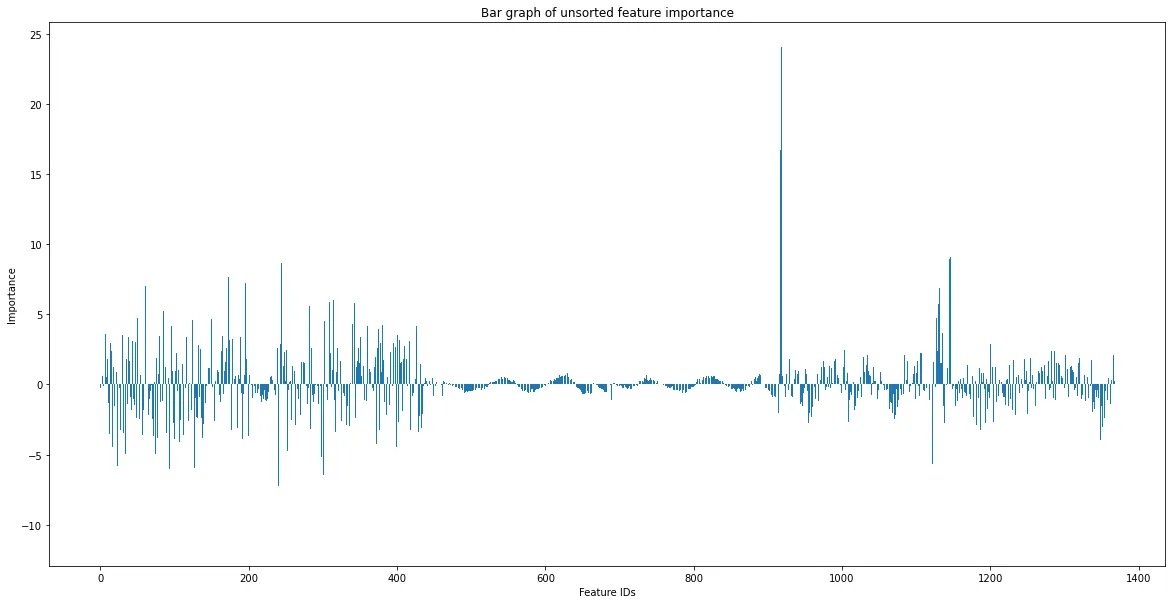
After extracting the desired features from the captured data streams, feature selection is a useful, and often underestimated, intermediate step. Various filters are needed to standardise outliers, noise, the data domain, etc. Of the many features generated, 1,360 in this case, only the most valuable should progress to the next stage and ultimately be used as training data. The original dataset corresponds to a run-to-failure experiment, so it contains information covering the full tool life. Dividing the dataset into 40 different bins means that each bin contains information on approximately 2.5% of the tool’s service life. These labels can be used to train a simple linear regressor. Using the accuracy of the fully trained model as a benchmark, we systematically remove features from the training set and compare the score. In this way, differences in accuracy indicate the contribution of a particular feature. Graph 1 shows all the features (on the x-axis) and their ‘impact factor’ on correctly identifying a bin.
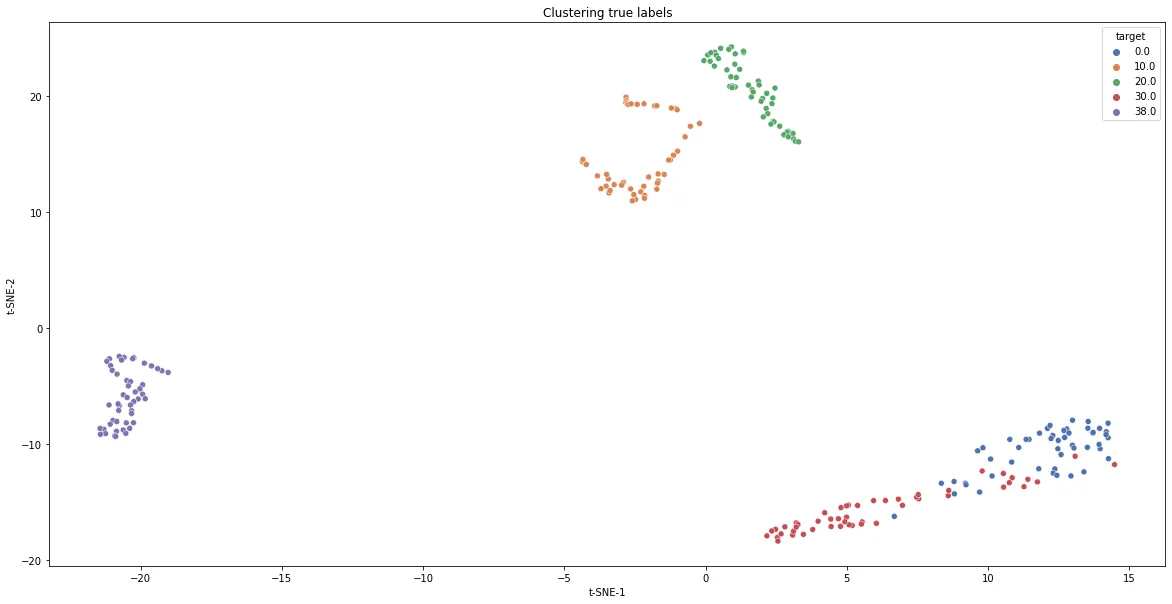
Ideally, the features retained are significant and represent the different bins with unique characteristics. t-SNE can be used to visualise this multidimensional dataset. By converting the original space into probabilities, it reduces the 59 dimensions to just 2, making the data easy to display graphically. Figure 2 shows 5 bins in different colours. Note that two bins partially overlap, which may make subsequent classification more difficult.
Now that only the most important parts of the dataset remain, it is time to decide which model is suitable. Given its unsupervised nature and relatively few tuning parameters, Density-Based Spatial Clustering of Applications with Noise (DBSCAN) was a logical choice. The literature reports good results with a similar implementation of this technique for tool wear. One important tuning parameter is the average distance between ‘normal’ data points (ε). Generating the point cloud and carrying out a few iterative calculations gives us the following data.
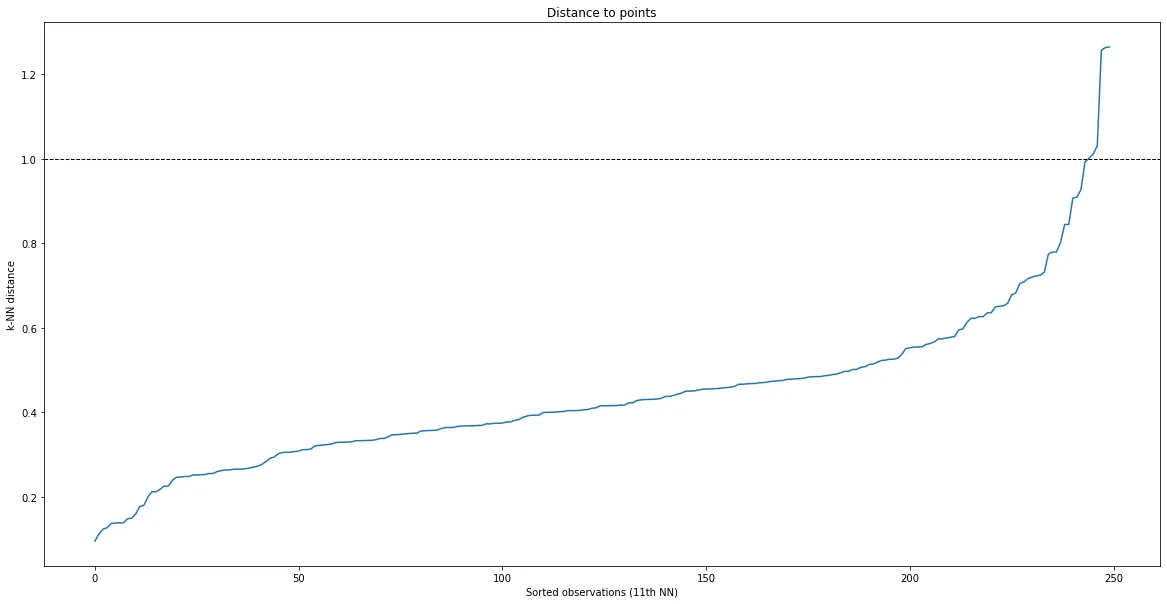
Outliers and noise are further away from points belonging to a cluster. We therefore set ε below this peak, which in this case gives a value of approximately 1. By applying this to the DBSCAN algorithm, we can identify clusters without providing it with any information about the process.
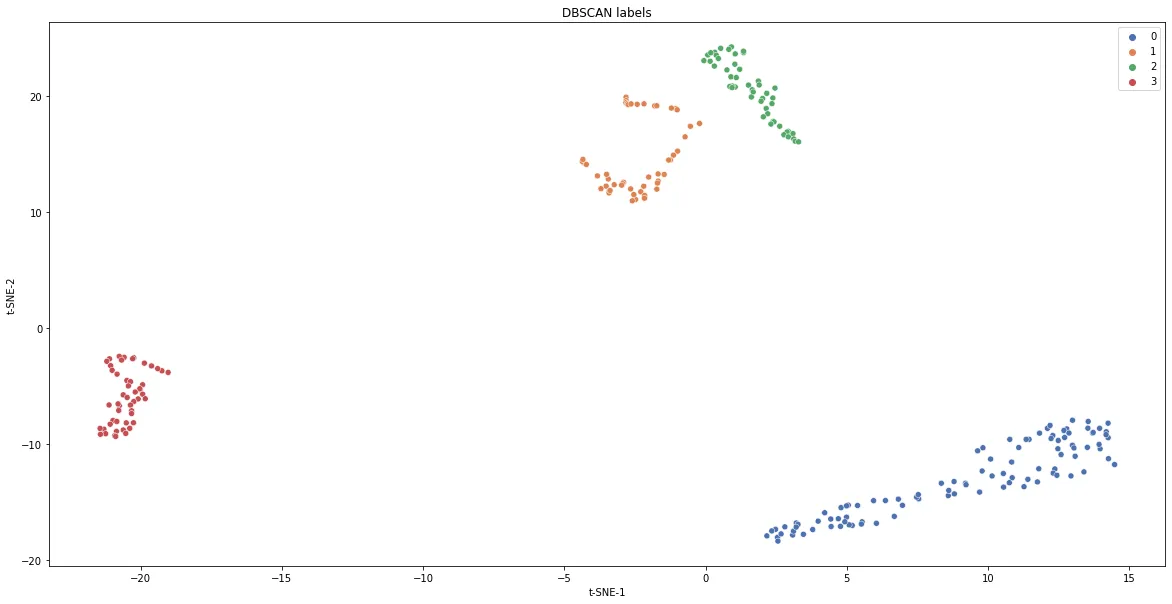
The DBSCAN model is clearly able to distinguish different clusters. At the bottom right of Figure 4, two bins have been merged into a single cluster. Since the information for these data points was measured midway through the tool’s service life, we can conclude that there is less variation between these bins than between bins from the break-in or end phase of the tool’s service life. This conclusion is consistent with previous experiments and matches the observations of the machine operators.
IV. POTENTIAL
The implications of implementing ML/DL in existing machines should not be underestimated. This example does not include information on ML deployment, but clearly shows that break-in and accelerated-wear regions can be distinguished using unsupervised machine learning algorithms. Further development of this approach could lead to systems for industrial applications that prevent catastrophic failure. This directly helps to minimise downtime, which in turn increases production. Greater insight into machine condition makes condition-based maintenance possible, further reducing downtime and extending the operating time of each tool. More production hours per tool mean lower stock levels and reduced associated stock costs.
V. CONCLUSION
Data-driven techniques are not simply the latest technological fad. They represent a shift in vision and perspective. They fit perfectly with the Industry 4.0 philosophy, and any organisation wishing to follow this path must develop a robust structure. This is not a one-off project, but a transition to a data-centric approach. For any company with a sound data management system, it will be a step closer to predictive maintenance and smart data exchange.
By showing that even relatively simple models can, for example, detect a failure, we have demonstrated the effectiveness and potential of this approach. We are convinced of its potential and look forward to extending it to other applications.
VI. ACKNOWLEDGEMENTS
We would like to thank dr. Tim Claeys and prof. dr. ir. Jeroen Boydens for their support and dedication to this project. Project team members Hans Naert, Pieter Ideler, Peter Vanbiervliet and Robin Loicq were indispensable in capturing the data and communicating with the industrial partners.
Question about this story? Ask your question
Keep following this
Get an email when a new story is published. No account needed.
- ThemeData from shop floor to decision
- SubjectNews







