












The growing importance of track and trace
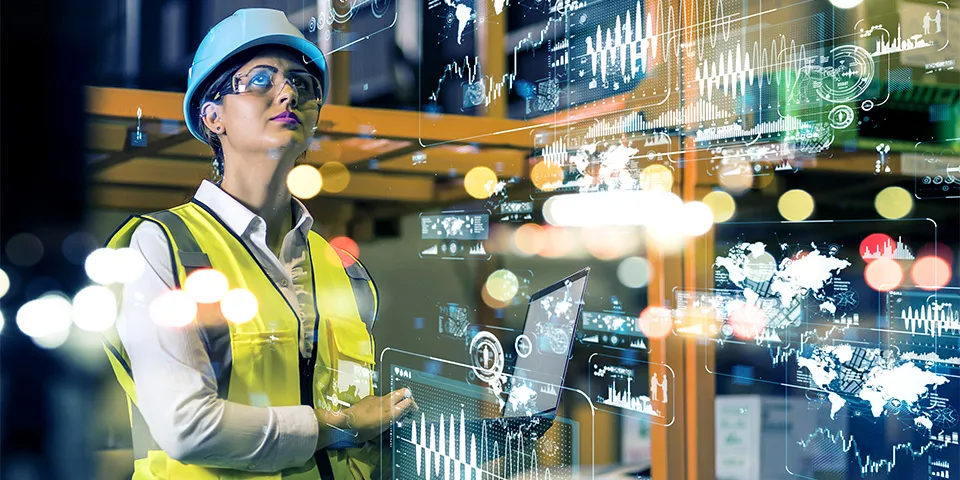
Track-and-trace technology is not new. Yet it is being adopted by more businesses than ever. There are two reasons for this. Firstly, the cost of this technology has fallen dramatically, putting it within reach of more businesses. Secondly, the time is right. The digitalisation ushered in by Industry 4.0 has opened up more possibilities and applications for track-and-trace technology. This prompted Agoria to organise an interesting afternoon seminar on the subject. We take a closer look at Johannes Cottyn’s presentation.
Track and trace: three words that are now commonly used as a single concept. But there is more to it. Alongside tracking and tracing, it also involves monitoring, planning and control. This gives users a complete picture of where a product has been (trace), where it is now (track), where it is going (control), what the process looks like (monitor) and what the future will look like (plan). The same source of information is needed at every stage. Initially, this information came mainly from the product itself, which was also the main focus. Today, track and trace is also used to track assets and resources. As businesses increasingly need to be flexible, the number of movements will only rise in the future, even for machines. Examples include the introduction of carriers on the production line, or tools that need to be tracked throughout production. The complexity increases further when this mobility is combined with orders, tasks and quality control all being linked together.
Greater insight needed
The growing adoption of track and trace is closely linked to businesses’ need for greater insight into their production. This is not only to meet legal requirements, but equally, and perhaps more importantly, to make real-time optimisations. But where should a business start when introducing track and trace? The key is to know the answers to a number of questions. What level of detail do you need? Do you want manual or (semi-)automatic identification? Is the process discrete or continuous? Is any additional information needed, for example about location, distance, temperature, or the conditions in which identification takes place? Only once these questions have been answered can you choose the right technology.
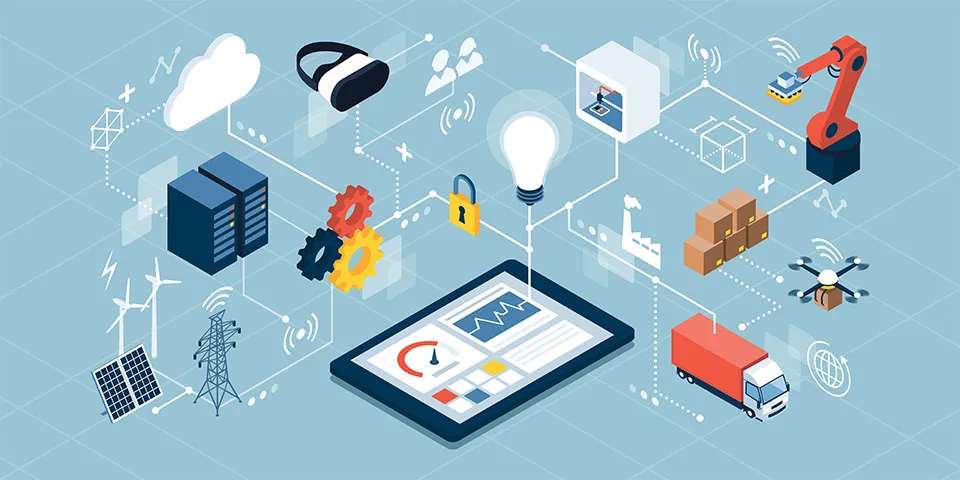
By combining all the separate signals into a whole, you create a flow of information throughout
your production, especially if you choose technology that can provide additional data.
A wide choice of technology
Users have a wide choice of technologies. RFID is now well established. A tag (transponder), an antenna, a reader, a controller and a network: that is all you need to track products, assets or resources. Indoor positioning is another option. This can use RFID, Wi-Fi, BLE (Bluetooth Low Energy) or UWB (Ultra Wide Band), and can be server-based or client-based. For those looking to operate on a larger scale, however, industrial 5G communications will be crucial. Real-time location can also be used. Various sensors on the production line pick up signals and use their orientation, distance and time differences to locate products. The more sensors there are in production, the greater the accuracy. A good internet connection ensures that all the signals are synchronised. Bluetooth can also be used for proximity-based localisation. Passive sensors, in turn, are an excellent way to combine information. Information is not generated continuously, but only when a tag comes within range of the reader. The final option discussed was 3D vision. Its advantage is that no additional material, such as a tag or barcode, is needed. Identification is based on geometry.
Added value lies in bringing data together
This hardware is used to collect raw data. Of course, a software solution is then also needed to gather it and turn it into useful information. The value of track and trace lies precisely in bringing data together. By combining all the separate signals into a whole, you create a flow of information throughout your production, especially if you choose technology that can provide additional data. This also opens the door to extensive product individualisation.
Question about this story? Ask your question
Keep following this
Get an email when a new story is published. No account needed.
- ThemeSmart manufacturing and logistics
- SubjectNews







