












The growing importance of Industrial Ethernet connectivity in pneumatic valves
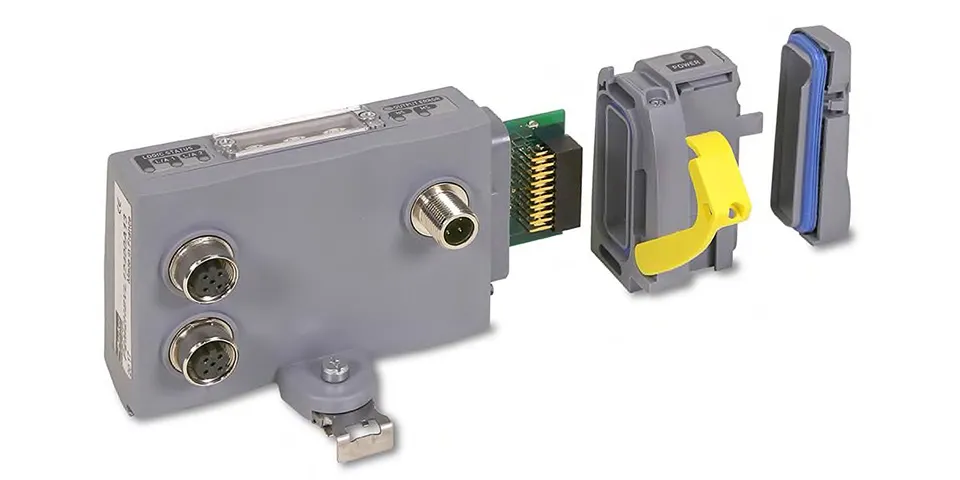
The growing popularity of Industrial Ethernet (IE) places certain demands on suppliers of components such as pneumatic valves, where reliable, robust and high-performance connections are becoming less necessary.
IE is growing at an annual rate of 22% and currently accounts for 52% of the connectivity market. In recent years, various IE protocols have been introduced and widely adopted by manufacturers of automation equipment because of their advantages over traditional fieldbus networks. Alongside the availability of these protocols and their increasingly widespread acceptance by the market, the growing popularity and usability of IE can also be attributed to good backward compatibility and the availability of robust components (wired), which are protected as standard against electrical noise.
Another reason for the enormous growth of the global IE market is the emergence of cloud technologies and simply greater demand for connected devices. In addition, Industry 4.0 is driving the desire for more smart factories, which operate in real time with predictive maintenance and built-in equipment diagnostics. Ultimately, the aim of the smart factory is to eliminate downtime and improve productivity. Such facilities therefore need to be much more intelligent, flexible and dynamic. Production processes need to be organised differently, with complete production chains, from suppliers and logistics to product lifecycle management, closely connected across company boundaries.
To realise these ambitions, smart factories rely on collecting and analysing data. Data analytics on an IE network means improving productivity through real-time production monitoring, capturing and generating data that helps with predictive maintenance and facilitates decisions based on accurate reporting of what is happening on the shop floor. Analytics can be used in many ways. For example, data can be stored and retrieved as required (acyclic data) or sent back over the network in real time for immediate attention (cyclic data).
IE, which can simply be defined as Ethernet applied in an industrial environment, often requires rugged connectors and cables and, most importantly, greater determinism: a guarantee that the network will deliver the workload to the intended nodes on time. To achieve this, IE uses specialised protocols. Various application-layer protocols for IE, such as Profinet, Ethernet /IP, EtherCAT etc., are now widely used in industry, as users seek higher data rates and longer distances.
Each protocol has its own set of attributes, so the choice depends on the application. Profinet, for example, is compatible with a standard TCP/IP stack as well as real-time channels. Alternatively, standard switches and other off-the-shelf IE infrastructure can be used with EtherNet/IP, helping to keep equipment costs down. EtherCAT introduced the principle of forwarding data (on-the-fly processing), eliminating single-node targeting and enabling maximum bandwidth utilisation.
Regardless of which protocol best suits the application, these breakthroughs have been more than enough to make IE a key component of control systems worldwide.
Another advantage of IE is its compatibility with standard access points, routers, switches, switches, hubs, cables and fibre optics. Meanwhile, peer-to-peer environments can replace master-slave configurations, resulting in better interoperability. IE not only saves space and wiring, but also simplifies commissioning by offering readily available tools for system integration.
Although industry is clearly making greater use of IE, the key for developers of automation equipment is to achieve IE connectivity in a cost-effective and straightforward way. Now, however, any engineer tasked with finding a cost-effective way to connect pneumatic valves to IE can consider using the latest high-power, high-reliability network nodes.
One example is Parker Hannifin’s recently introduced P2M IE network node. Developed with advanced factory automation in mind, the connection is simple and cost-effective to configure. As a result, H Universal ISO Series valves, Moduflex valves and H Micro valves can now be connected to the IE network.
An inexpensive connection with integrated diagnostics makes network connections an affordable alternative to traditional wired networks. Solutions of this kind should help reduce complexity and costs at the machine, while supporting the simple diagnostics needed to align the needs and objectives of smart factories and Industry 4.0. Solutions of this type should help reduce complexity and costs at the machine.
Parker now offers a full range of IE connectivity options, including EtherNet/IP, Profinet IO, EtherCAT, Ethernet PowerLink, Modbus TCP/IP and CC-Link IE protocols.
Network connectivity is also enhanced by Parker’s H-series network portal, which provides on-machine flexibility for IE applications on the H-series ISO valve with universal manifold. The network portal supports digital or IO-Link I/Os for machines, eliminating the need for additional PLC input and output cards or other external modules. With the I/O on the valve manifold connected via the network portal, centralised machine applications can be implemented simply and cost-effectively, even in corrosive, washdown or hazardous areas, and in environments with extreme temperatures.
Demanding automation applications such as motion control and safety are ideal candidates for IE, as both can benefit from the reliability and additional bandwidth this solution offers. At last, low-cost connectivity with integrated diagnostics has become a reality, further reducing complexity and costs at the machine while providing connectivity tailored to the needs of smart factories and Industry 4.0. The connectivity solution is one of the key advantages of this solution, which offers reliability and additional bandwidth.
Looking ahead, IE networks are likely to continue growing and become a mainstay of industrial communications, enabling industry and infrastructure to be controlled by connecting different devices, machines, systems and users, regardless of location. IE compatibility in key automation components such as pneumatic valves is vital if industry is to make full use of the benefits that comprehensive and reliable connectivity can offer.
Question about this story? Ask your question
Keep following this
Get an email when a new story is published. No account needed.
- ThemeData from shop floor to decision
- SubjectNews







