












The 5 digital commandments for your next machine upgrade
A machine upgrade often starts with the electrical or control systems. Yet an upgrade is the ideal opportunity to review the digital possibilities too, particularly data and connectivity. But digitalisation takes place centrally within your company, not just at machine level. So what should you plan for at machine level during an upgrade? These five commandments point the way.
I. CHOOSE OPEN PROTOCOLS
No connectivity, no digitalisation.
Open protocols are the best way to facilitate connecting everything.
- For your machines, this means using OPC UA.
- For IT-related systems such as ERP and other planning and/or production systems, this means OData.
Here are some of the key features of OPC UA:
- OPC UA is an open, platform-independent protocol.
- It works on a publish/subscribe basis: I subscribe, and you let me know when you have something.
- Client/server technology: the server communicates with the sensors/actuators. The client requests information from the sensors and can ask the server to pass on information only when certain changes occur.
- Built-in keep-alive protocol: if the connection drops, the client automatically reconnects.
- Most OPC UA servers have built-in data logging and temporarily store data values.
- It works with data types: a date is a date, and a number is a number.
II. THINK AHEAD TO INDUSTRY 4.0
As well as open connectivity, you can already incorporate the following into the machine control system:
- The machine control system is open to receiving information from higher-level systems: production orders, planning, maintenance, tracking & tracing, …
- Sensor parameters are already converted into engineering units. For example, a 4-20mA sensor is converted into temperature, and the number of pulses into product quantity, …
- Use components with built-in Industry 4.0 functionality:
- Automatic configuration of sensors and actuators when they are replaced.
- Built-in processing of data to produce valuable information.
- Simple connectivity.
- Consider “predictive maintenance”, for example by analysing data, either in the cloud or by implementing “condition monitoring” on the machine’s mechanical components.
- Consider machine learning algorithms to improve your real-time data analysis.
- Consider whether you want to view your machine’s status anywhere on a smart tablet or mobile phone via IoT.
III. MAKE USE OF MACHINE VISION…
Machine vision is developing at an enormous pace. Tasks that were once impossible or unthinkable to automate are now opening up new possibilities, even when your processes involve a high degree of variation and flexibility.
Machine vision is used in a wide range of applications:
- As a robot’s ‘eye’ for positioning. Useful when positions vary or when picking up objects.
- Assembly error checks: machine vision can see far more detail than the human eye.
- Improving quality and speed:
- counting parts,
- measuring length and thickness,
- detecting (transparent) objects,
- automated inspection,
- pattern recognition,
- analysis of electronic components,
- material inspection
- …
IV. … COMBINED WITH DEEP LEARNING
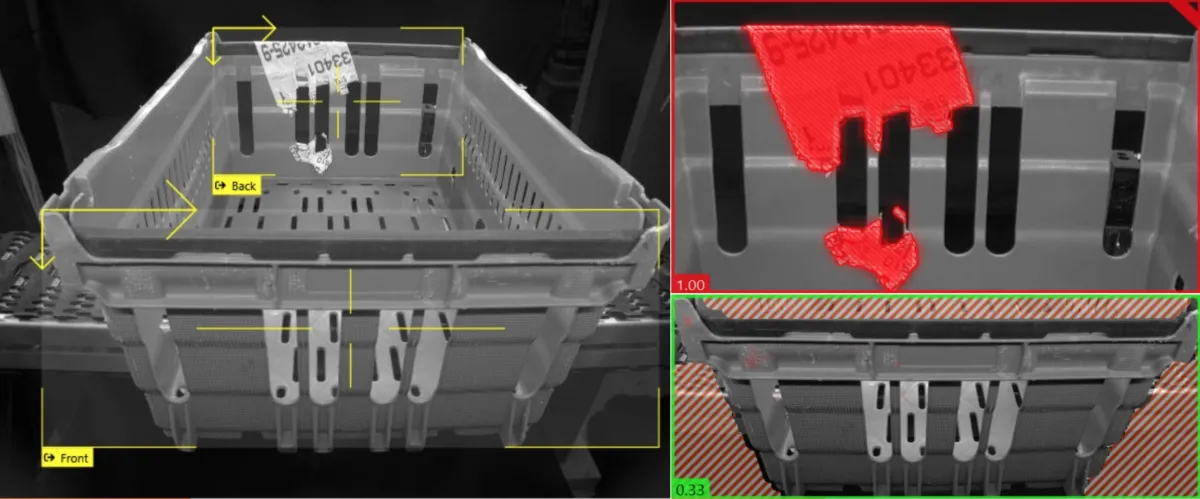
Deep learning adds another dimension to machine vision. Although deep learning and AI are not new concepts, they are now being widely applied in machine vision systems.
The razor-sharp images produced by machine vision make deep learning more relevant and applicable than ever. The better the system captures every detail, the more effectively deep learning can do its job. Think of damage detection, for example in fruit growing, or detecting damage in plastics and metals.
Thanks in part to advances in faster computer hardware, the computing power needed to implement deep learning technology is now available in every modern production hall. This allows its potential to be realised more efficiently and effectively, and opens the door to new business models.
Want to find out more about the new possibilities offered by combining machine vision with deep learning? Discover them in the article When conventional vision techniques fall short.
V. INVEST IN SECURITY
The shift to Industry 4.0 means that machines are increasingly being connected to one another. Production systems need to communicate with ERP systems more and more often, and information needs to be sent to the cloud, …
These additional connections make it easy to exchange data. But they also pose a significant risk.
IT security has been well established for many years, but OT security is still in its infancy. This often leads to situations where the connection to the public internet is strongly protected by the IT department, but once inside the local network, there are often no security measures in place. As a result, all systems on the network can communicate with one another without restriction, bringing associated cybersecurity risks.
The aims of cybersecurity can be divided into 3 distinct pillars:
- Confidentiality: data can only be read and modified by people/systems with the appropriate authorisation and approval.
- Integrity: all changes must be traceable and correct.
- Availability: protection against system failures. The system must remain operational.
OT vs IT
OT cybersecurity is a relatively new concept. This means that many existing installations are not suitable for direct connection to large networks, let alone to the internet. These systems therefore require particular care when establishing a secure network perimeter, using firewalls, for example.
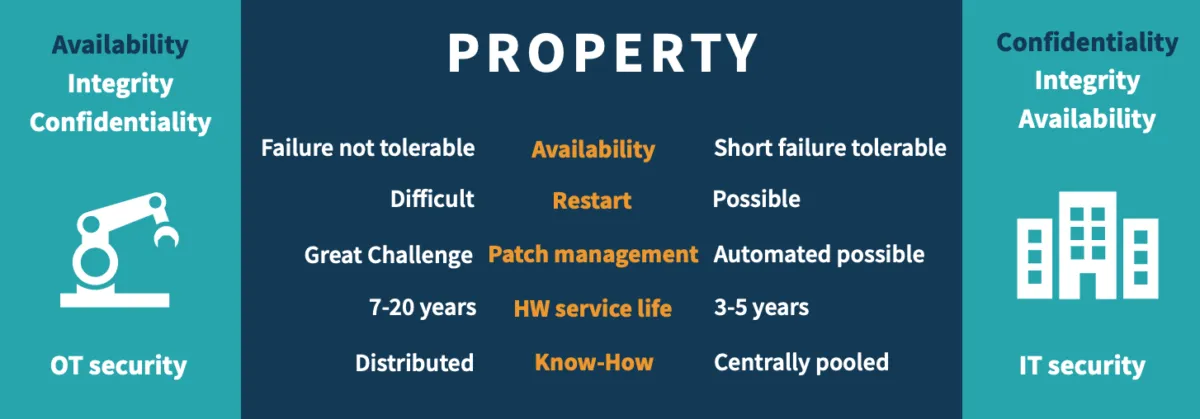
A second major challenge is the mismatch between IT and OT requirements.
Cybersecurity is a key requirement for both, but priorities are often ranked differently. For IT, confidentiality is the most important factor, followed by integrity and availability. In OT, the order is completely reversed, with availability the top priority, followed by integrity and confidentiality. For IT, it is relatively easy, for example, to restart a server/application/… outside working hours to install an update. In OT, it is often not feasible to stop production, or a network problem may arise.
WHITE PAPER: MACHINE UPGRADING
In our white paper Machine Upgrading 4.0, we take a closer look at machine security and the role of the IEC 62443 standard. In addition to the digital aspects, we also discuss the electrical, mechanical and conformity aspects of a machine upgrade.
Question about this story? Ask your question
Keep following this
Get an email when a new story is published. No account needed.
- ThemeData from shop floor to decision
- SubjectNews







