












TETRA VEooX project: digital twins in logistics and production
Text Laureline Vansteenkiste Beeld HITLAB Howest
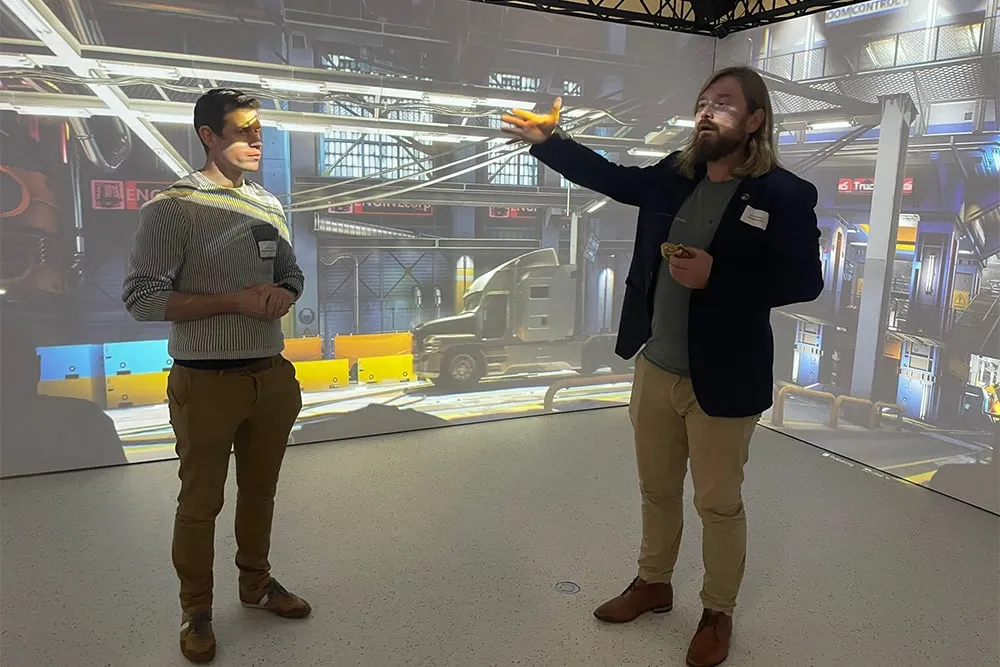
What if you could replicate a company’s operations virtually, then test different scenarios cost-effectively without affecting your current production and logistics? In a nutshell, that is the aim of the TETRA VEooX project, an initiative by FlandersMake@UGent, ISyE and HOWEST University of Applied Sciences. At the kick-off event, UGent professor Johannes Cottyn and HOWEST researcher Charlotte Larmuseau explained why companies should get involved in the project.
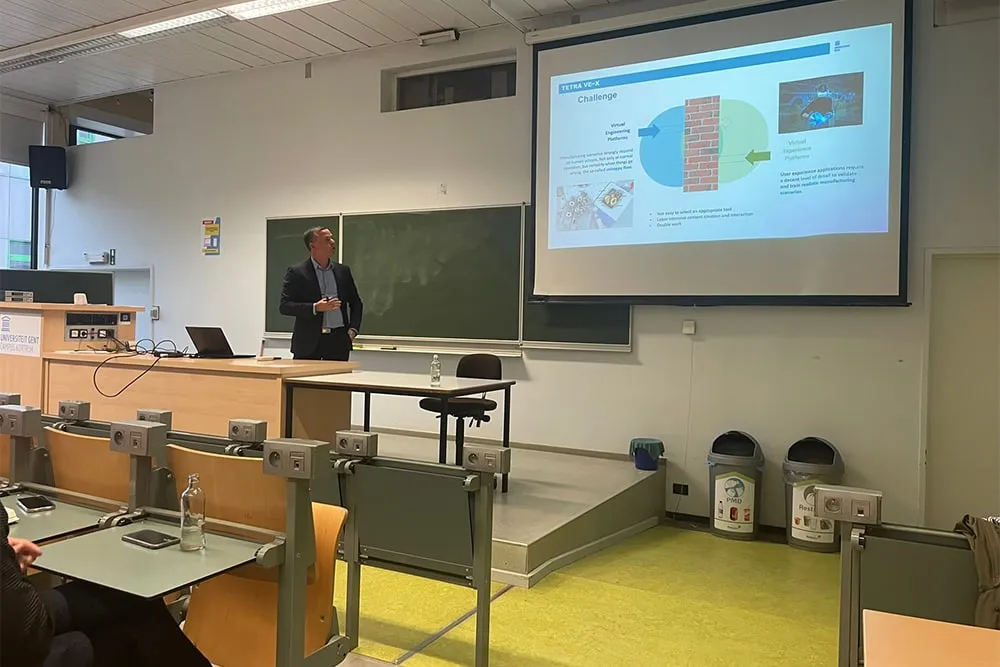
The kick-off of the TETRA VEooX project took place in Kortrijk on Thursday 7 November. The TETRA programme is a VLAIO initiative for practice-oriented research. Its aim is to facilitate the transfer of technology-driven knowledge between universities of applied sciences and universities, on the one hand, and companies and non-profit organisations, on the other. The VEooX project is a collaboration between FlandersMake@UGent, ISyE and HOWEST University of Applied Sciences. Companies including Daikin, Actemium, Engico, Dewilde engineering, Vandewiele, Octoo, Pattyn, Talumis and Vintiv were represented.
VEooX, a combination of virtual engineering and user experience, aims to use digital tools to replicate the physical reality of production and logistics environments virtually, and to (re)design, control and/or optimise them. The project seeks to apply digital twins, virtual prototyping and virtual training in the manufacturing industry to launch innovations, technologies and products without affecting existing processes. Companies can take part in the project by joining the user committee to provide input and feedback, and potentially developing their own case.
Synergies between engineering and experience
At the kick-off, UGent professor of industrial automation and head of the Manufacturing Knowledge and Automation Engineering competence domain at FlandersMake@UGent, ISyE Johannes Cottyn outlined the ambitions of TETRA VEooX. The project brings together two domains: virtual engineering and virtual user experience. The first involves using 3D models to dimension a production process and commission it virtually. The second enables employees to work through realistic production scenarios in a 3D environment, tailored to their roles. Both domains are valuable in their own right, but it is the synergy between them that sets VEooX apart.
Using virtual engineering platforms in production and logistics offers many opportunities, but also presents a number of challenges. One is selecting, setting up and maintaining the right tool. Another is the need for human interaction when testing scenarios, which most tools do not currently support. Virtual experience platforms, meanwhile, require a high level of detail to develop realistic logistics and/or production scenarios. VEooX aims to bring the two approaches together for more effective and cost-efficient results.
Detailed market study
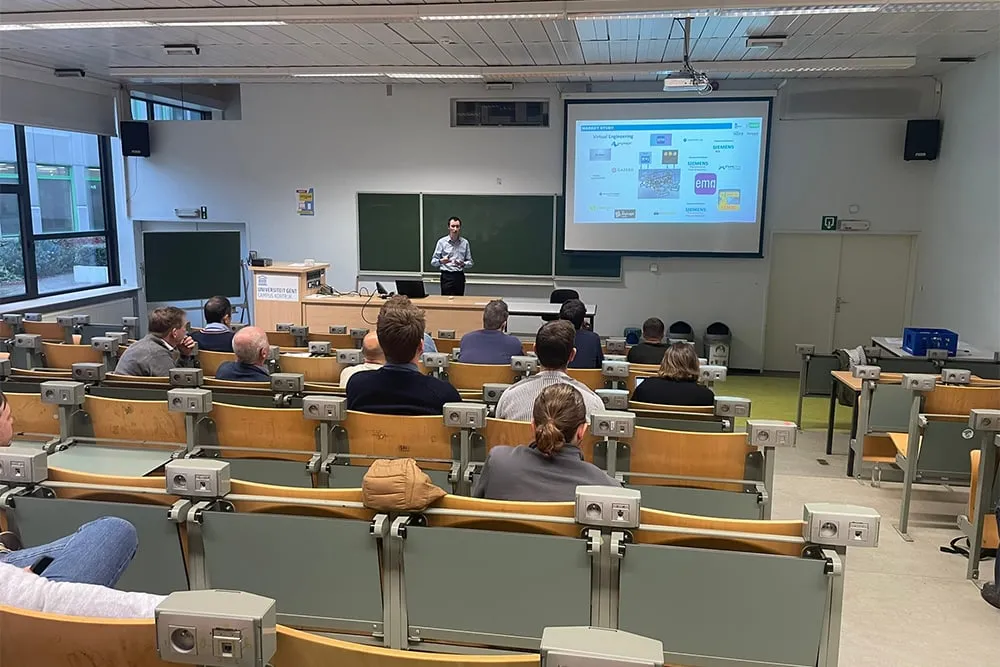
Although the VEooX project has only recently got under way, the team has already conducted a market study of software tools available for virtual engineering and experience. UGent postdoctoral researcher Matthias Schamp explained how the team classified sixteen tools against around fifty criteria and then ranked them. This comparative overview is compiled in an online database accessible to members of the user committee. The database will be expanded with other tools and/or additional information from suppliers.
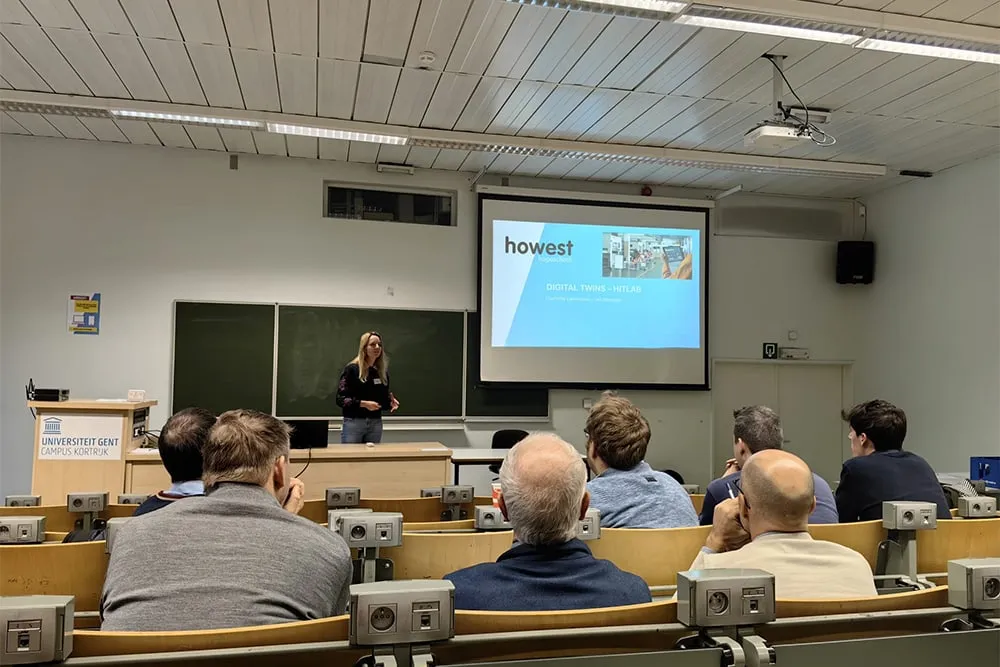
Simulating the human factor
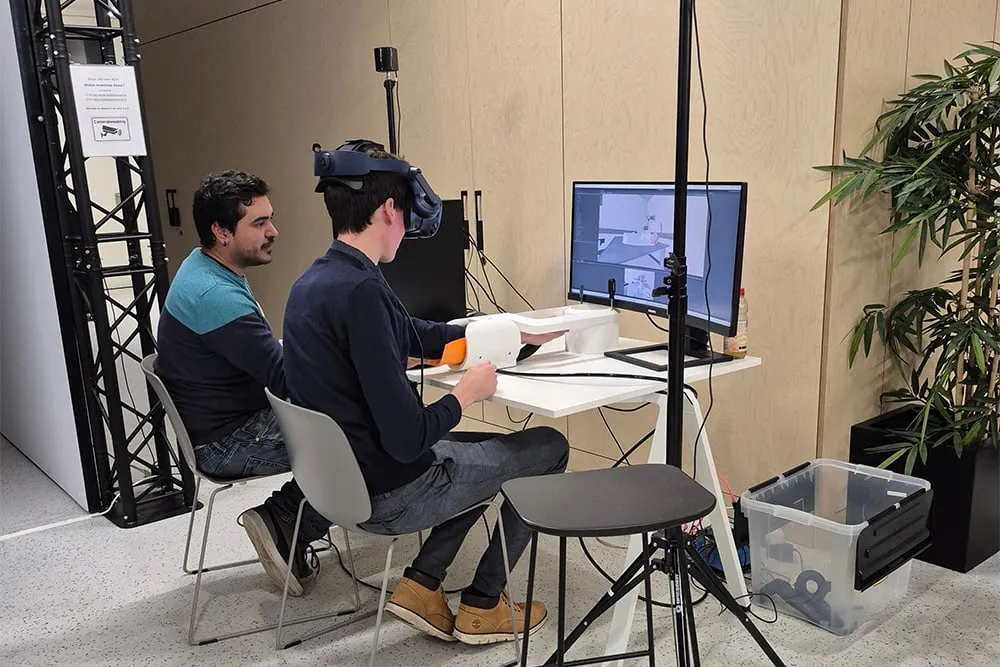
HOWEST researcher Charlotte Larmuseau demonstrated the value of user experience applications for gathering feedback on virtual prototypes, without the high development costs of a physical prototype. They also make it possible to incorporate human actions into test scenarios for engineering projects, for example those involving safety and ergonomics. Engineering tools, in turn, help create scenarios for different types of employees efficiently in terms of cost and time.
As well as providing standard workflows and developing a test environment, the VEooX project supports interested companies in guiding and documenting an industrial case. VEooX is aimed at manufacturing companies, machine builders and system integrators, with a focus on SMEs, as well as technology providers and consultancy firms working with simulation and emulation tools and AR/VR applications. The project runs from 1 October 2024 to 30 September 2026. More information is available on the ISyE website.
Question about this story? Ask your question
Companies in this story
Keep following this
Get an email when a new story is published. No account needed.
- ThemeFrom design to flexible machine
- SubjectNews
- CompanyActemium
- CompanyVINTIV







