












Stefan Fesser and Koen Leemans on the success of Volvo’s Ghent factories
Text Björn CrulImage Tjorven
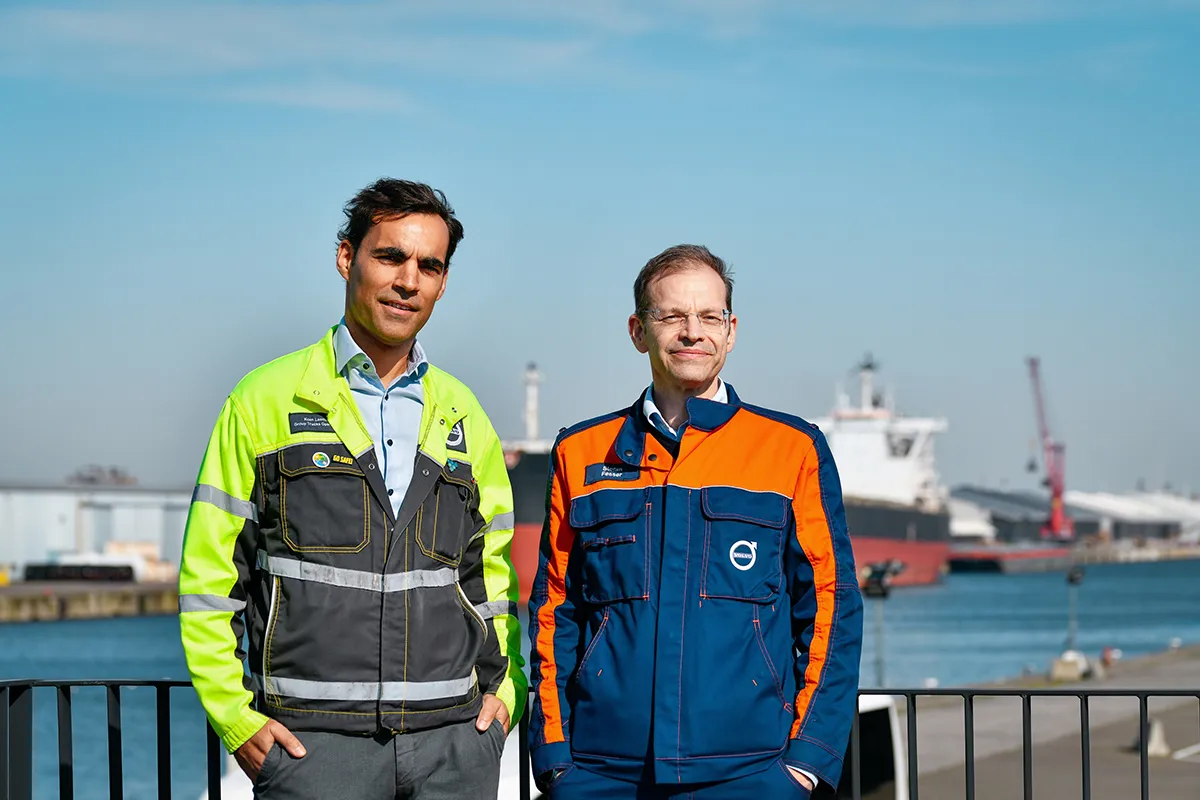
“Our teams’ drive to innovate is our greatest asset”
In the 1990s, our country could still boast a significant presence of car manufacturers. But following the closure of Renault Vilvoorde (1997), Opel Antwerpen (2010), Ford Genk (2014) and Audi Vorst (2025), Volvo Car in Ghent is the only car manufacturer left in the country. A little further along, in North Sea Port, we also find the world’s largest Volvo Trucks factory. Although the two companies now have different owners, their success stories have striking parallels, as a joint interview with Stefan Fesser, CEO of Volvo Car Gent, and Koen Leemans, CEO of the Volvo Trucks factory in Ghent, reveals.
Your companies have a long history in Ghent. Volvo Cars opened its factory here in 1965, while Volvo Trucks has been present in the port area since 1975. What makes North Sea Port such an attractive location?
Koen Leemans: Having a factory in a port area with excellent multimodal connections is a major asset for us. We have a very good freight link with our head office in Göteborg, which is essential. We produce 40,000 heavy-duty trucks here each year, making this the largest production site in our group worldwide. Many partners are also nearby, including DFDS and Katoennatie. Together with the port authority, we are working on what is known as a green corridor, with the aim of making transport of our finished products to Southern and Eastern Europe greener. North Sea Port’s ambitions for carbon neutrality fit perfectly with our own objectives.
Stefan Fesser: A central location in Europe is also crucial for us. As a company, we want to manufacture in the markets where we operate and source as many parts as possible from our own region. To this end, we have built up a large supplier ecosystem around this factory. The port of Ghent is highly accessible for our inbound and outbound logistics. For example, we have our own rail terminal on site and also use a short-sea connection with the port of Antwerp. Together with North Sea Port and the port community, we are working to ensure that we have the right infrastructure and sufficient renewable energy in the future, so that we can make our logistics more sustainable.
Manufacturing in Belgium is facing difficulties. How have your factories managed to weather the successive crises of recent years?
Stefan Fesser: A combination of factors has enabled us to establish such a strong foothold here. For me, it is primarily down to the flexibility and agility of all our teams. We have proved that we can deliver new assignments flawlessly and efficiently. We were the first site to start battery assembly. We were the first Volvo factory in Europe to build a fully electric car, and we are now on our third EV model. Last year, we produced more than 186,000 cars with a team of 6,500 employees. Staying at the forefront of innovation and never resting on our laurels makes our factory and the entire supplier ecosystem more resilient. Ultimately, that is what protects jobs. We are still hiring, too.
Koen Leemans: Much the same applies to us. For decades, we have had a culture that drives us to deliver strong results. The Volvo Trucks factory in Ghent stands for premium quality at an affordable cost, delivered on time. We are also a first mover in innovation. Our factory, for example, has been carbon neutral since 2007. We have designed our production lines to handle all models, whether diesel or fully electric. Because we perform so well, the group continues to invest, and we continue to recruit to expand our team of more than 4,000 employees.
Multinational groups often see an internal battle to secure new models or orders. What do you have to do to remain competitive?
Stefan Fesser: We know that energy and labour costs in Belgium put us at a disadvantage. That is why we are focusing strongly on reducing our energy demand, for example with new electric ovens in the paint shop. Generating our own renewable energy also makes us less dependent on price shocks in the energy market. We have both wind turbines and solar panels, and a heat network with Stora Enso, through which we recover its surplus heat. When it comes to labour costs, there is only one solution: keep innovating and automating to improve efficiency. We introduced the new EV model EX30, with more than 500 new robots on our lines, in half the time planned. Achievements like that do not go unnoticed by our Chinese owner Geely.
Koen Leemans: We produce all Volvo Trucks’ heavy-duty models for the European market, so there has never been competition for a new model. However, we have seen the transition to electric trucks progress more slowly than expected. For the first time, the group is therefore asking whether we should continue to produce electric heavy-duty vehicles at all our sites. That requires major investment. In the long term, of course, it is a no-brainer, but for now we are keeping a very close eye on market developments. The geopolitical situation, including import tariffs, also plays a role. But there is no doubt that we are keeping a close watch on our efficiency, both in terms of energy and labour costs.
What is the biggest challenge your site is facing at the moment?
Stefan Fesser: Everyone knows that the automotive industry is highly competitive. Fortunately, we can draw on a long history and Volvo’s strong reputation for design and safety. The challenge now is to be more flexible and faster than the rest of the market. We are investing in a green and digital transformation. Fortunately, the government is supporting us. The European Commission’s Clean Industrial Deal is a good start, but the key will be to turn it into measures that benefit us in practice.
Koen Leemans: I completely agree with Stefan. We too know that new competitors are on the way and will challenge us. We therefore need to reinvent our production, because incremental innovation alone will not get us there. For me, staying relevant in the future also means upskilling and reskilling the available talent. We will need hundreds of new people to continue transforming our operations, people with the right attitude who are willing to continue their training.
Both Volvo Car Gent and Volvo Trucks are currently recruiting, including for dozens of technical roles. Are you competitors in the labour market?
Koen Leemans: Yes, in that respect we are competitors. The tight labour market persists, and we are both looking for technical talent, people with digital skills and employees willing to work shifts. At the same time, I believe that the fact that applicants often come across the Volvo brand is also a benefit, because both companies are growing and have a positive image. However, the difficult situation does not mean we will simply open the doors to everyone: we stick to our recruitment process. People must continue to fit the organisation’s DNA. That is precisely our strength. In total, around seventy different nationalities are represented among our employees.
Stefan Fesser: Our strength is that we offer people a highly skilled workplace in companies that invest heavily in innovation. That is good news for the port community and for Ghent as a whole: Volvo Car and Volvo Trucks have long-term ambitions and offer sustainable employment. The challenge is to keep explaining that industry is about people, and to clearly communicate the appeal of our jobs to the next generations entering the labour market. Our recruitment policy puts culture and values first. This is one of the reasons why our workforce includes more than seventy nationalities. We are proud that people from the second or even third generation of the same family now work at our factory too.
Finally, what does the future hold? What plans do you have for your factories?
Stefan Fesser: The launch of the Volvo EX30, which runs on the same line as the existing models, is a major milestone for Volvo Car Gent. It represents a total investment of 220 million euros. It proves that our factory is ready for the future. We have the potential to increase production to 250,000 cars a year over the coming years. But we will need to remain agile, as technology is still evolving at a rapid pace and market developments are less predictable than ever.
Koen Leemans: The future looks positive. I see plenty of opportunities in our master plan through to 2028, and we still have land available to expand our site. The challenge is to keep strengthening our competitiveness. Taking the factory to an even higher level with the whole team is a challenge, but at the same time it is very rewarding if you are open to it. The time we are living through now is one of the most interesting periods of my career.
Question about this story? Ask your question
Keep following this
Get an email when a new story is published. No account needed.
- SubjectNews







