












Sioen streamlines logistics with Pick-to-Light system
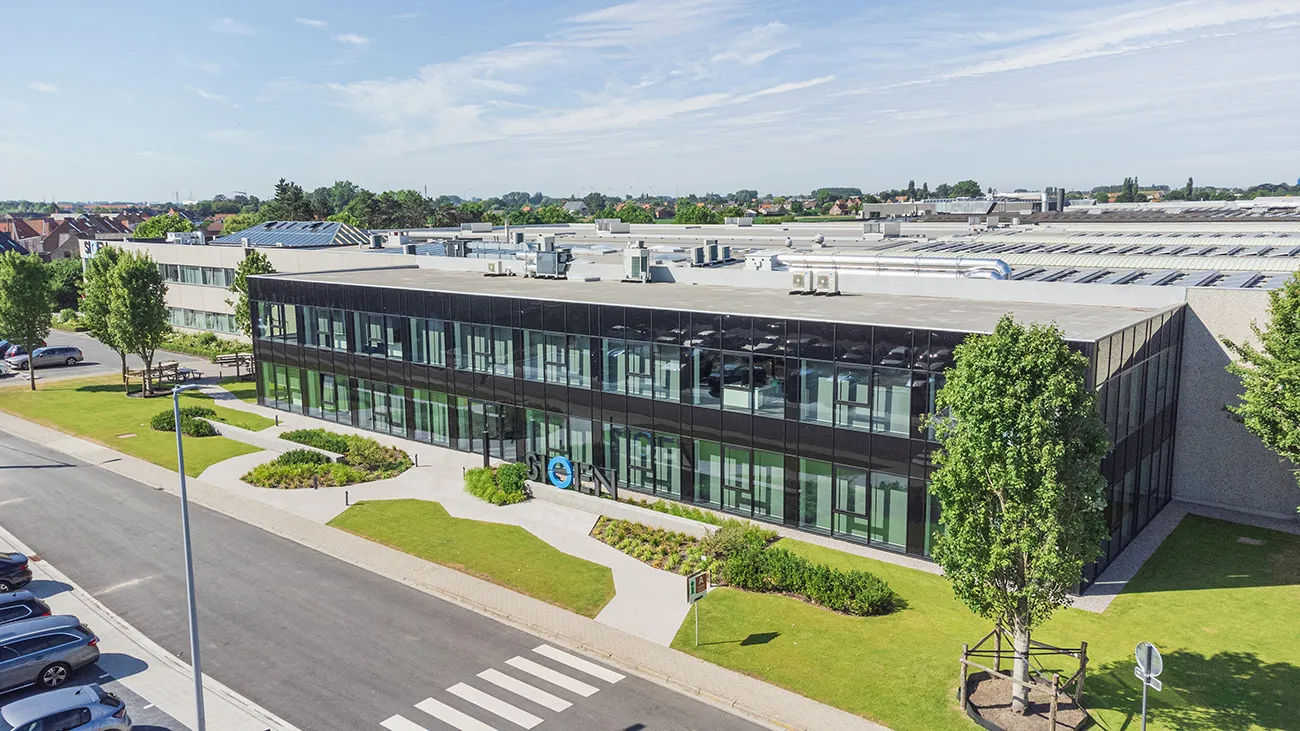
Belgian company Sioen specialises in technical textiles and professional protective clothing, supplying customers all over the world. Its logistics department has recently achieved a major efficiency boost thanks to a carefully designed automation project, with Banner Engineering’s PTL110 Pick-to-Light system, distributed by Turck Multiprox in Aalst, playing a key role.
With operations in twenty countries and 22 production centres, Sioen manufactures yarns, fabrics, nonwovens, colour solutions, coated textiles and garments for a wide range of applications. The company’s site in Mouscron makes it immediately clear that Sioen is a major player on the global stage.
Filiep Vanwymelbeke, logistics director at Sioen Apparel, the distribution centre of Sioen Industries, explains: “The common thread running through our activities could be described as ‘technical expertise’. We never shy away from a challenge: the more difficult it is, the better. This certainly applies to the many types of protective clothing we produce, more than three million garments a year. They protect firefighters, police officers, factory workers, paramedics, soldiers, welders and, in short, anyone working in a potentially life-threatening situation.”
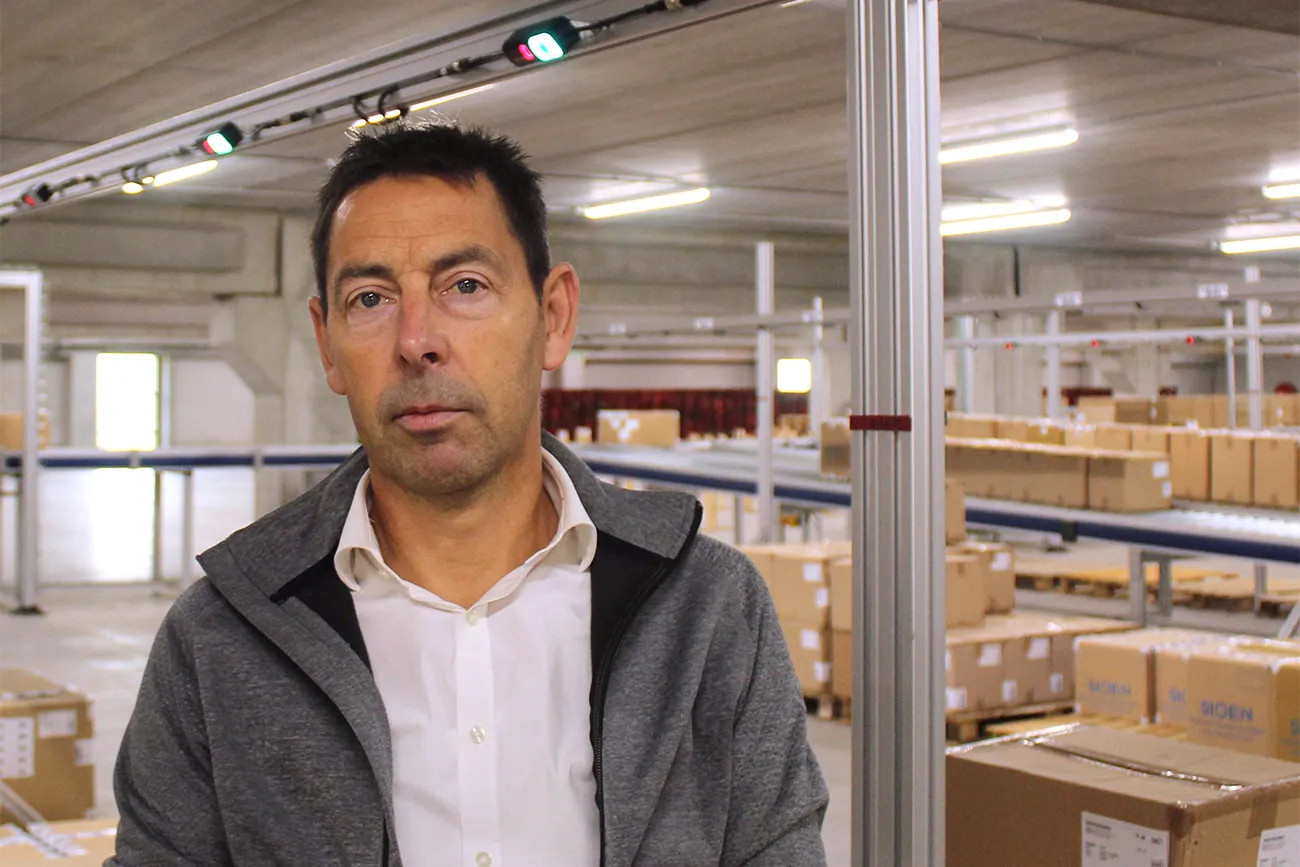
Efficient logistics processing is crucial
The logistics department was officially opened in 2001, alongside the spinning, weaving, coating and extrusion departments. “We store and dispatch clothing here, along with accessories such as knee pads and helmets.”
Sioen Apparel generates a turnover of 190 million euros. Goods are transported from production sites around the world to Mouscron for processing, storage, picking and dispatch to customers. “Naturally, fast and efficient processing is very important. However, there were areas for improvement, both inbound and outbound.”
For inbound, most of the work was done manually. The only thing that moved, so to speak, was the forklift truck. Each pallet was brought to an employee, who scanned the products and placed them one by one in their designated pallet location. “That location was always reserved for that product, whether or not we had it in stock. It took four to five people five hours to process a lorry.”
For outbound, employees were given a picking list for each customer and collected the items in the warehouse. Once they had finished, the process started all over again.
Tackling the challenges
“Our logistics processes lacked efficiency. We therefore set out to find a system that would tackle the challenges in both inbound and outbound operations.”
The answer came in the form of a brand-new, high-performance WMS system from C&W Logistics, combined with carefully designed automation using a pick-to-light system from Banner Engineering. The manufacturer of products including photoelectric sensors and signal lights has been a Turck Multiprox partner for more than thirty years.
“We developed the logistics layout in collaboration with Logflow. Easy Systems in Geel, working with MV Automation in Gierle, handled the integration of the pick-to-light system.”
PTL takes centre stage
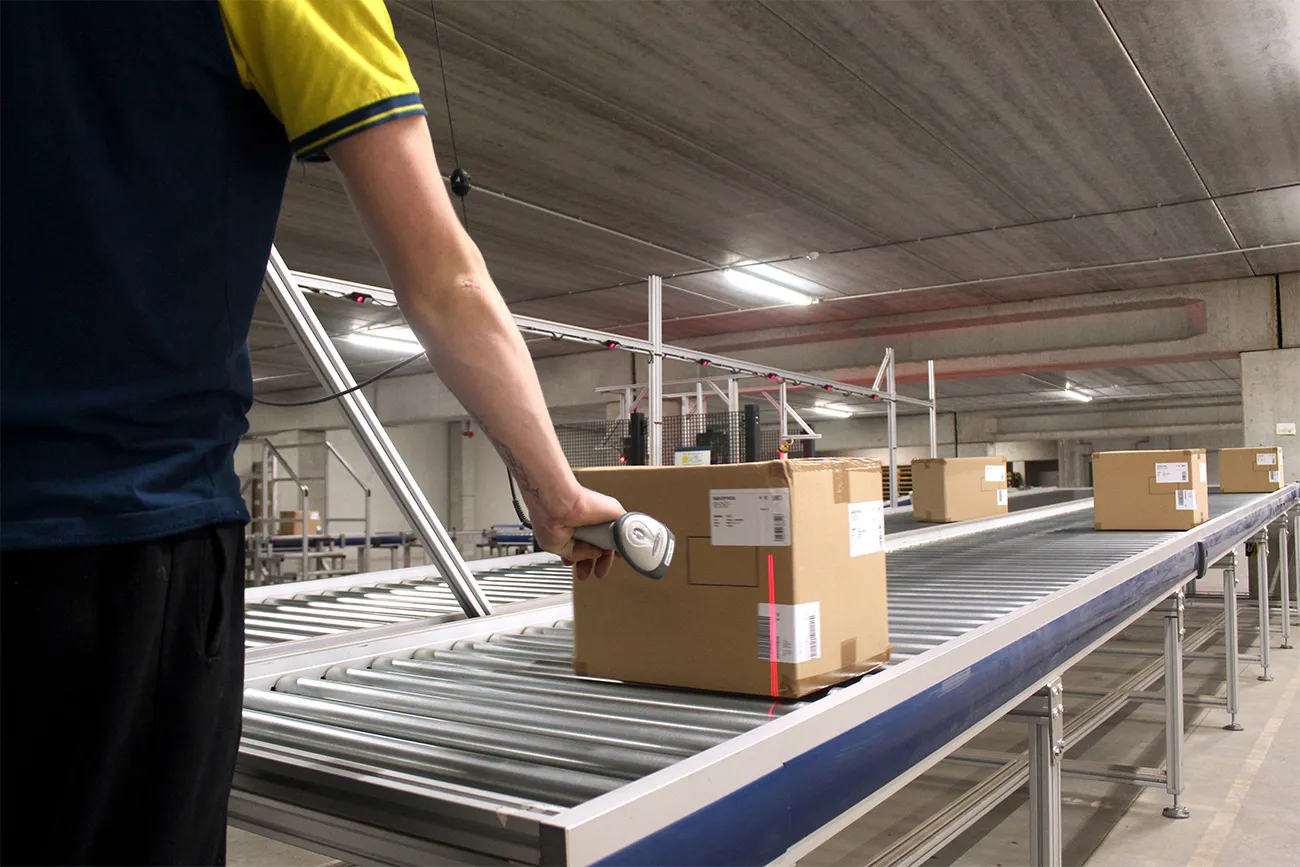
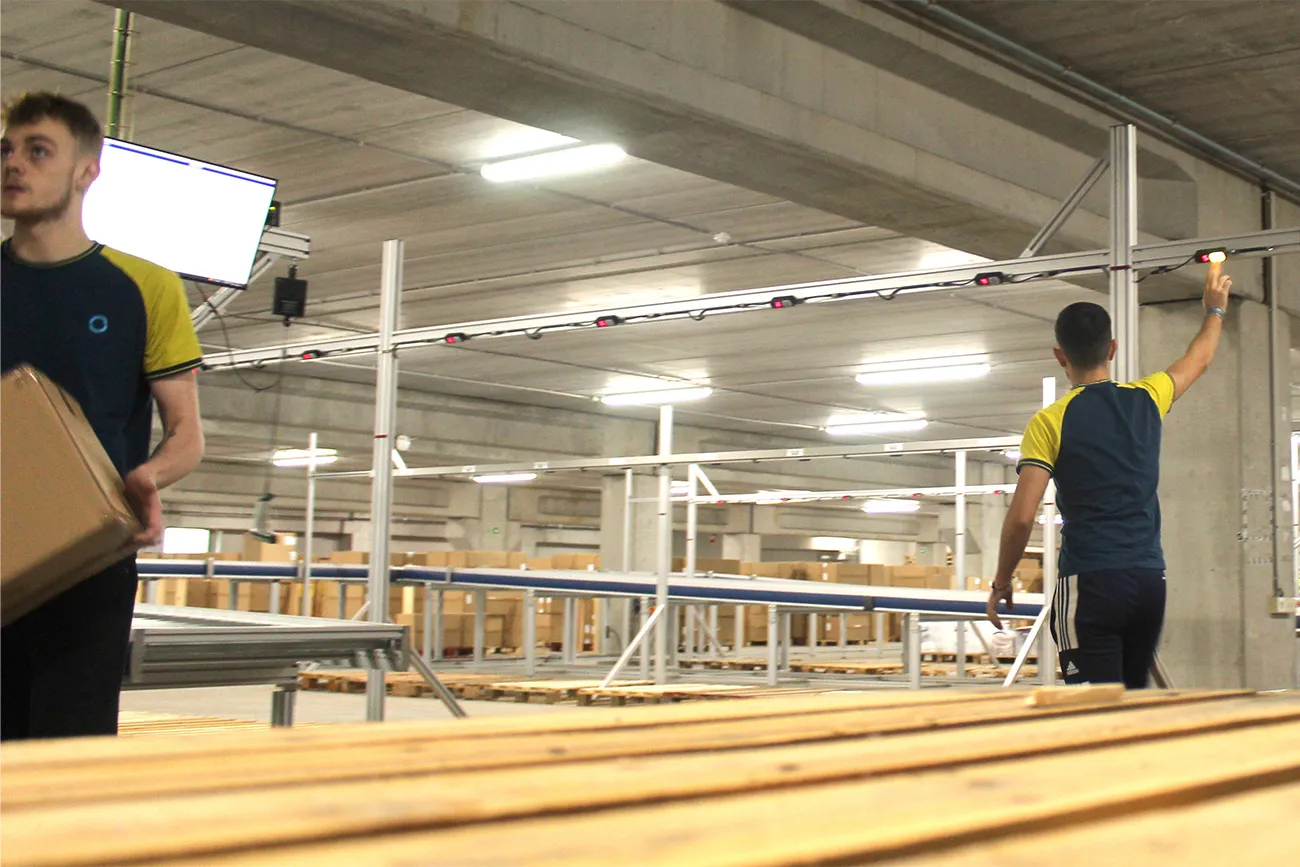
The new inbound system is easy to explain. Incoming pallets from the various departments are unloaded downstairs, and the boxes are placed on the conveyor one by one. The boxes then pass through the scanners’ detection area, where their labels are read. Depending on their contents, they are directed to one of the six conveyors. If a label cannot be read, the box is sent to a reject conveyor for manual processing.
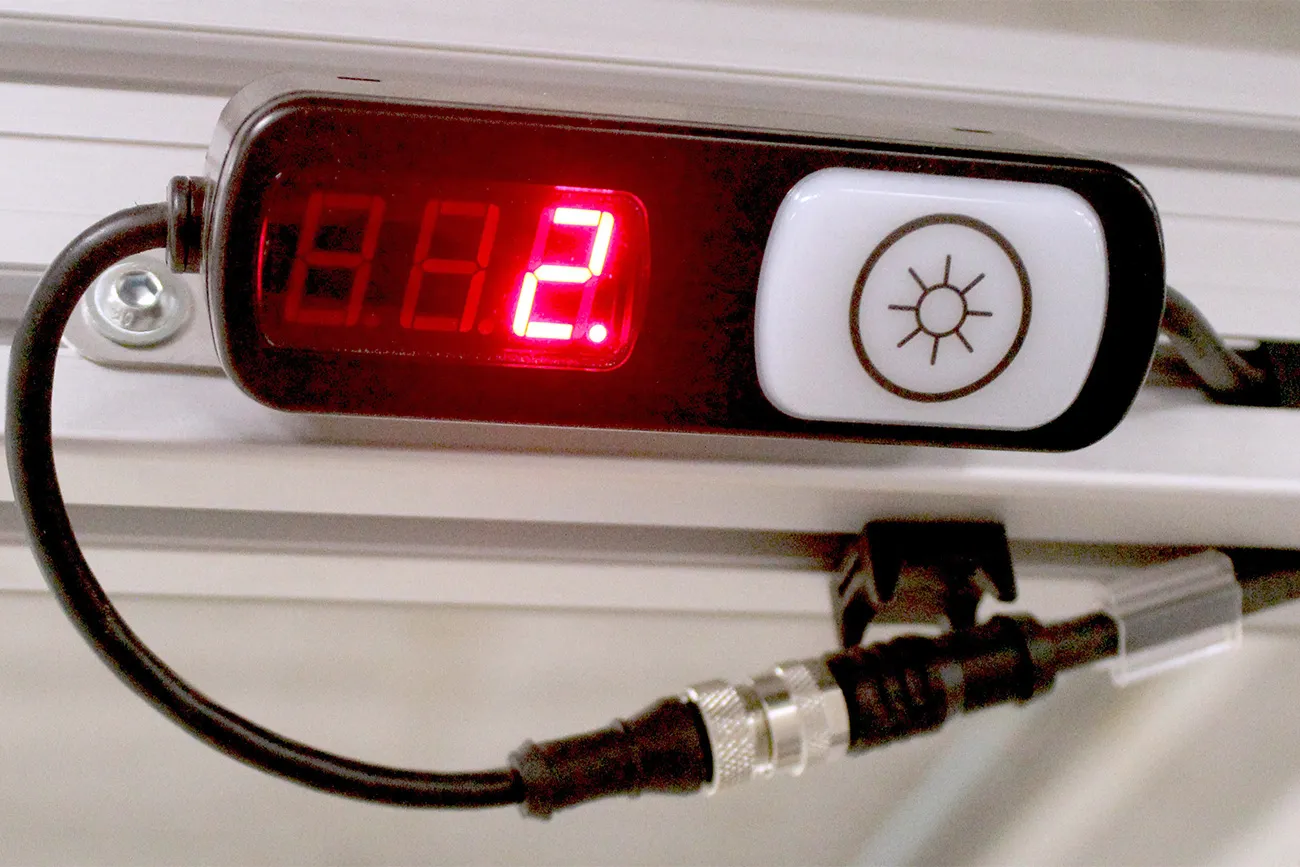
“At the end of each of the six conveyors, an operator scans the box. The WMS immediately uses the pick-to-light system to indicate with a green light which pallet the box belongs on. The operator places the box on the pallet and then confirms the action manually on the PTL with a simple press of a button.” The PTL’s 3-digit display then shows how many boxes are on the pallet.
Almost no errors
“One important feature is that we can use the PTL to indicate several different statuses,” Vanwymelbeke continues. As well as green, there is a red signal if the operator has forgotten to confirm the previous action on the PTL. A purple signal indicates a mixed pallet intended for quality control. Finally, the PTL lights up blue when the pallet is complete and ready to be moved.
“Thanks to the PTL, the inbound error rate is now virtually zero. The system is truly foolproof. What’s more, products now need to be moved a maximum of six metres, so we work much more efficiently. We have gone from five employees taking four to five hours to process a lorry to three employees taking no more than two to three hours. This means we can assign our employees to other tasks.”
Outbound: orders mixed together
The PTL system also adds value to outbound operations, although the setup is different. “Two flows of goods come together here: full boxes containing a single product, and detail-picking boxes containing a varied mix of different products. Thanks to a Ranpak machine, the height of these boxes can be adjusted to suit their contents.” Both flows converge on the outbound conveyor.
This is where the PTL system comes into play again. The employee scans the box, and the WMS decides which destination pallet it should go to, depending on the customer and carrier. In this case, 19 PTL points each indicate a destination pallet location. This allows for the most efficient approach: orders are grouped according to destination, carrier, quantity and shipment type. Here too, simple colour signals on the PTLs indicate the location. “We are very pleased with this approach and are considering doubling the number of outbound PTLs, which would allow us to serve even more customers and carriers at the same time.”
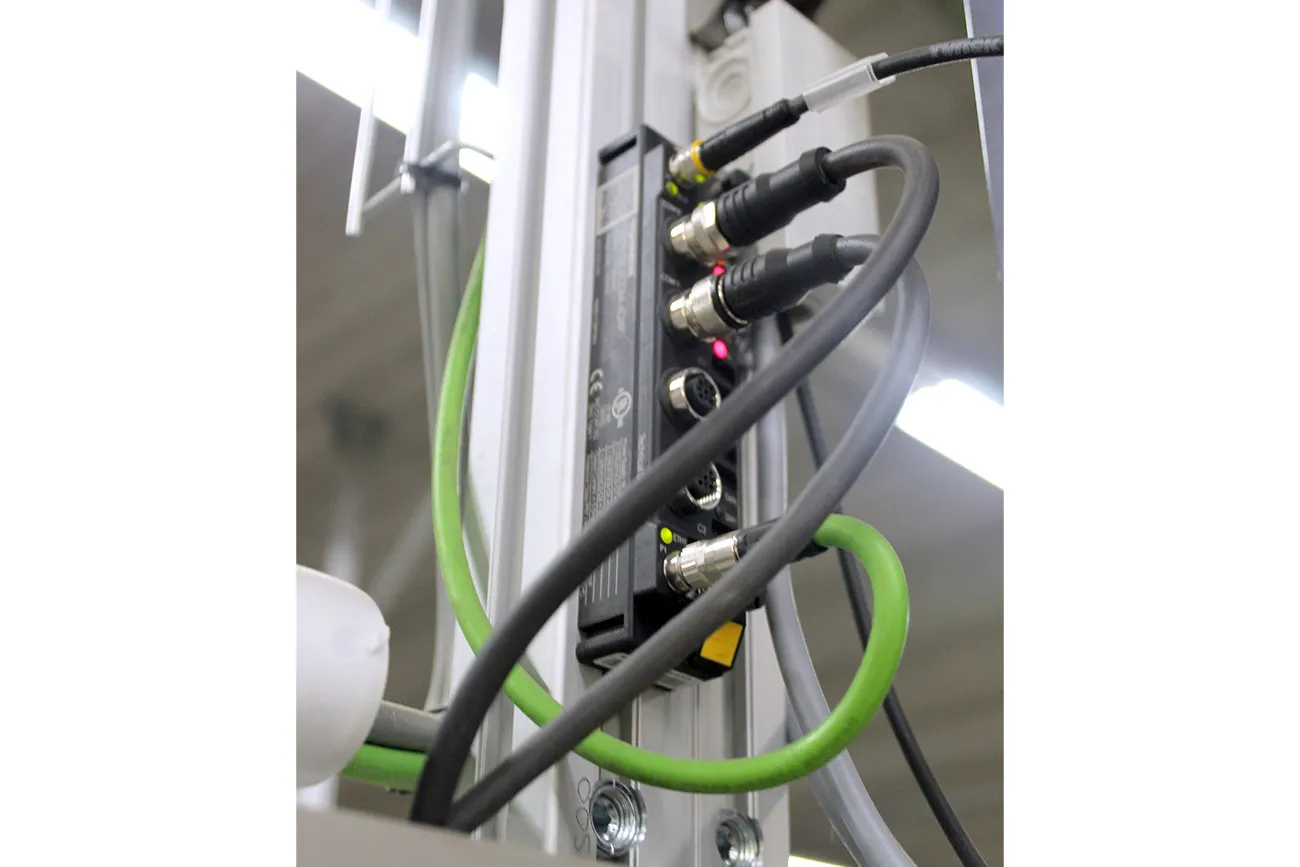
PTL and WMS connected via Turck multiprotocol I/O module
“Communication between Banner Engineering’s PTLs and the WMS is of course crucial to keeping operations running smoothly,” says Hans De Craemer, marketing manager at Turck Multiprox. “All PTLs are connected to TBEN-S multiprotocol I/O modules from our parent company, Turck. These come with ARGEE as standard, at no extra cost. ARGEE is web-based configuration software that turns any multiprotocol I/O module into a small controller.”
The PickIQ programme runs on these TBEN-S modules, making it very easy to configure communication with the WMS platform. The system uses standard communication protocols (ModBus registers), with the ARGEE software acting as a bridge between the PTLs and the WMS. “IT staff therefore don’t need any knowledge of automation software to configure PTL functions. Pick-IQ is a serial bus protocol that uses a common ID to avoid the typical ‘latency’ or delay caused by polling multiple devices. This means the system also runs without delays during busy periods.”
“The gains speak for themselves”
The PTL110 is ideally suited to applications of this kind and is also highly versatile. Its use in both the inbound and outbound systems is a clear example. The multifunction indicators, with options including a touch button, optical sensor and 3-digit display, clearly show what needs to be done or how many boxes are on a pallet. The PTL110 systems also offer fast response times and flexible installation options. This makes it easy to adapt and expand the installation. M12 connector cables enable multiple devices to be installed quickly and safely. The indicator can also display up to fourteen colours, alongside several animation functions for distinguishing between different conditions.
Vanwymelbeke concludes: “I could list other interesting options, but this project says it all: the gains in speed, productivity and quality speak for themselves.”
Een zakelijke vraag aan TURCK MULTIPROX nv? Get in touch
Companies in this story
Keep following this
Get an email when a new story is published. No account needed.
- SubjectNews
- CompanyTURCK MULTIPROX nv







