












Schneider Electric and AMD release first Helios Platform Reference Design to accelerate AI factory roll-outs
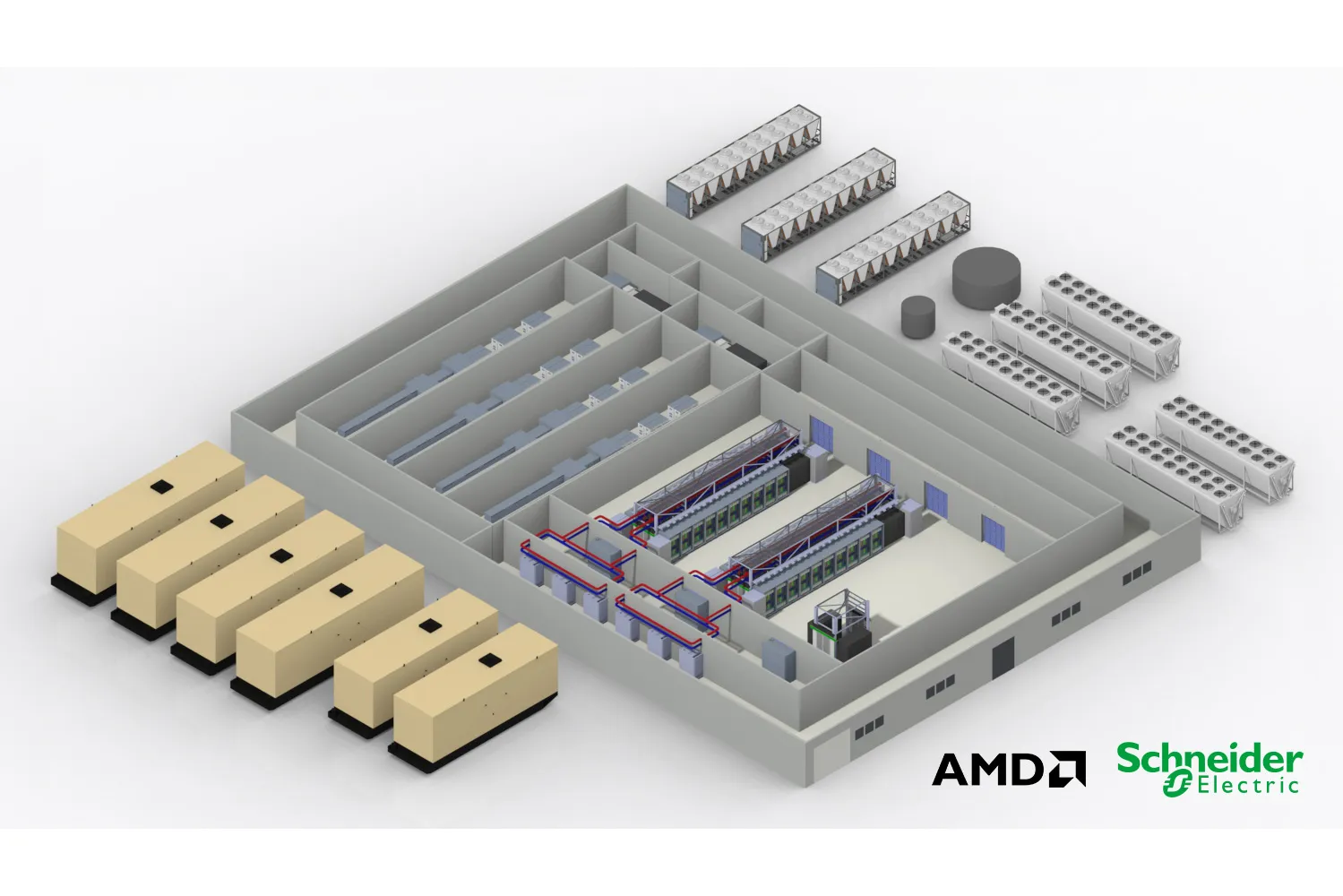
Schneider Electric, a global leader in energy technology, and AMD today announced a jointly developed and validated Reference Design for the AMD Helios rack-scale solution. The design offers a scalable approach to deploying high-density AI environments faster, with less risk and complexity. The Reference Design marks the first milestone in the collaboration between Schneider Electric and AMD, aligning with both companies’ shared focus on simplifying the deployment of AI factories.
- The jointly developed Reference Design provides a proven foundation for rolling out high-density AI clusters faster and with less risk.
- The design supports AI racks of up to 246 kW and large-scale deployments with modular AI clusters of up to 10.4 MW IT load, making it easy to scale up.
- The collaboration combines AMD’s AI innovation with Schneider Electric’s expertise in power, cooling and digital infrastructure.
The new Reference Design is the first ever developed to support high-density AI workloads on the Helios rack-scale solution, powered by AMD Instinct™ MI455X GPUs, 6th-generation AMD EPYC™ CPUs, AMD Pensando™ Vulcano NICs and the open ROCm™ software ecosystem. AMD Helios is designed to deliver breakthrough AI performance through advances in compute power, interconnect bandwidth, memory capacity and system-level integration. This enables customers to run larger, more complex AI workloads faster while optimising power consumption and efficiency.
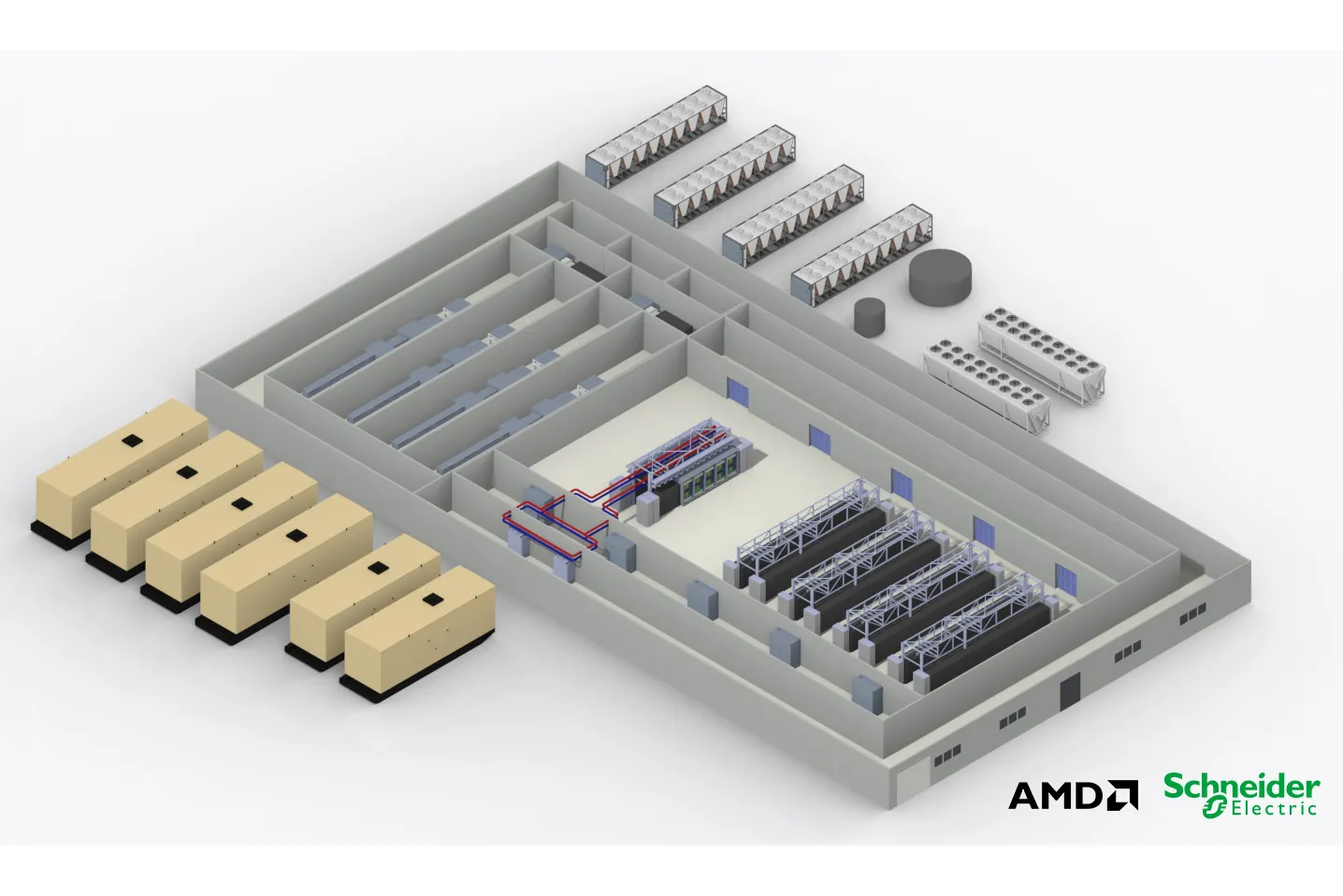
As AI workloads push data centre infrastructure to unprecedented limits, Reference Designs give data centre architects and operators tested, scalable designs that can demonstrably support new power densities, thermal requirements and operational complexity. By modelling the performance of physical data centre infrastructure, these pre-validated blueprints help shorten the planning process by defining how power, cooling and IT infrastructure should be organised to build a reliable, scalable and AI-ready data centre. The AMD Helios Platform Reference Design covers four technical areas: power, cooling, IT space and lifecycle software.
“Organisations need comprehensive, AI-ready Reference Designs to move from planning to deployment faster and with less risk,” says Manish Kumar, Executive Vice President, Secure Power & Data Centers at Schneider Electric. “Our collaboration with AMD enables us to deliver an engineered Reference Design that bridges the gap between advanced AI compute platforms, energy technology and real-world data centre deployment. This allows customers to deploy scalable, high-density AI environments with greater confidence, efficiency and speed.”
“AI infrastructure is evolving rapidly towards large-scale AI factories, which calls for an integrated approach that designs compute, networking, power and cooling as a whole from the outset,” says Forrest Norrod, executive vice president and general manager of the Data Center Solutions Business Group at AMD. “AMD Helios provides an open rack-scale architecture designed to deliver the performance, efficiency and flexibility required for next-generation AI workloads. By developing a validated Reference Design with Schneider Electric, we are giving customers a practical roadmap to accelerate high-density AI deployments, reduce integration risks and scale up with greater confidence and efficiency.”
Reference Design accelerates AMD Helios deployment
This new collaboration combines innovation in the AMD AI platform with Schneider Electric’s expertise in power, cooling and digital infrastructure. The result is a more tightly integrated approach to deploying both entirely new AI factories and high-density retrofit environments. The Reference Design supports:
- Modular, multi-cluster environments, with AI clusters of up to 10.4 MW IT capacity for greenfield deployments.
- High-density AI workloads of up to 246 kW per rack.
- Advanced liquid cooling using Schneider Electric’s Motivair, based on CDUs and hybrid air/liquid solutions that can remove up to 84% of heat.
- A digital-first approach to infrastructure, including:
- Electrical and thermal design validated using ETAP and EcoStruxure™ IT Design CFD simulation tools, enabling real-time monitoring and analysis, AI-driven predictive maintenance and system-level optimisation of power, cooling and IT.
- Integrated Electrical Digital Twin capabilities to model, analyse and manage infrastructure performance.
- Support from AVEVA’s Unified Operations Center for real-time monitoring and operational insight.
- Power and cooling infrastructure deployments that meet the requirements of the AMD Helios platform, reducing integration complexity and deployment risks.
- Improved energy efficiency, with a PUE that can fall to around 1.12 at full load.
The Reference Design has been validated against ANSI standards for deployments in the United States. Plans are in place to extend the framework in future to support IEC standards, making it suitable for global deployment.
Een zakelijke vraag aan Schneider Electric? Get in touch
Companies in this story

Keep following this
Get an email when a new story is published. No account needed.
- SubjectNews
- CompanySchneider Electric







