












Save CO2 and meet legal requirements with Rittal
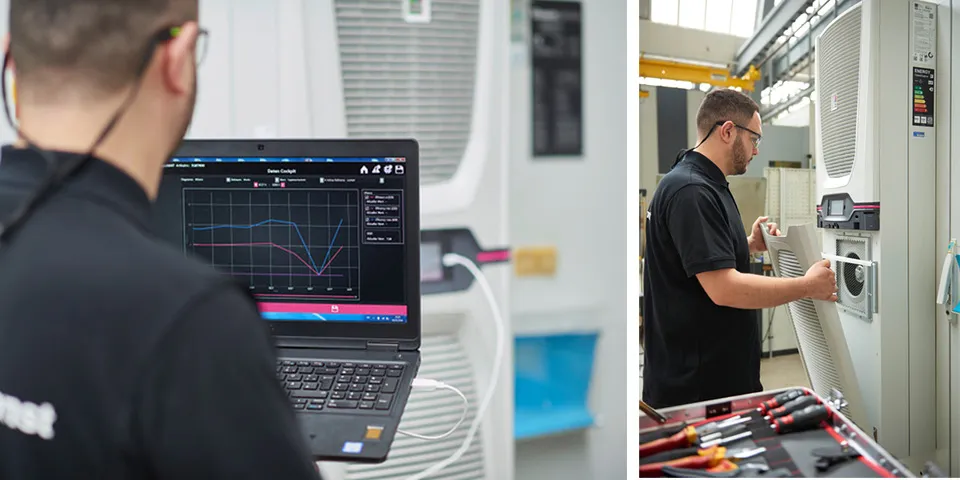
From 1 January 2020, the use of certain refrigerants will be banned. In addition, a number of new rules and requirements will come into force for the maintenance and labelling of refrigeration and air conditioning systems. Operators of refrigeration systems with questions can turn to Rittal. Through personalised advice and comprehensive service, the company makes its cooling solutions future-proof. This means not only complying with the new F-gas regulation, but also improving energy efficiency.
New F-gas regulations
The phase-down of fluorinated greenhouse gases is a particularly pressing issue, placing operators of refrigeration systems, including car manufacturers, under considerable pressure. Fluorinated greenhouse gases, or F-gases, are used as refrigerants in products such as cooling units and air conditioning systems. In the future, emissions of these climate-damaging substances will need to be gradually reduced to limit their impact on global warming, either through targeted substitution or by using alternative technologies.
Environmental protection: the F-gas regulation
EU Regulation 517/2014 on F-gases, which entered into force on 1 January 2015, aims to reduce industrial emissions by as much as 70% by 2030, compared with 1990. More specifically, emissions of fluorinated greenhouse gases in the EU must be reduced from 70 million tonnes of carbon dioxide equivalent (CO2e) to 35 million tonnes of CO2e by 2030. In practical terms, this means that from 1 January 2020, the use of refrigerants with a GWP (Global Warming Potential) of 2500 or higher will be prohibited, and new and amended requirements will apply to the maintenance, servicing, leak checks, certification, disposal and labelling of the refrigeration systems concerned.
Approved cooling units and chillers
The ban on the use of F-gases and products containing these gases raises many questions for operators of refrigeration systems. Which of their existing cooling units and chillers will they still be allowed to use after 2020? They can rest assured, however, that Rittal has been designing all its cooling solutions in accordance with F-gas requirements for many years, so no further action is needed.
Rittal cooling units and chillers use a hermetically sealed refrigeration circuit and approved refrigerants, which means they can continue to be used without issue after 2020.
Rittal F-gas calculator provides clarity
With the F-gas regulation coming into force, operators of refrigeration systems containing a specified quantity of refrigerant are required to carry out regular leak checks. The Rittal F-gas calculator makes it easy to determine the extent to which an existing system is affected by the F-gas measure. This online tool calculates the GWP and the corresponding CO2e based on the type and quantity of refrigerant used. The CO2e value determines what action the operator must take to comply with the measure.
How the Rittal F-gas calculator works: https://www.rittal.com/de_de/f-gase/rechner.php?lang=en
Enter all system parameters (as shown on the rating plate), along with the type of refrigerant and the charge quantity for each circuit. The result is the system’s CO2e. The calculator also shows whether topping up the refrigerant is permitted in the event of a leak, and provides practical advice on operating the existing system.
Personalised assistance
As a trusted service partner, Rittal offers expert advice to all users of refrigeration systems. This ranges from assessing the actual condition of a system and calculating its efficiency, to drawing up an action-oriented recommendation, identifying potential savings, setting up a new system with a maintenance contract, and removing old equipment. Rittal supports companies with personalised advice to help them overcome any challenges associated with the new requirements and efficiency targets. Customers can count on transparent costs, qualified maintenance technicians and extended warranties. So contact Rittal Customer Service today on +32 (0)9 353 91 45 or email [email protected].
Question about this story? Ask your question
Keep following this
Get an email when a new story is published. No account needed.
- SubjectNews







